


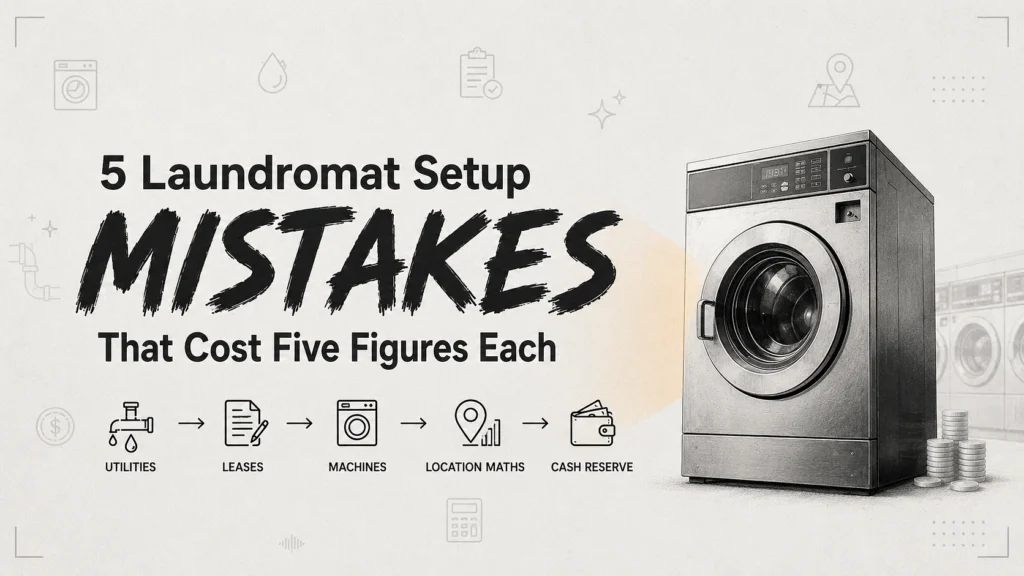
I almost bought a laundromat once. It was listed cheap, the photos looked clean, and the broker’s math showed a tidy return, so I did the smartest thing I’ve ever done in business, I paid a guy named Tony, who owns three laundromats two towns over, two hundred dollars to walk the space with me. Tony killed the deal in under twenty minutes. He didn’t look at the machines first, or the counters, or the foot traffic. He walked to the back, looked at the water heater and the sewer line, asked the broker two questions about the lease, and then took me to lunch and explained why the cheap listing was cheap.
That lunch is this article. Laundromats are genuinely good business, simple, cash-generating, recession-resistant, but they punish setup mistakes harder than almost any small business, because the mistakes get bolted into the floor. Here are the five that each cost five figures, in the order Tony checks them, which is not the order anyone shops them.
1: Signing a Space Before Verifying the Utilities

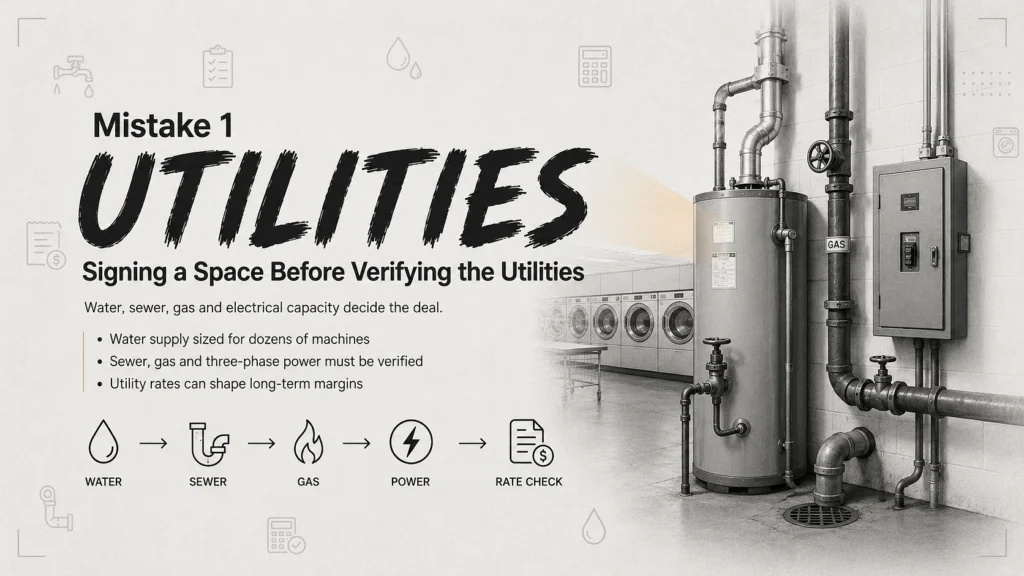
This is the one that kills more first-timers than any other, and it’s the reason Tony walks to the back of a building before he looks at anything else. A laundromat is not a retail business that happens to use water. It’s light industrial infrastructure wearing a retail storefront, and most retail spaces cannot support it as-built.
The checklist that decides everything: water supply lines sized for dozens of machines filling simultaneously, sewer capacity and connection sized for the discharge, gas service big enough to feed a wall of dryers, and electrical service, often three-phase, that ordinary retail spaces frequently don’t have. Retrofit any of those into a space that lacks them and you’re into serious five-figure territory before a single machine turns, and in some municipalities the sewer connection and impact fees alone, charged per fixture or per gallon of capacity, can rival the equipment budget. The cheapest laundromat space is almost never the cheapest laundromat space once the pipes are priced.
And the utility mistake has a second, quieter half: the rates. Water, sewer, and gas together are typically the largest operating cost in this business after rent, commonly running a heavy share of revenue, and they vary wildly between neighboring municipalities. Two identical stores on opposite sides of a city line can have permanently different margins because of a water district boundary nobody checked. Before any lease conversation, get the actual utility rate schedules for that exact address and run them against your projected volume. It’s an hour of work that prices the next twenty years.
2: Signing a Normal Retail Lease for an Abnormal Business


A laundromat’s build-out, the plumbing under the slab, the bulkheads, the venting, is sunk into the building and cannot move. That means the lease is the business. Your equipment has value, your customer habits have value, but both are worthless at any other address, so when you eventually sell, the buyer is really buying your remaining lease term, and a store with a few years left is close to unsellable at any price that reflects what you put in. The five-figure cost of this mistake arrives silently, years later, as the difference between selling a business and abandoning one.
The lease terms that matter, in rough order: a long initial term with multiple renewal options, ten-plus years of total control being the working standard; an assignment clause that lets you transfer the lease to a buyer without the landlord holding your sale hostage; clarity on who owns and who removes the infrastructure at the end, since a demolition-and-restore clause can hand you a five-figure exit bill; and honest language about utility infrastructure responsibilities from day one. A landlord who understands laundromats will negotiate these knowingly. A landlord who doesn’t is a risk in himself.
3: Buying Machines for Your Budget Instead of Your Neighborhood

The machine mistake comes in two flavors, and both cap your revenue permanently.
The first flavor is the wrong mix. First-timers price out a wall of small and mid-size washers because the per-unit cost is friendlier, and in doing so they build a store for a customer who barely exists anymore. The money in modern laundromats skews heavily toward large-capacity machines, the ones that swallow comforters, family-size loads, and the week’s everything, because the customer who needs a laundromat most is the customer with the most laundry. Big machines charge multiples per cycle, run fewer cycles for the same revenue, and are the reason customers drive past a competitor. A store built entirely small has a revenue ceiling installed on opening day, and replacing the mix later costs what it would have cost to do it right, plus the removal.
The second flavor is buying orphaned equipment used machines with no local distributor, no parts pipeline, and no tech within a hundred miles. A dead washer isn’t just a repair bill, it’s a stall earning zero while customers learn a new habit at the store down the road. Before choosing a brand, choose the service reality who stocks parts locally, who answers in days not weeks, and what the machines’ duty history actually is. Bearings and boards, not paint, are what you’re inspecting on used equipment, and a cheap row of tired machines is a five-figure replacement bill on a two-year fuse.
4: Doing Traffic-Count Math Instead of Renter Math

The location mistake is the most seductive, because the wrong math looks so rigorous. First-timers count cars, admire the busy road, and note the shopping center’s anchor tenant, and none of it answers the only question that matters: how many renter households without their own washer live within about a mile?
That’s the customer. Not commuters passing through, not homeowners with laundry rooms, and, counterintuitively, not affluent renters either, since newer upscale buildings put washers in the units. The sweet spot is dense, working, renter-heavy blocks in older housing stock, and the location math is a short honest worksheet renter share of households in the immediate radius, age of the housing (older buildings mean fewer in-unit machines), competitor capacity within the same radius counted in machines rather than storefronts, and the practical layer, parking, visibility, and safety at night, since laundry is a ninety-minute stay, not a grab-and-go. A gorgeous space on a fast road in an owner-occupied suburb is a five-to-six-figure lesson in whose laundry you were counting. Tony’s phrasing at lunch, which I’ve never improved on “You’re not buying a location. You’re buying the two thousand households around it, so meet them before you sign anything.”
5: Spending Every Dollar on Opening Day

Laundromats ramp slowly, and this surprises everyone. Laundry is a habit business; customers change stores when their routine breaks, not when your sign goes up, so realistic ramps run months, sometimes most of a year, to full volume. Meanwhile the bills are instant: rent from day one, utility deposits, best insurance, and, on schedule with cruel reliability, the first serious repair. The owners who fail rarely fail because the store was bad. They fail in month seven, out of cash, selling a fundamentally sound business at a distressed price to someone patient, frequently to someone like Tony. The working rule: open with a reserve covering at least six months of full operating expenses, plus a separate repair fund, and treat that money as untouchable by the build-out. If the budget can’t fund the reserve, the correct move is a smaller build, not a thinner cushion.
I never did buy a laundromat, for what it’s worth. The next listing Tony walked with me passed all five checks and sold to someone faster while I hesitated, which he tells me is the sixth mistake and refuses to waive his fee about. But the framework has since saved two friends from two bad deals, and it compresses to one sentence you can carry into any walkthrough: check the pipes, then the lease, then the mix, then the renters, then the reserve, and only then, if everything holds, allow yourself to notice how nice the countertops are.