


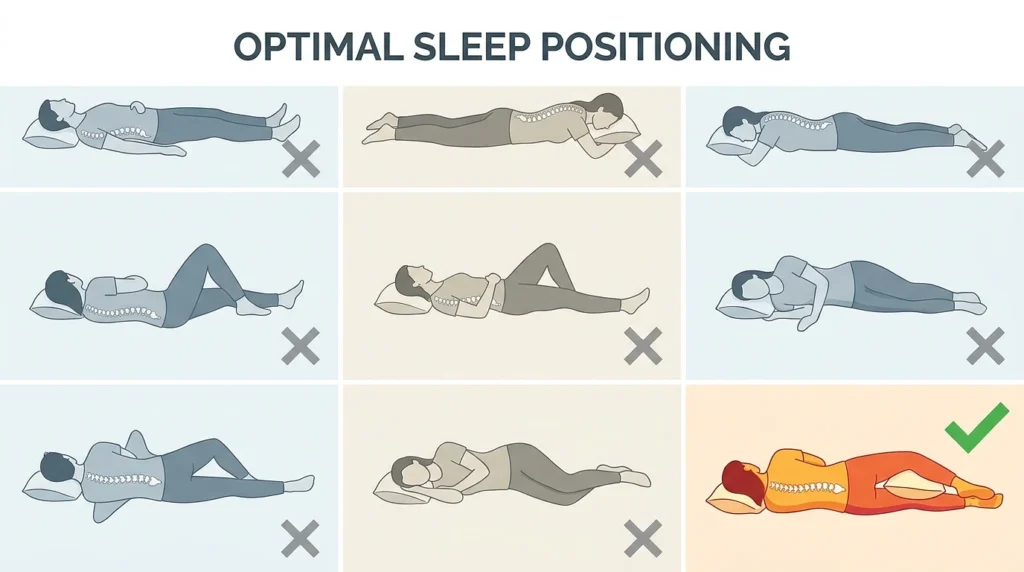
The soldier, the starfish, the log, a couple of fetal variations, and so on, each one paired with a confident little paragraph about what it says about your personality and what it’s doing to your spine. I used to assume there was real science under all of it, some study that ranked the nine and crowned a winner. So I went and read the actual peer-reviewed work, and here’s the uncomfortable thing I found: eight of these positions are basically vibes and folklore. The names come from a mattress-company survey, not a lab. Only one position has genuine, published, converging evidence behind it, and it comes from two fields of medicine that have nothing to do with each other.
The 9 Positions, Defined Plainly

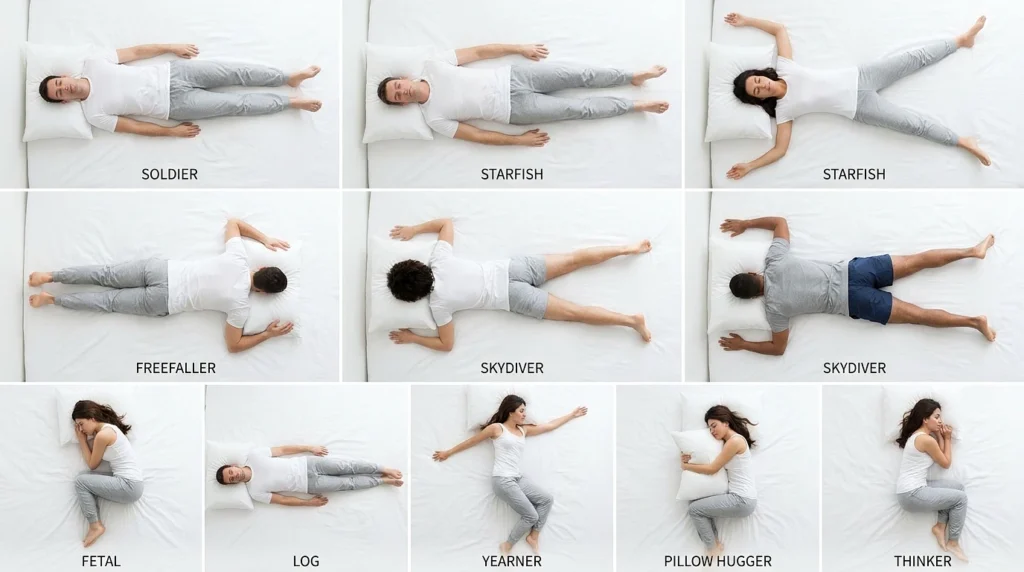
A quick note before the list. Most of these names trace back to popular sleep surveys and pillow marketing rather than clinical research, so treat them as a shared vocabulary for describing how a body lies down, not as diagnoses. With that said, here’s the standard nine, grouped by which way you’re facing.
Back Positions (Supine)
- The Soldier. Flat on your back, arms straight down at your sides, legs together. Tidy, symmetrical, and, as you’ll see, the position the medical evidence likes least.
- The Starfish. On your back, but sprawled, arms up near the pillow, legs spread. Same supine downside as the soldier, just more territorial about the mattress.
Stomach Positions (Prone)
- The Freefaller. Face-down, arms wrapped around or under the pillow, head turned to one side. Popular with a lot of people and rough on the neck, since the head has to stay rotated all night.
- The Skydiver. A near-identical stomach position, arms and legs splayed out, chest pressed to the bed. The name changes; the neck-and-lower-back strain does not.
Side Positions (Lateral)
- The Fetal. On your side with knees drawn up toward the chest, the single most commonly reported position in the surveys. The one to remember, for reasons the whole back half of this article is about.
- The Log. On your side, body straight as a plank, both arms down along the sides. Same lateral family as the fetal, just uncurled.
- The Yearner. On your side with both arms stretched out in front of you, as if reaching for something. Still lateral, still in the good family, just with the arms extended.
Combination and In-Between Positions
- The Pillow Hugger. Any side position where you wrap arms and often a leg around a pillow or partner. Functionally lateral, with the pillow doing alignment work for your spine and hips.
- The Thinker. A fetal-adjacent side pose with a hand tucked up near the face or chin. Cute name, ordinary side sleeping underneath.
Notice what happens when you sort them this way. Two are on the back, two are on the stomach, and the remaining five are all variations of lying on your side. The lists present nine equal options. The bodies present three real categories, and one of those three is about to walk away with all the evidence.
The One With Evidence: Lateral, and It’s Not Close
Strip away the names and the personality quizzes, and the research converges hard on a single category: the side. What makes this convincing isn’t one study shouting loudly. It’s two unrelated fields of medicine, studying two different systems, arriving at the same place without coordinating.
Evidence Line One: Your Brain’s Overnight Cleaning
Around 2012, scientists identified the glymphatic system, the brain’s own waste-clearance network, which uses cerebrospinal fluid to flush out metabolic garbage, including the amyloid-beta and tau proteins associated with Alzheimer’s, and does most of that work while you sleep. A team at Stony Brook University then asked whether body position changes how well this cleaning runs. Publishing in the Journal of Neuroscience, they used contrast MRI to compare clearance in the supine, prone, and lateral positions, and found that waste removal, including amyloid clearance, was most efficient in the lateral position. The researchers even proposed that side sleeping, already the most common posture in humans and animals, may have evolved partly because it optimizes this overnight brain-cleaning. One honest caveat, which the viral versions always drop: this study was done in rodents, and the authors themselves flagged that it awaits confirmation in humans. Strong and plausible, not yet proven in people.
Evidence Line Two: Your Airway
Here’s what turns a promising animal finding into a convincing recommendation. Sleep-apnea medicine reached the same conclusion decades ago, in humans, for reasons that have nothing to do with brain waste. When you lie on your back, gravity pulls the tongue and soft tissues of the throat backward into the airway. A systematic review of body position and obstructive sleep apnea documents that the airway collapses more readily on the back than on the side, and that avoiding the supine position alone can ease mild apnea. The specifics are blunt:
- More than half of all sleep-apnea cases are position-dependent, with symptoms shifting significantly based on posture.
- Many sufferers experience at least twice as many breathing blockages on their back as on their side, and the back-sleeping ones run longer and drop oxygen further.
- Sleep medicine built an entire recognized treatment on this, positional therapy, endorsed by the American Academy of Sleep Medicine, whose whole mechanism is keeping people off their backs.
So the brain-imaging researchers and the breathing doctors, in different buildings chasing different questions, agree completely: the back is the position to avoid and the side is the one to seek. Two independent lines of evidence stacking up the same way is roughly the strongest signal sleep science ever gives you. Of the nine positions on every list, only the five lateral variations sit on top of that evidence. The other four sit on top of a survey.
Left or Right? A Small but Real Wrinkle
If the winner is “your side,” the reasonable next question is which one. For a healthy person, either side beats the back and the gap between left and right is small. For two groups, though, the choice is real:
- Reflux or heartburn: the left side keeps the stomach-esophagus junction above the acid pool, which clinical sources tie to fewer reflux episodes than right-side or back sleeping.
- Late pregnancy: left-side sleeping is commonly advised to ease pressure on the vein returning blood to the heart, improving circulation to the placenta.
Both are worth knowing, and both are reminders that the “best” position bends around your particular body, which is exactly the caution the next section is about.
When to Throw the List Out Entirely
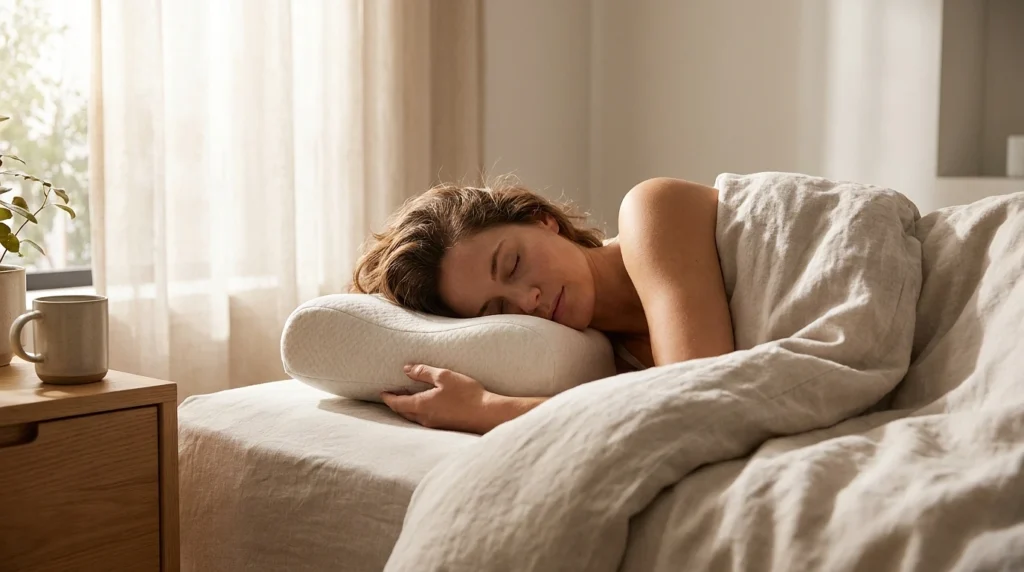
The single most important sentence in any sleep-position article is the one the listicles bury: the best position is the one that actually lets you sleep. Position is a tiebreaker, not a command, and a few people have a stronger reason to ignore the general advice:
- If you sleep soundly on your back or stomach and have no apnea, forcing a switch that ruins your rest is a bad trade, because total sleep depth matters more to your brain than torso angle.
- If you’re a diagnosed apnea patient, your clinician’s plan, whether positional therapy or CPAP settings, comes before any article.
- If you’re pregnant, your obstetrician’s guidance always overrides a general recommendation.
- If side sleeping aggravates a shoulder or hip, comfort and a physical therapist’s advice win.
None of that dissolves the main finding. It just fences it properly. For most healthy adults with no overriding condition, the side is the best-supported default, and that’s a real, research-backed statement rather than a personality quiz.