


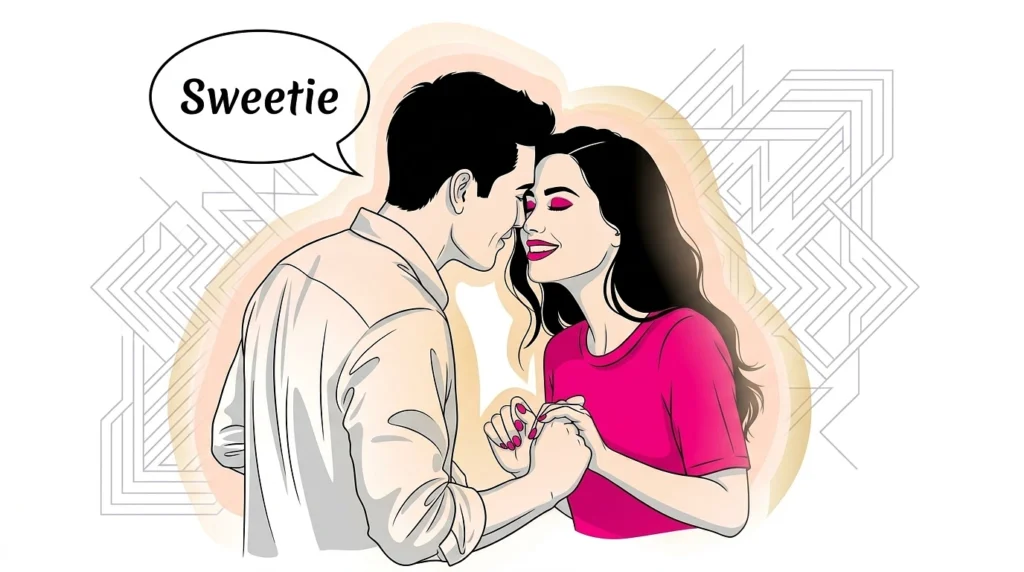
A man says “sweetie” to you and your read on it is instant, before you’ve even thought about it. Sometimes it lands warm. Sometimes it lands like a small hand on the top of your head, patting you back down to size.
Same six letters. Completely opposite feeling.
That gap is the whole thing, and it’s not in your imagination. There’s actual research on this exact word, and it says the meaning of “sweetie” lives almost entirely in everything around it, who’s saying it, where, and whether you’re standing on equal ground.
Why Does The Same Word Feel Like Two Different Words?
Because context isn’t a small modifier on “sweetie.” Context is most of the message. The research splits cleanly along one line, who’s saying it to you, and whether they’re inside your life or outside it.
What Is It Doing When It Comes From Your Person?
Start with the easy case, the good one. When it’s your person saying it, “sweetie” isn’t filler. It’s a small unit of a private language, and private language between two people turns out to matter more than it looks.
The anchor study here is an old one that still holds up, a 1993 paper in the Journal of Social and Personal Relationships with the all-time title “Sweet Pea and Pussy Cat.” It looked at married couples and found the ones who used idiosyncratic little nicknames and inside-language reported higher marital satisfaction. Later work keeps landing in the same place, pet names track with closeness, security, and commitment, and people actually report dissatisfaction when the names stop coming.
That last bit is the tell. If the pet name meant nothing, nobody would notice it going missing. People do. The researcher behind that 1993 study describes a relationship as a “mini-culture” a little country of two with its own customs, and “sweetie” is one of its everyday words. Inside that country, it’s a verbal hug.
The trouble starts when somebody from outside the borders uses the same word.
Why Does It Sting From A Stranger?
Here’s where I stop being neutral, because this is the version most women actually wrote in about. The “sweetie” from a man you’ve never met. The contractor, the guy at the counter, the senior colleague who’s decided you’re a kid.
The research is blunt about what’s happening there. A set of four studies published in 2022, titled, I’m not kidding, “Honey, Sweetie, Dear,” found that terms of endearment used toward adult women outside close relationships communicate and reinforce benevolent sexism, the polite, smiling kind that frames women as warm and sweet but not quite competent. In one study they had an interviewer use those terms on women in upper-level business classes. The women came out of it feeling less positive, less warm, and less competent. The word reached in and turned a dial on how capable they felt.
There’s a detail in there I find almost funny, in a grim way. The effect showed up most in the women who reject sexism, not the ones who’ve made peace with it. If you already believe women should be cherished-and-protected, a stranger’s “sweetie” slides right past. If you don’t, it grates, because some part of you correctly clocks it as a demotion dressed up as a kindness.
And it cuts at the speaker too. Another study in the same paper had people read about a man who either used these terms or didn’t, and the ones who read about the “sweetie”-user pegged him as more sexist and more into hierarchy. So the word isn’t just doing something to the woman who hears it. It’s quietly broadcasting something about the man who reaches for it.
Is It The Word, Or The Way He Said It?

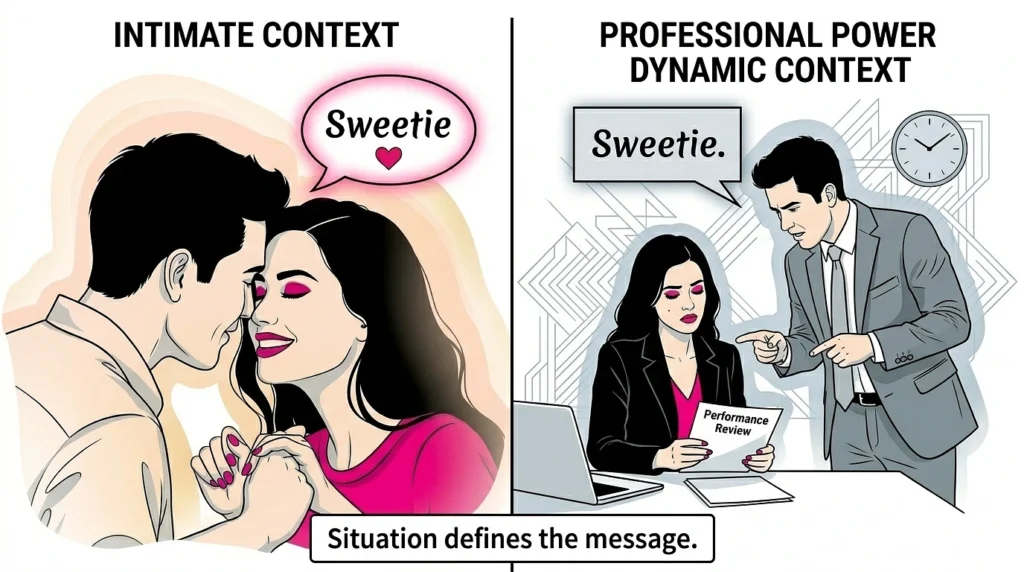
Strip it down and most of “sweetie” isn’t the word at all. It’s the delivery.
Same six letters, whispered across a pillow versus said flat and slow to a grown woman in a meeting, are not the same act, and you decode the difference in a fraction of a second without trying. The dictionary definition is doing almost none of the work here. Tone, who holds the power in the room, the history between two people, that’s where the actual message sits.
Which is why nobody can hand you a clean rule for whether “sweetie” is sweet or insulting. There isn’t one. It’s situational all the way down, and your gut read on the situation is usually picking up something real.
Did Every Language Really Invent This?
Pretty much, yeah, and that’s the part I’ll give the warm side of the ledger. The impulse behind a pet name is close to universal. Nearly every culture made up its own, and they’re wonderful and a little ridiculous:
- French, mon petit chou, my little cabbage (or cream puff).
- Russian, vishenka, little cherry.
- Spanish, media naranja, my half-orange, the other half that makes you whole.
- Thai, chang noi, little elephant.
Notice they’re almost all tiny, edible, or soft. Across languages with nothing else in common, people reached for the same move, shrink the person you love into something small and sweet you’d want to keep in your pocket. That part of “sweetie” is genuinely lovely, and it’s old, and it’s everywhere.
So What Do You Do With A “Sweetie”?
You don’t need a policy. You need to trust the read you already made.
If it came from someone who’s earned the warm version, take it as the verbal hug it is, the research says that hug is doing real work for the relationship. If it came from a stranger, or a man holding the power in the room, and it made your jaw tighten, that reaction isn’t you being difficult. There are four studies’ worth of evidence that the tightening is a correct read on a small power move.
The word is the same either way. Everything that gives it meaning isn’t.