


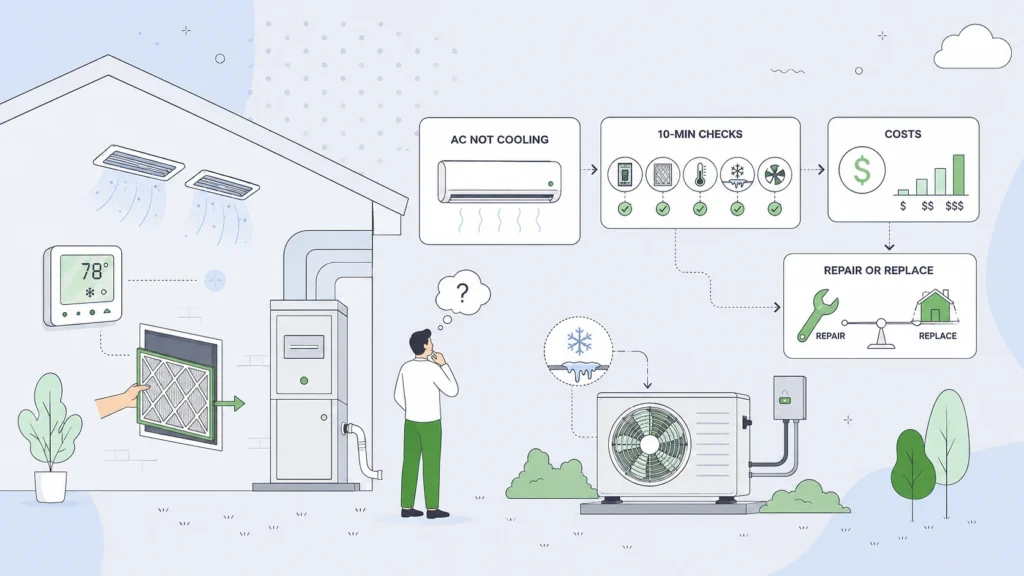
The house is 84 degrees, the vents are blowing, and what’s coming out feels like breath. Before you call anyone, spend ten minutes on the checks below, because a decent share of no-cool calls end with a technician flipping a breaker or pulling out a filthy filter and charging $75 to $200 for the trip. That service fee is real money for something you could have found yourself, and most companies charge it even when the fix takes ninety seconds.
One safety line before the list. You can check a thermostat, a filter, a breaker, and look at the perfect outdoor unit. You cannot open the unit itself, because the run capacitor inside holds a stored charge even with power off, and refrigerant work legally requires EPA certification anyway. Look, don’t open.
The Ten Minute Checks, In The Order A Tech Would Ask


1. Thermostat first, and actually look at it. Cool mode, not fan or heat. Setpoint at least three degrees below the room temperature. And if the screen is blank or acting strange, change the batteries before doing anything else, because dead thermostat batteries produce a perfect imitation of a broken air conditioner and it happens all summer long.
2. Pull the filter. A clogged filter chokes airflow until the system can’t move enough air to cool anything, and left long enough it freezes the coil solid. Hold the filter up to a light. If you can’t see light through it, that might be your whole problem, and the fix costs about five dollars. Filters need changing monthly during heavy cooling season, which almost no one does.
3. Breakers, both of them. Your AC runs on two circuits, one for the indoor air handler and one for the outdoor condenser, and either can trip alone. A tripped condenser breaker gives you exactly the symptom in this title: indoor fan blowing fine, warm air forever, because the half of the system that actually removes heat is sitting dead outside. Flip a tripped breaker fully off, then on. If it trips again, stop and call, because a breaker that won’t hold is protecting you from something.
4. Walk out to the condenser. Is the fan on top spinning? Is the unit humming? Clear leaves, grass clippings, and anything leaning against it, since the coil needs about two feet of breathing room to dump heat. And check the small metal disconnect box mounted on the wall beside the unit, because landscapers and curious kids pull those more often than you’d think.
5. Look at the big copper pipe. The thicker refrigerant line where it enters the indoor unit, is it iced over? Frost or ice anywhere on the lines or coil means low refrigerant or blocked airflow, and running the system frozen can take out the compressor. Turn cooling off, run the fan only for a few hours to thaw it, and book the call. This one is not a wait-and-see.
6. Vents and drain. Make sure supply vents are open, the big return grille isn’t blocked by making furniture, and if your system has a condensate float switch, check whether the drain pan is full, because a full pan shuts the system down on purpose and the fix is clearing a clogged drain line.
If you got through all six and the air is still warm, now the call is worth making, and you’ll be able to tell the dispatcher what you already ruled out, which genuinely speeds up the visit.
What Each Symptom Costs To Fix
Diagnostic fees run $75 to $200 and reputable companies credit them toward the repair. After hours and weekend calls add 25 to 50 percent on labor, which is a strong argument for the checks above buying you until Monday. The common repairs cluster between $150 and $650, and the national average sits around $350.
| What the tech finds | Typical cost, parts and labor | How common |
|---|---|---|
| Run capacitor | $100 to $300 | The single most common AC repair |
| Contactor relay | $150 to $300 | Very common on older, high use systems |
| Thermostat replacement | $100 to $300 | Common |
| Clogged condensate drain | $75 to $250 | Common, often part of the service call |
| Condenser fan motor | $300 to $600 | Occasional |
| Refrigerant leak, found and fixed, plus recharge | $400 to $1,000 and up | The expensive middle tier |
| Evaporator coil | $1,200 to $2,400 | The repair-or-replace conversation |
| Compressor | $1,200 to $2,800 | The repair-or-replace conversation, loudly |
The capacitor deserves a sentence because it’s the happy ending version of this story. It’s a $20 part, the swap takes about twenty minutes, and it’s the most frequent reason an AC stops cooling. Plenty of scary-seeming dead systems come back to life for a couple hundred dollars.
Two things on the expensive rows. Compressors commonly carry 5 to 10 year manufacturer warranties, so if your unit is younger than that, you may owe labor only, and it’s worth checking before approving anything. And refuse the refrigerant top-off if it’s offered on its own. An AC is a sealed system that does not consume refrigerant the way a car uses oil, so low refrigerant means there is a leak, and paying $200 or more to top off without fixing the leak means paying it again next summer, and the summer after that. Fix the leak or have the replacement conversation. The top-off alone is renting your own cold air.
When Replacing Wins The Math


The rule most techs use is simple enough to do in the driveway: multiply the unit’s age by the repair quote, and if the answer is over 5,000, replacement usually wins.
A 10 year old unit needing a $300 capacitor is 3,000. Repair it, easily. The same unit needing an $800 refrigerant repair is 8,000, and that money is better going toward a new system. A 12 year old unit with a $400 quote lands at 4,800, right on the line, and there the tiebreaker is history, because two major repairs inside two years signals a system in decline and the third one is usually already on its way.
A few situations skip the math entirely. If your system was made before 2010 it likely runs R22 refrigerant, which is discontinued and now costs $50 to $150 a pound against $10 to $20 for the current stuff, so any leak on an R22 system points straight at replacement, full stop. A failed compressor out of warranty on a unit past 10 years, same answer. And any repair quote above half the price of a new system is the system telling you something.
There’s an honest case on the other side too. If you’re selling the house within a year, a repair that keeps things running is the pragmatic call, since you won’t be around to collect the efficiency savings. But for a unit you’ll live with, a 15 year old system is running at maybe 10 to 12 SEER while new ones start at 14 and the good ones pass 20, and that gap shows up on every summer power bill from now on. Get a second opinion on any quote over $500 either way. The companies confident in their diagnosis don’t mind, and the other kind minding is its own information.