


One ton of cooling equals 12,000 BTU per hour, and the square footage rule most contractors quote you, whether that is 20 to 25 BTU per square foot or 400 to 600 square feet per ton, oversizes the average home by 20 to 40%. The correct method is an ACCA Manual J load calculation, which is a room by room measurement of your actual house rather than a formula applied to your floor area. Oversized systems fail in a specific way that most people never connect to sizing, because they cool the air fast, shut off before the coil has pulled the moisture out, and leave you with a house that hits the set temperature and still feels clammy. On efficiency, higher SEER2 pays back in three to five years in hot southern climates where the system runs 2,000 hours a year or more, and in cool northern climates it often does not pay back at all inside the life of the equipment.
One Ton Equals 12,000 BTU Per Hour, And The Square Footage Rule Used To Find It Is Wrong Most Of The Time

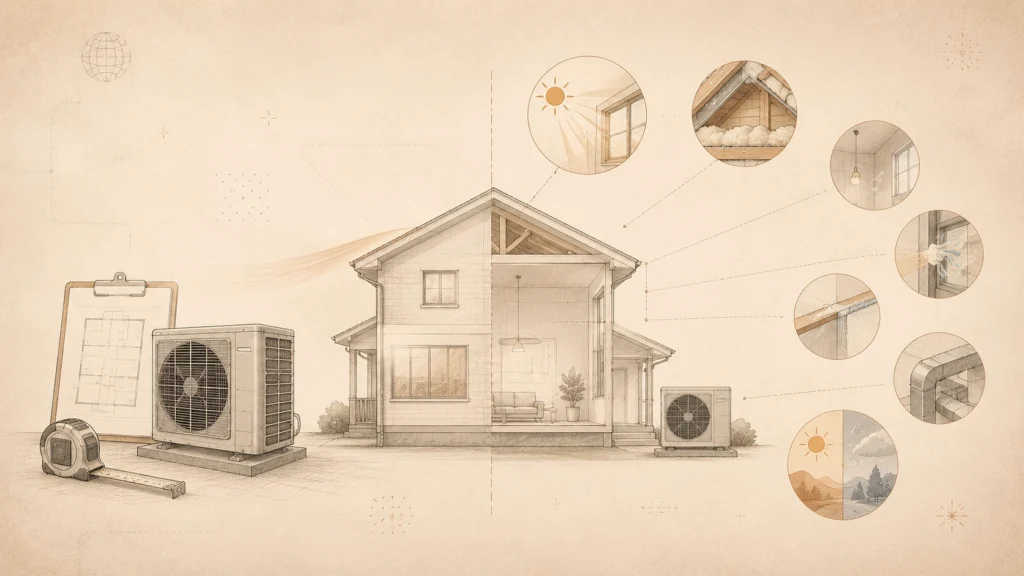
The tonnage number on a residential system is a heat removal rate, not a weight. One ton means the unit removes 12,000 BTU of heat per hour, and residential equipment sells in half ton steps from about 1.5 tons up to 5 tons.
So how does a contractor get from your house to a tonnage figure? The fast way is the square footage rule, and it comes in a couple of flavors that amount to the same thing. Either 20 to 25 BTU per square foot, or 400 to 600 square feet per ton. Multiply, divide, done in about fifteen seconds on a clipboard in your driveway.
The problem is that the answer it gives is usually too big, and not by a small margin. Load calculation guidance from the industry itself puts the rule of thumb error at 20 to 40% oversizing on average, which is enough to move a house from a correct 3 ton system to a 4 ton system that will cause problems for the next fifteen years.
Here is the number that made this click for me. Building science writer Allison Bailes published the results of 40 real Manual J load calculations run on homes in hot and mixed climates, and the average came out to 1,431 square feet per ton. The range across those 40 houses ran from 624 all the way to 3,325 square feet per ton. Compare that spread against a rule of thumb that assumes 500. His conclusion is blunt and worth repeating, that if your load calculations are averaging 400 to 600 square feet per ton, you are not doing them correctly.
Why is the spread that wide? Because square footage does not tell you the things that actually drive the cooling load:
- Insulation levels, where a well insulated house can need 30% less capacity than a poorly insulated one of the same size.
- Window area and which direction the windows face, since south and west facing glass loads a house far harder than north facing glass.
- Ceiling height, because you are cooling volume rather than floor area.
- Air sealing quality, duct location and duct leakage.
- Your actual climate, since the same 2,500 square foot house may need around 5.4 tons in Houston and only 3.5 tons in Chicago.
Manual J Is The Real Standard And It Measures Your House Room By Room
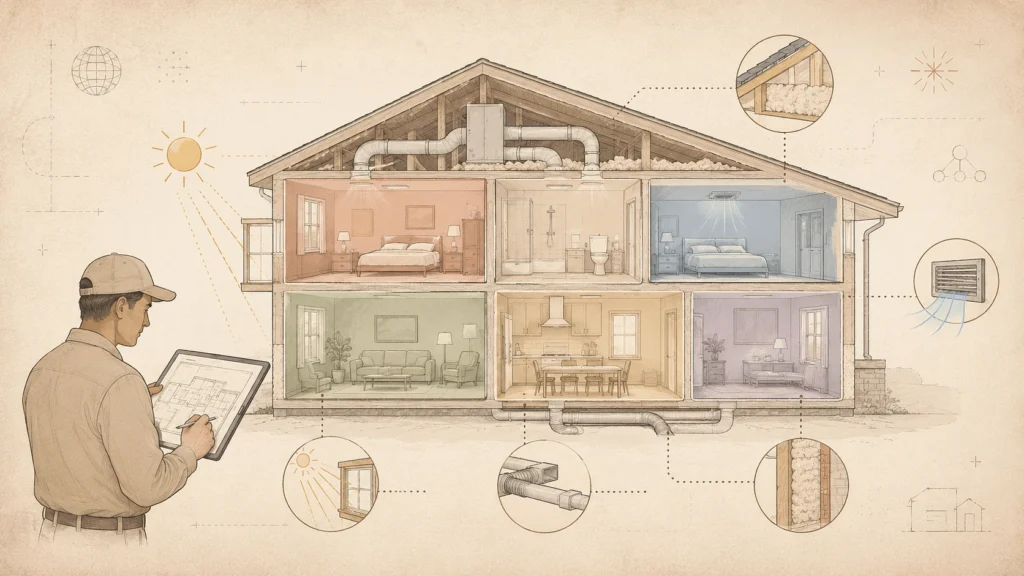
Manual J is published by the Air Conditioning Contractors of America, and it is the ANSI recognized standard for residential load calculations. What it produces is not a single whole house number but a room by room breakdown of heating and cooling load in BTU per hour, calculated against the design day conditions for your specific location.
That room by room part matters more than people realize. Whole house rules of thumb are a big reason for the most common comfort complaint there is, which is one bedroom that never gets cool enough while the living room freezes. If nobody calculated the load for that individual room, nobody sized the airflow to it either.
A proper Manual J takes somewhere between fifteen minutes and two hours depending on the software and the complexity of the house, which is worth knowing when a contractor tells you it is too time consuming to bother with. It is also increasingly required rather than optional, since many building departments want one before issuing a permit, some manufacturers want one for warranty compliance, and homeowners applying for federal heat pump rebates worth up to $8,000 need a certified load calculation to qualify.
One honest wrinkle, because I would rather give you the full picture than a clean one. Manual J itself is designed conservatively, and its calculated loads typically come out 10 to 20% higher than the true cooling load of the house. Energy Vanguard makes this point directly in their sizing analysis. So even a correctly performed Manual J leaves you with a slight cushion built in, which is exactly why adding your own safety margin on top of it is the wrong instinct. The margin is already there.
Oversized Units Fail Because They Cool The Air Before They Can Dry It
Picture this one, because it is the most common version of the complaint. Your thermostat reads 72 and the house still feels muggy and sticky, the air feels heavy, and you keep dropping the setpoint lower trying to fix a problem that is not actually about temperature at all. That is what an oversized air conditioner feels like from inside the house.
Short Cycling Is The Mechanism Behind Almost Every Oversizing Complaint
An oversized system reaches the thermostat setpoint before it has completed a full cycle. In practice, that looks like the unit kicking on, blasting cold air for five to seven minutes, hitting the target temperature, and shutting off, then repeating the whole thing a few minutes later, over and over, all day.
It seems efficient. It is the opposite, and the numbers back that up, with oversized equipment wasting 15 to 30% more energy than a correctly sized system. Modern equipment reaches its best efficiency when it runs at 60 to 90% capacity for long stretches, not when it sprints and stops.
The Humidity Failure Is The Part Homeowners Actually Feel
An air conditioner removes moisture as a byproduct of cooling, and only while the evaporator coil stays cold long enough for water to condense on it and drain away. A five minute cycle does not get there. The coil barely gets going before the compressor shuts down, so the moisture stays in your air.
That is why an oversized unit produces a house that is technically at temperature and genuinely uncomfortable. In humid regions the system is doing two jobs, cooling and dehumidifying, and oversizing lets it do the first one while failing at the second.
Every Short Cycle Costs Compressor Life
Starting a compressor is the hardest thing it does, drawing far more current than steady running. Multiply those starts across a summer of five minute cycles and you are spending equipment life at a rate the manufacturer never planned for, which shortens the useful years of a system you paid five figures to install.
Worth sitting with: up to half of residential air conditioning systems in the United States are improperly sized, mostly because the load calculation step got skipped.
Higher Efficiency Pays Back Fast In Hot Climates And Frequently Never Pays Back In Cool Ones
SEER2 measures seasonal cooling efficiency, and the arithmetic connecting it to money is simple enough to do yourself.
Each point of SEER2 improvement saves roughly 5 to 7% on cooling electricity, so moving from 14 to 18 SEER2 saves somewhere around 20 to 25% of your annual cooling bill. The payback calculation is the equipment premium divided by the annual savings.
What decides the answer is not the efficiency rating at all. It is how many hours per year your system actually runs, and that varies enormously:
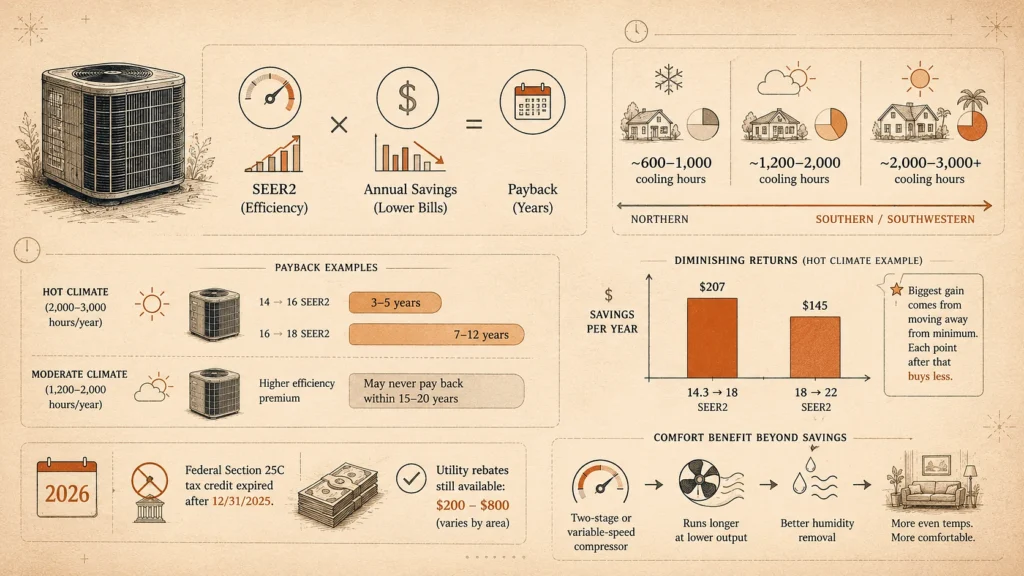
- Northern climates run roughly 600 to 1,000 cooling hours per year.
- Mixed climates run about 1,200 to 2,000 hours.
- Southern and southwestern climates run 2,000 to 3,000 hours and up.
Run the same upgrade through both ends of that range and you get completely different advice. In a hot southern climate, a 16 SEER2 unit typically pays back its premium in three to five years while an 18 SEER2 system takes seven to twelve years. In a moderate climate, a $1,500 premium may never pay for itself inside the equipment’s fifteen to twenty year life.
The diminishing returns are worth seeing too. In a hot climate scenario, going from 14.3 to 18 SEER2 saves about $207 per year, while going from 18 to 22 SEER2, which is the same four point jump, saves only about $145 more. The biggest gain always comes from getting away from the legal minimum, and every point after that buys less than the one before it.
Two things that change the math in 2026 specifically. The federal Section 25C tax credit expired for equipment placed in service after December 31, 2025, so do not let anyone quote you a federal discount that no longer exists. Utility rebates are still very much alive though, commonly $200 to $800 for qualifying high efficiency equipment lists what is available in your area.
There is also a comfort argument for higher efficiency that has nothing to do with payback. Higher tier systems generally come with two stage or variable speed compressors, and those run longer at lower output, which is exactly the behavior that pulls humidity out properly. If your complaint is a clammy house, the variable speed equipment may fix it whether or not the electricity savings ever catch up to the premium.
What To Ask The Contractor Standing In Your Living Room
Two contractors just quoted your house and one said three tons while the other said four, and there is no obvious way to tell which one measured and which one guessed. That is the situation almost everybody is in, so here is how to tell them apart.
Ask whether they will perform a Manual J load calculation and whether you can have a copy of the report. A contractor who does real load calculations will hand it over without hesitation, because it is the work they are proud of. Ask what square feet per ton their calculation came out to, and if the answer lands between 400 and 600, you have learned that they used a rule of thumb regardless of what they called it. Ask whether the calculation was room by room, since that is what determines whether your back bedroom gets enough air.
And if a contractor tells you they always add a half ton for safety, that is the moment to get another quote. The safety margin is already inside Manual J, the oversizing consequences land on you rather than on them, and rounding up is the single most common way a good installation goes wrong before anyone opens a box.