


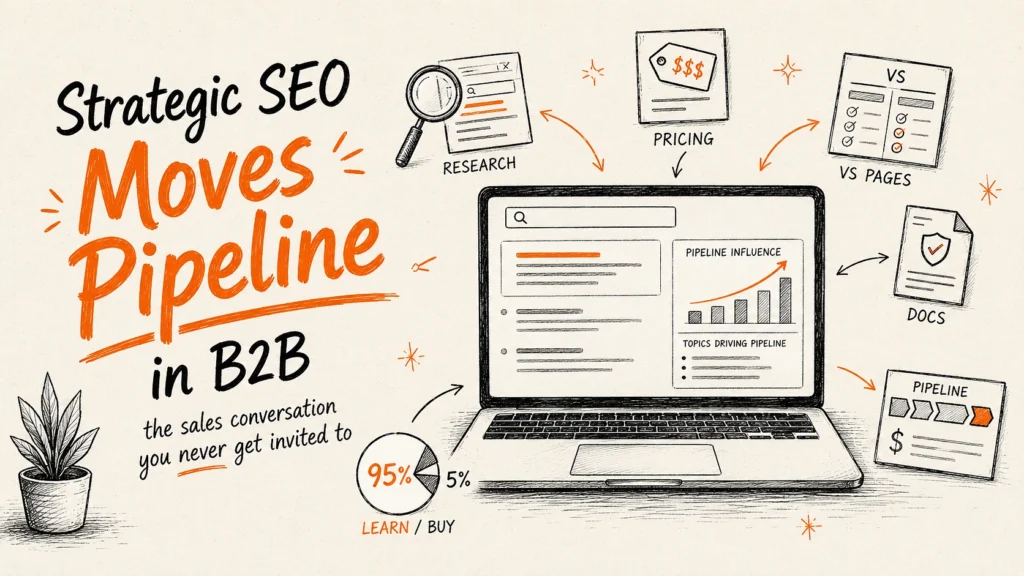
By the time the demo request lands in your CRM, the decision has mostly been made. That is not a figure of speech. 6sense’s buyer research across thousands of B2B purchases finds that buyers hold off contacting vendors until they are roughly 70% of the way through their journey, they arrive having already formed a preliminary vendor choice, and the vendor they favored at that first contact goes on to win the deal about 80% of the time. Your sales team is not competing for the deal. Most quarters, they are validating a decision that was made somewhere they could not see.
So where was it made? Gartner’s buyer survey data breaks the journey into time spent, and the largest single block, 27% of the entire purchase process, is buyers researching independently online. Meeting with potential suppliers gets 17%, and any one supplier gets 5 to 6%. Read those numbers as a media plan and the conclusion writes itself. The biggest share of the B2B buying journey happens in search results, documentation, comparison content, and communities, with no sales rep in the room. That anonymous research block is where strategic SEO either wins the deal or was never present for it, and that is my argument in one line. In B2B, SEO is not a lead source. It is the sales conversation you are not invited to.
The 95:5 Rule Decides What Your Content Is Actually For

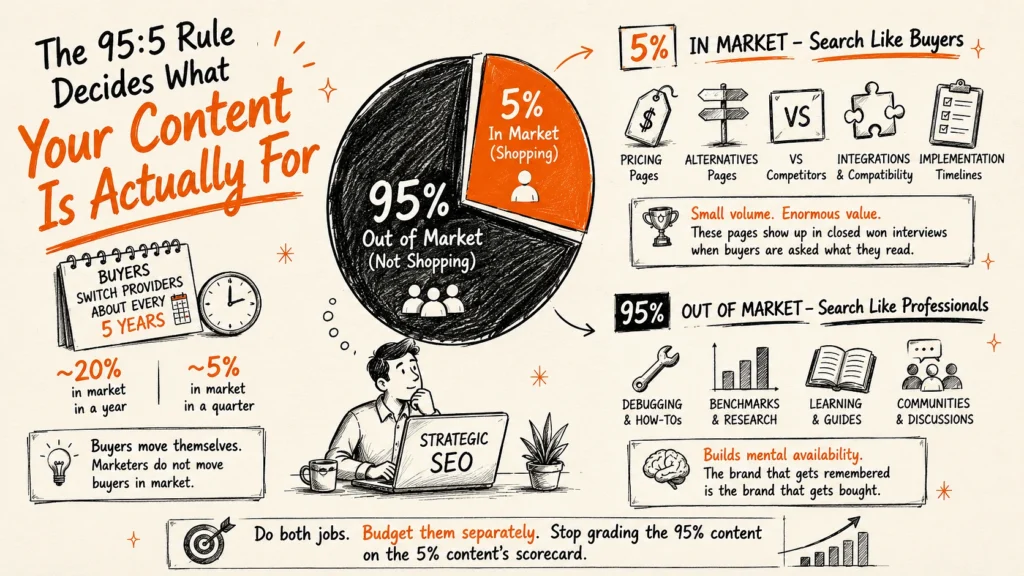
Before touching keywords, sit with the finding that reorganizes the whole program. Professor John Dawes at the Ehrenberg-Bass Institute, in research done with the LinkedIn B2B Institute, observed that companies switch providers of major services about every five years, which means only around 20 percent of your market is in market in a given year, and roughly 5 in a given quarter. The other 95 percent are not shopping, cannot be persuaded to shop, and per Dawes, marketers do not move buyers in market. Buyers move themselves, when a contract ends or a system breaks or a new leader arrives with opinions.
That splits every keyword you could target into two different jobs.
The in marketing tips 5% search like buyers. Pricing pages, alternatives pages, your product versus a competitor, integration with whatever they already run, implementation timelines. These queries are tiny in volume and enormous in value, and they are the pages that show up in closed won interviews when someone finally asks the customer what they read. If your program ignores them because the search volume column looks embarrassing, your program is optimized for a spreadsheet instead of a pipeline. Frankly, half of strategic B2B SEO is just refusing to be embarrassed by small numbers.
The out of market 95% search like professionals doing their jobs. They are not evaluating you. They are debugging something, benchmarking something, learning a discipline. Content for them does not convert this quarter and was never supposed to, its job is what Ehrenberg-Bass calls mental availability, the memory link that fires years later when the buying trigger finally arrives. The institute’s own phrasing is the cleanest version of it, the brand that gets remembered is the brand that gets bought. A genuinely useful benchmark report or troubleshooting guide read by someone eighteen months before their renewal date is doing pipeline work that no attribution model will ever credit properly.
Do both jobs. Budget them separately. And stop grading the 95% content on the 5% content’s scorecard, because that mismatch is where most B2B content programs quietly die.
The Pages That Show Up In Pipeline Are The Unglamorous Ones
Ask what content actually appears in the journeys of deals that closed, and the answer is consistent and a little deflating for anyone who loves publishing thought leadership. The selection phase runs on evaluation material. Comparison pages against named competitors. Alternatives pages, including the ones where you list yourself among options for a unhappy customers. Honest pricing information, because a hidden price does not create a sales conversation anymore, it creates a preliminary choice for the vendor who published theirs. Integration and security documentation, since somewhere in that Gartner buying group of six to ten stakeholders sits an IT reviewer whose entire evaluation is whether your product plays with their stack and passes their review.
One Gartner finding deserves its own uncomfortable sentence here. Their research found 69% of buyers report inconsistencies between the vendor’s website and what sellers later told them. Since the website gets the buyer first, that means most sales conversations open with the rep contradicting the research the buyer already trusts. Strategic SEO includes keeping the public material accurate and current, not because a crawler cares, but because that content is conducting the early sales calls on your behalf, and right now it may be conducting them badly.
What About The Classic High Volume Educational Blog Post?
It still has a place, just an honest one. Broad educational content reaches the 95% and feeds the memory bank, and it earns links that help the evaluation pages rank. What it does not do is show up as the deciding touch in pipeline, and treating its traffic as the program’s headline metric is how teams end up with a million visits, forty demo requests, and a CFO asking fair questions.
Measurement Is Where B2B SEO Programs Earn Or Lose Their Budget

The measurement problem is structural, so name it plainly to your business leadership before they name it to you. The research block where SEO does its heaviest work, that 27% of independent online research, is anonymous by nature. Buyers read six pages across four months, tell no one, then arrive through a branded search or type the URL directly, and last touch attribution hands the credit to the homepage. The influence was real. The tracking was blind.
The practical response is triangulation rather than false precision:
- Self reported attribution, a plain “how did you hear about us” field on the demo form, which routinely surfaces the content and search journeys the analytics missed.
- Pipeline influence reporting, counting deals where target accounts touched organic content anywhere in the journey, instead of only deals where organic was the last click.
- Closed won interviews, five minutes with new customers about what they actually read and compared, which costs nothing and reliably embarrasses the attribution model.
- Cohort direction over lead counting, whether organic touched pipeline is growing quarter over quarter, since that trend line survives scrutiny that individual lead credit does not.
And ok, none of that produces the tidy dashboard a paid channel produces. It is not supposed to. The research above says the majority of the buying journey is invisible to sellers by the buyer’s own preference, Gartner puts 75% of buyers as preferring a rep free experience outright. A channel that works inside the invisible part of the journey will always measure worse than it performs, and the teams that understand this fund the work anyway, which is a large part of why their demo requests keep arriving with the decision already leaning their way. The demo request from the first paragraph was never the beginning of the deal. Strategic SEO is the act of accepting that, and going to work where the deal actually starts.