


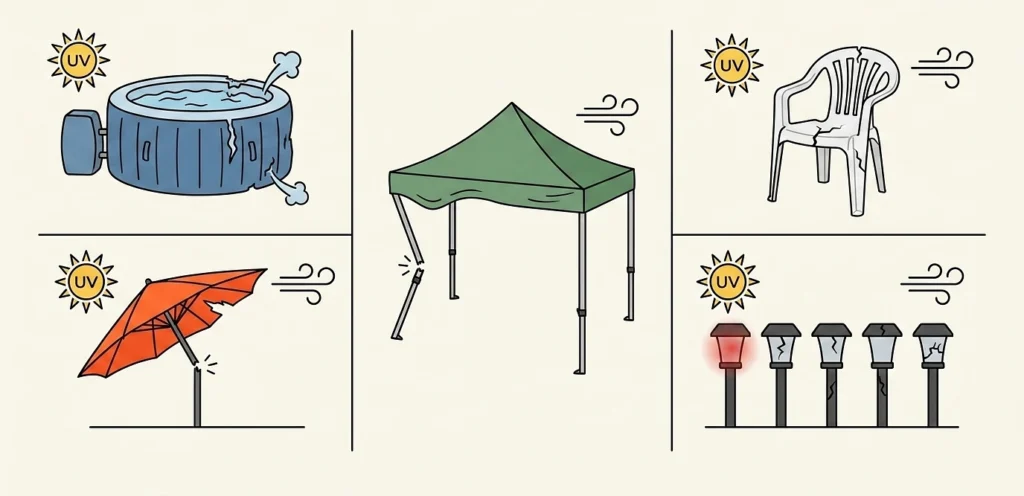
Divide what a backyard product truly costs, purchase, installation, and running costs across its life, by the number of times you will honestly use it, and the rankings flip. The $850 fire pit you light sixty evenings a year beats the $15,000 outdoor kitchen you fire up six times, and it is not close. The winners on cost per use are the boring ones, seating, shade, fire, and light. The losers share one trait, materials that fail before the payments feel finished, with inflatable hot tubs the documented worst at 2 to 5 years of life.
Here is the arithmetic almost no one runs in the store aisle. An outdoor kitchen installed at the national midrange, call it $11,000, used for six big cookouts a year across ten years, works out to roughly $183 per use before you buy a single steak. A basic installed fire pit at $850, lit twice a week through spring and fall plus the odd summer night, call it sixty uses a year over the same ten years, comes out to about $1.42 per evening. Both products improve a backyard. One of them costs a hundred and thirty times more per actual moment of enjoyment, and the store will never frame it that way, because the expensive one carries the margin.
So let me define the measure properly, since the whole ranking runs on it. Cost per use is total lifetime cost divided by honest lifetime uses. Total lifetime cost means the sticker price plus installation plus running costs, gas, electricity, chemicals, covers, replacement parts, across the years the product actually survives. Honest lifetime uses means the number your real life produces, not the number the brochure imagines. The two dishonesty traps sit on opposite sides of the fraction. People undercount the running costs of complicated products, and they overcount how often they will use anything that requires effort. A product you use without planning, walk out, sit down, flip a switch, racks up uses. A product that needs propane runs, water chemistry, or an hour of prep does not, and the fraction punishes it forever.
The Rankings, And The Verified Prices Underneath Them
The installed costs below come from current contractor pricing data, with Angi’s 2026 fire pit figures anchoring the fire category, above ground units running $200 to $1,500 installed and the national average landing near $850. The uses per year are my stated assumptions, and you should rerun the math with yours, since your climate and your habits move every number.
| Product | Verified installed cost | Honest uses per year | Rough cost per use over 10 years |
|---|---|---|---|
| Quality patio seating set | $800 to $2,500 | 150, it is furniture, you sit on it constantly | Under $1.70 |
| Fire pit, above ground | $200 to $1,500, average $850 | 60 evenings | About $1.42 |
| String and landscape lighting | $200 DIY to $3,500 professional | 200 nights, it runs itself | Pennies to $1.75 |
| Pergola | $2,100 to $6,000 | 100, it shades every use of the space under it | $2 to $6 |
| Grill, midrange gas | $400 to $1,200 | 50 cooks | $1 to $3 with fuel |
| Gazebo, permanent | $5,358 to $9,058 | 80 | $7 to $11 |
| Outdoor kitchen | $5,057 to $17,276 | 6 to 20, honestly | $25 to $180 plus |
Two things jump out of that table once it is sitting in front of you. The best performers are all products that work with zero activation effort, seating, light, shade, and the reason patio furniture wins the whole board is embarrassing in its simplicity, you cannot use any other backyard product without somewhere to sit. Fire lands second because it is the one product that extends the season, which multiplies uses, and Forbes’ home improvement analysis backs the resale side too, permanent fire features return well at sale precisely because buyers can picture using them.
And the outdoor kitchen at the bottom deserves a fair hearing rather than a sneer. For a family that genuinely entertains most weekends, twenty plus uses a year, the math improves fast, and the quality of those evenings is real. The point of the fraction is not that expensive products are bad. It is that the fraction forces the one question the showroom never asks, which is how your actual calendar looks, and ok, if your calendar really does hold forty cookouts, buy the kitchen with a clear conscience.
Which Product Improves A Backyard Most Per Dollar For A Normal Family?
Lighting, and it is not particularly close. A few hundred dollars of decent string and path lighting turns the space usable for every dinner, every conversation, every glass of wine after the kids go down, and it does so automatically, every night, with no activation cost at all. The professional landscape systems at $3,500 are lovely. The $200 version captures most of the benefit, which is the kind of sentence that gets a writer disinvited from trade shows.
The 5 That Won’t Last, And The Failure Mechanisms Are Predictable

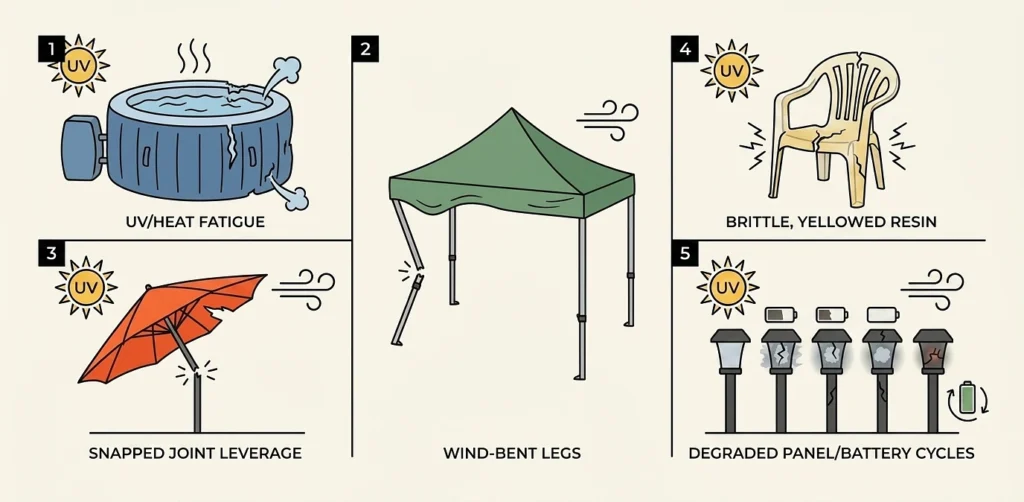
This list is built on materials and mechanisms rather than brand grudges, and the first entry carries hard numbers because the industry itself publishes them.
- Inflatable hot tubs. The documented lifespan runs 2 to 5 years, with sun exposed units failing in 2 to 3, because UV breaks down the PVC shell, seams fatigue under heat cycling, and the integrated pump and control unit is frequently the first component to die even while the shell holds. Even Jacuzzi’s own lifespan guide puts inflatables at 2 to 5 years against 10 to 15 for a standard acrylic tub. Add the $20 to $50 a month in electricity these thinly insulated tubs draw and the cheap purchase price stops being cheap. Divide a $600 tub plus three years of power and chemicals by the honest winter uses and it is among the worst cost per use purchases in the entire category.
- Pop up canopies used as permanent shade. They are event equipment, engineered to be light, which means thin telescoping legs and stressed joints, and the failure mechanism is wind loading on a product designed to be taken down before weather arrives. Left standing all season, the first serious gust bends a leg or tears the corner stitching, which is why the same canopy that survives ten farmers markets dies in one backyard summer.
- Bargain patio umbrellas on undersized bases. The mechanism is leverage. An umbrella is a sail on a stick, the cheap ones pair a thin pole with a base too light to counter it, and the tilt joint or the rib ends snap in the first wind that catches the canopy open. The umbrella is rarely the problem. The missing seventy pounds of base is.
- Uncovered resin and plastic stack making furniture. The same UV chemistry that kills the hot tub shell embrittles cheap molded resin, the surface chalks, the material goes brittle, and the chair that flexed politely in year one cracks under a guest in year three. White goes yellow along the way, purely as an insult.
- Solar string lights at the bottom of the price bin. Two consumable parts decide everything, a small battery that survives a limited number of charge cycles and a cheap cell panel that degrades in the exact sunlight it needs. The failure is gradual, they glow dimmer and die earlier each night until one autumn they simply do not come on, and the low sun angle of the season they would improve most is the light they can least harvest. Plug in LED strings cost slightly more once, draw almost nothing, and are still working when the third set of solar ones has gone in the bin.
The pattern across all five is the same one, and it is the honest close to the whole subject. Products fail where their materials meet their real conditions, sun on PVC and resin, wind on light frames and open canopies, charge cycles on small batteries, and the store price never discloses any of it. The fraction does. Divide by the years the thing will genuinely survive and the uses your genuine life will give it, and the backyard budget mostly spends itself, on a place to sit, a fire, some light, and shade that was built rather than inflated.