


Teeth are bad at asking for help. A gum can stay inflamed for months, and a tooth can lose a fair bit of enamel, before anything hurts enough to send you to a dentist. What you get instead are small signs that are easy to explain away. A pink streak shows up in the foam when you spit. A front tooth twinges at ice water. An edge looks a little flatter than it did in last year’s photos.
A week’s delay on any of those does no harm. A few years of delay is how fillings, gum treatment and crowns come about, so it pays to know which part of your mouth each sign belongs to.
Blood On The Brush or The Floss Means Your Gums Are Inflamed
Healthy gums don’t bleed under a soft toothbrush. When yours do, plaque has most likely been sitting along the gumline, and the tissue has swollen up around it. Dentists call that early stage gingivitis. Careful brushing and flossing each day, plus a professional cleaning, will usually settle it.
Left alone, the trouble can travel deeper. The National Institute of Dental and Craniofacial Research describes gum disease as an infection of the tissues that hold your teeth in place, and its figures put it down as the most common reason adults lose teeth. Smoking raises the risk more than anything else on the institute’s list.
Oddly, soreness is a poor guide, since inflamed gums often don’t hurt much. Watch for these as well:
- gums that look red or puffy.
- bad breath that brushing doesn’t shift.
- teeth that seem longer because the gum has drawn back.
- a tooth that feels loose, or chewing that hurts.
A word on flossing, because plenty of us quit when we see blood and blame the floss. Gentle daily flossing tends to calm the bleeding down. If it carries on past a couple of weeks, book a visit.
Teeth That Sting With Cold Drinks May Be Losing Enamel to Acid
Enamel is the hardest material your body makes, and acid softens it anyway. Each acidic mouthful loosens the surface a little, then saliva hardens it again over the following hour or so. Trouble starts when the acid comes round more often than saliva can keep up with.
Thin enamel has a few giveaways. Cold drinks sting. Teeth look yellower however much whitening toothpaste you get through, because the darker layer underneath is showing. The biting edges of the front teeth can turn faintly see-through.
Diet Soda Is An Acid Drink Too
The American Dental Association’s advice on acidic foods and drinks singles out soft drinks and sports drinks as the worst for erosion. Sugar isn’t the reason. Carbonation makes a drink more acidic by itself, so a zero-sugar cola spares you the sugar and keeps the acid. Citrus juice and wine belong in this group as well.
Coffee has acid in it, though far less than a soda. Tasters actually prize it, and acidity is one of the qualities marked on the SCA cupping form. Your enamel is less of a fan, particularly when the mug lasts until noon.
One Drink Sipped All Morning is Harder On Teeth Than One You Finish
Saliva needs a gap to do its repair work, and a drink you keep going back to never gives it one. If you want a soda, have it with lunch and finish it. Go back to water afterwards.
Wait An Hour Before You Brush
We’d guess most of us were taught to brush straight after breakfast. With orange juice on the table, that habit works against you, because a toothbrush scrubs away enamel that acid has just softened. The ADA’s advice is to hold off for an hour after anything acidic and to rinse with plain water in the meantime.
Calcium Keeps The Jaw Strong, But It Won’t Bring Enamel Back

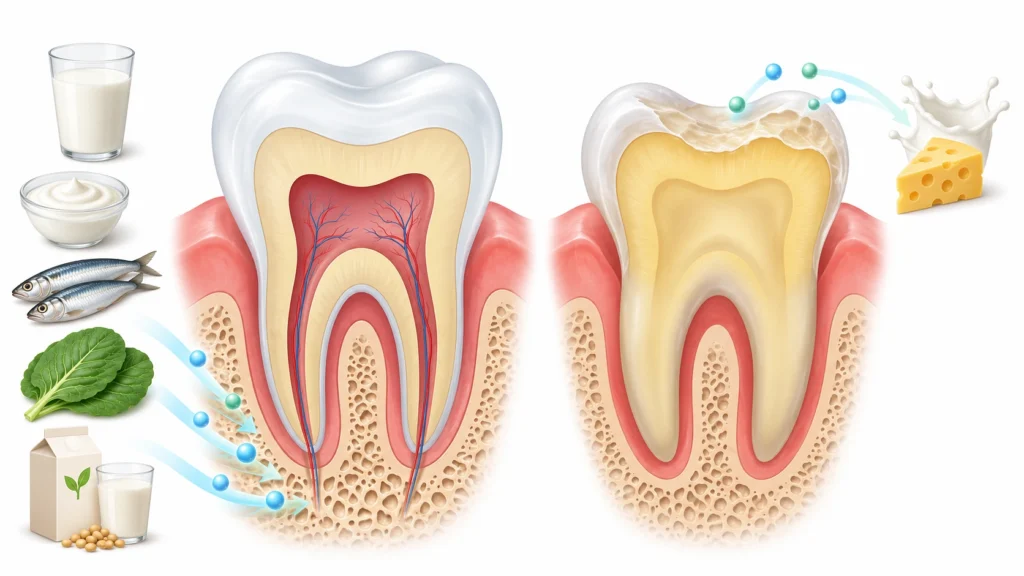
Worn enamel doesn’t grow back, whatever you eat. A finished tooth has no cells left that could make more of it. So if a product hints that calcium will rebuild your enamel, be skeptical.
Calcium earns its place for two other reasons. Your teeth are anchored in the jawbone, and bone needs a steady supply. Then there’s what happens at the table: the ADA suggests following an acidic meal with a glass of milk or a bit of cheese, since dairy helps neutralize the acid.
Food is the place to start. Try putting calcium-rich foods on the plate at meals you already eat. These amounts are the Bone Health and Osteoporosis Foundation’s:
- milk, about 300 mg in an 8-ounce glass.
- plain low-fat yogurt, 310 mg in 6 ounces.
- canned sardines, 325 mg in 3 ounces.
- cooked collard greens, 266 mg a cup.
- fortified soy or almond milk, 300 to 450 mg a glass.
A Front Tooth That Looks Shorter or Chipped Can Come From Grinding at Night
You won’t catch yourself doing this one. Clenching and grinding during sleep can be loud enough to wake whoever is lying next to you, yet the person doing it sleeps through. If nobody is there to complain, your mornings are the evidence. Mayo Clinic’s list of signs of teeth grinding includes:
- a jaw that feels tired or tight when you wake.
- a dull headache starting at the temples.
- teeth that have gone flat, chipped or slightly loose.
- enamel worn through to the layer beneath.
Mayo Clinic also ties sleep grinding to snoring and sleep apnea, and names caffeine, alcohol and smoking among the things that raise the risk. That’s a little unfair on anyone drinking extra coffee to get over a bad night. If you grind and you also snore heavily, mention the two together to your doctor.
Sometimes The Teeth Just Don’t Meet Evenly
Uneven wear has a second cause that has nothing to do with sleep. When the upper and lower teeth come together badly, a few surfaces take most of the load and wear down ahead of the others. A chip that keeps returning in one spot is a hint. An orthodontist is the person to check it, and bite problems are treated in adults as well as children, according to the American Association of Orthodontists.
A night guard takes the wear so your enamel doesn’t, but your teeth will go on meeting as they did before. Should your dentist offer you a guard, ask what’s behind the grinding too.
Tell The Dentist What You’ve Noticed Before The Exam Starts
A dentist sees your mouth for a few minutes once or twice a year, and you see it daily. Say what you’ve spotted as soon as you sit down, because it changes what gets looked at.
If your gums have been bleeding, ask for a gum measurement. The dentist or hygienist slides a thin probe between tooth and gum and reads off a depth in millimeters. Shallow is good. Ask what your readings were and how they compare with last time.
Sensitivity is worth raising for a different reason. Erosion comes from acid in what you eat and drink, whereas a cavity starts when plaque bacteria feed on sugar and make acid of their own. A dentist can tell them apart by looking, and the fix for one won’t help the other.
Mention any flat or chipped edges as well. Signs of grinding show up in the chair long before you’d find them in a mirror.
Maybe whitening or veneers are on your list, as part of looking after yourself. Get the gums and enamel dealt with first, since cosmetic work sits better on a healthy mouth.
Put the readings in your phone before you leave. Next time, you’ll be able to see for yourself what has moved.