


Key takeaway
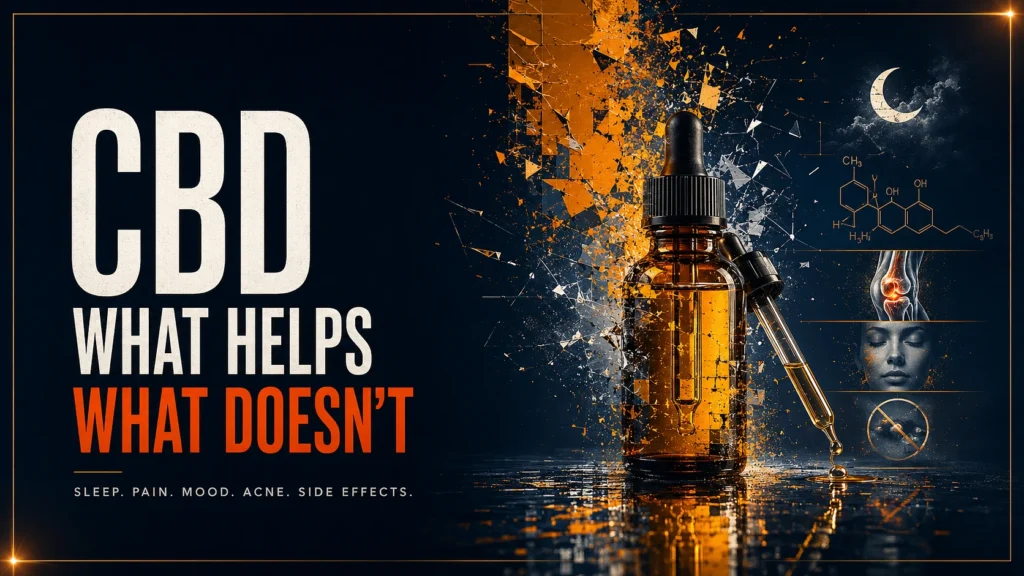
People take CBD mainly for sleep, pain, mood, cancer treatment side effects and acne, and the evidence behind those five is uneven rather than uniform. Sleep and anxiety have the most human research behind them, the acne finding comes from cells in a dish rather than from people, and a lot of pain research involves CBD mixed with THC rather than CBD by itself. The part most articles leave out matters more than any benefit on the list. CBD interferes with how your liver processes other medication, raised liver enzymes are documented, retail products are often mislabeled, and only one prescription CBD product has FDA approval. Worth trying for many people. Worth mentioning to your doctor first if you take anything daily.
I got curious about CBD the same way most people do, which is that somebody I trust swore it fixed something for them. A friend started taking it for sleep and stopped complaining about sleep, and that was enough to make me go read about it properly.
What I found is messier than the marketing suggests, and honestly more interesting. There are five areas where people take CBD and where research has actually looked. The strength of what we know varies a lot between them, so I have tried to be straight about which is which rather than treating all five as settled.
Sleep Is The Big One, Though The Reason Might Be Indirect

Sleep is what brings most people to CBD in the first place, and most CBD users are taking it for some kind of sleep problem rather than for pain or anything else.
Here is the part I found interesting. The sleep effect may not be a sleep effect at all. It might be a knock on from CBD’s impact on anxiety and general wound up ness, because a calmer person falls asleep more easily regardless of what calmed them. That distinction sounds academic until you are the person deciding whether to take it, since if your sleep problem is anxiety driven you have a better shot than if it is a breathing or circadian issue.
Worth saying plainly, a lot of the sleep research is small, short, or based on people reporting how they slept rather than measured sleep. That is not nothing. It is also not the same as proof.
Pain Relief, And The Delivery Method Question

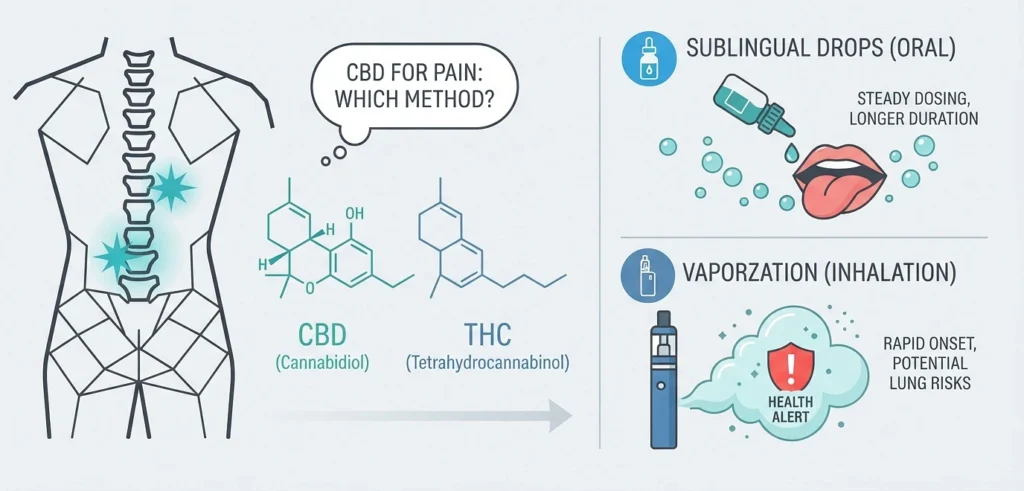
Chronic pain is the second big reason people try it, usually for arthritis or fibromyalgia.
I want to flag something about the evidence here because it gets glossed over constantly. A lot of the stronger pain research involves CBD combined with THC rather than CBD on its own, and the LiverTox database from NIH makes an uncomfortable point about this, which is that since many products contain trace THC and inconsistent CBD levels, some of what people attribute to CBD may actually be THC doing the work. That does not mean people are imagining relief. It means we are not always sure what is producing it.
On delivery, inhaling gets it into the bloodstream faster than swallowing an oil or a capsule does, which matters if you are chasing quick relief rather than steady background dosing. People going that route usually want to keep nicotine out of the equation, and a nicotine free vape juice selection makes sense there, partly because nicotine is inflammatory and you are presumably taking CBD to reduce inflammation, not add to it.
I would still be honest that vaping anything carries its own lung risks separate from what is in the liquid, and that is a real consideration rather than a disclaimer. If your reason for taking CBD is health routine, the delivery method deserves as much thought as the product.
Mood, Anxiety and Mental Health
Studies from around 2020 pointed to CBD reducing symptoms of anxiety and depression, and there is research into whether it helps with psychosis too. A 2019 study found it helped with PTSD related symptoms including nightmares in adults.
None of that makes it a treatment, and I would not want anyone reading this to swap prescribed medication for a gummy. Response varies wildly person to person, and the anxiety research in particular often uses doses far higher than what is in most retail products.
If you are going to buy any of it, buy from somewhere that publishes third party lab results, which is the whole reason people point toward established retailers like CBDistillery rather than whatever is cheapest on a marketplace listing. More on why that matters below, because it turns out to matter a lot.
Cancer Treatment Side Effects
Cancer treatment can be brutal, and the side effects of the treatment are frequently what wrecks a person’s quality of life rather than the disease itself in the earlier stages.
Research from 2022 looked at whether cannabis based products can ease the effects of cancer treatment, particularly nausea, vomiting and pain, and the early signals are encouraging. Getting dose and timing right appears to be a big part of whether it does anything.
This is the one area where I would say do not go it alone under any circumstances. Cancer treatment involves drugs with narrow margins, CBD interferes with how the liver processes a lot of medication, and adding it without telling your oncology team is a genuinely bad idea rather than a cautious one. Bring it up as a question. Plenty of teams have an opinion ready.
Acne, Where The Research is Real But Early
Acne vulgaris happens when dead skin cells and oil clog follicles, and beyond the physical discomfort it does a number on people’s confidence, which is reason enough to look for options.
There is a study people cite a lot showing CBD stopped human sebocytes, the cells that produce sebum, from producing as much of it. Pair that with CBD’s apparent anti inflammatory properties and the logic for acne is reasonable.
The thing nobody mentions when citing it is that the study was done on cells in a dish rather than on people’s faces. That is a legitimate starting point for research and it is not the same as a clinical trial showing your skin improves. Topical CBD is low risk to try, so trying it is fine. Just go in with the right expectations.
The Safety Stuff The Average CBD
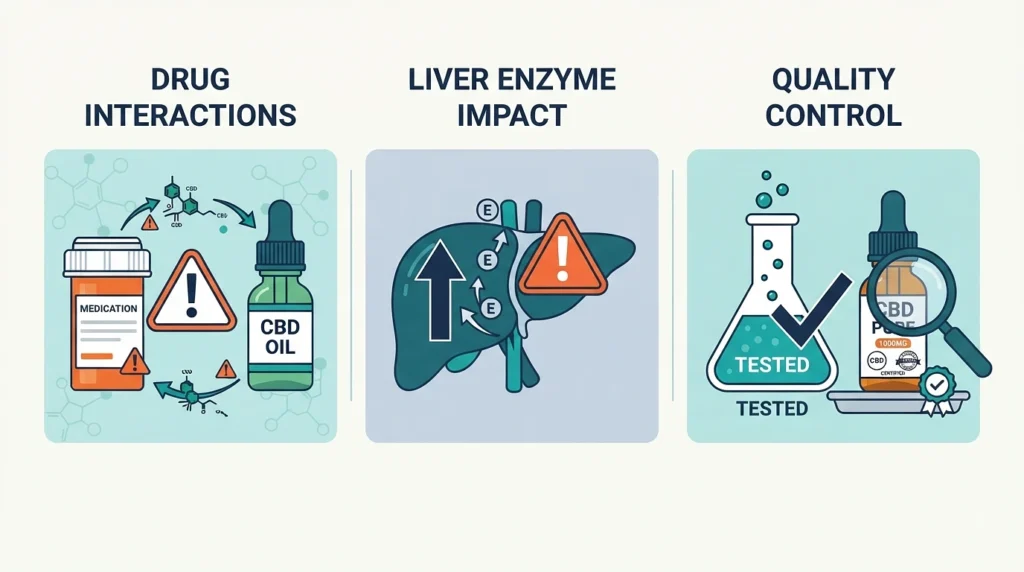
This is the part I actually think is missing from most of what gets written about CBD, and it is more important than any of the five sections above.
- CBD interferes with other medications. It inhibits the liver enzymes that process a large share of common drugs, which is why the FDA warns that CBD can change how your other medicines work, and that your other medicines can change how much CBD is safe for you. Blood thinners, seizure medication and various antidepressants all sit in that category. If you take anything daily, this is a conversation with a pharmacist rather than a thing to wing.
- Liver enzyme elevations are documented. Not a fringe theory. At the doses used in the approved prescription version, raised liver enzymes are a known and monitored effect, and the FDA has funded research specifically to work out what happens at the lower doses people buy over the counter.
- You often do not know what is in the bottle. The concentration of CBD in retail products varies widely and is frequently not what the label says, and some products carry trace THC or other contaminants. Testing has repeatedly turned up products containing detectable THC that could show on a drug test or affect a child.
- Only one CBD product has FDA approval. It is a prescription medication for a few specific severe seizure disorders. Everything on a shop shelf sits outside that, meaning nobody has evaluated it for effectiveness, correct dosing or interactions.
That is not an argument against trying CBD. It is an argument for buying from companies that publish their lab results, starting at a low dose, and telling your doctor you are taking it the same way you would mention any other daily supplement.
I am not a doctor and none of this is medical advice for your particular situation. What I would say is that CBD sits in an odd spot right now where the anecdotal reports are genuinely widespread and the clinical evidence is thinner than the marketing implies, and both of those things can be true at once. Go in curious rather than convinced.