


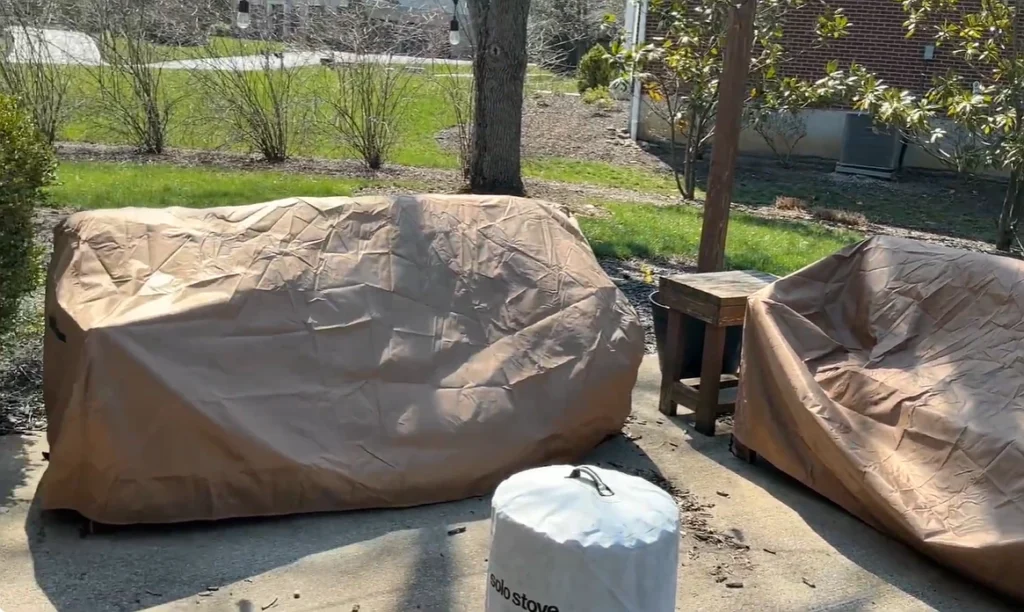
A neighbor of mine covered two teak chaise lounges last October with heavy vinyl covers, the completely sealed kind, cinched them down tight, and felt very good about it until April. What came out from under those covers smelled like a basement. Black mildew spotting across both cushions, and a gray film on the teak itself. The covers had done exactly what the packaging promised. Not one drop of rain got through. The water that killed the cushions came from underneath.
That failure is common enough that cover manufacturers write whole pages about it, and once you understand why it happens, the shopping decision gets simple.
Where The Moisture Comes From When Rain Can’t Get In
Cushions go under a cover holding a little humidity. So does the air trapped with them, and the ground below breathes moisture upward all night. When the temperature drops after dark, that water vapor condenses on the underside of the cover and on the furniture, the same way a cold glass sweats.
Under a breathable cover, that condensation evaporates out through the fabric the next morning and nobody ever knows it was there. Under a sealed waterproof cover, it has nowhere to go. Condensation and dew keep forming beneath the cover night after night, and the result is mildew on the cushions, water spots on the frame, rust on any metal. The chaise shape makes it a little worse than a dining chair, honestly, because you’ve got a big flat cushioned surface lying close to the ground where damp air sits.
So the sealed cover isn’t protecting the cushion from water. It’s sealing the cushion into a terrarium with its own water supply. The cover you want blocks rain from above and lets vapor escape from below, and those are two different properties that cheap covers treat as one.
| Fully waterproof (vinyl, PVC film) | Water-resistant and breathable | |
|---|---|---|
| Rain from above | Blocked completely | Blocked in normal weather |
| Condensation underneath | Trapped, accumulates nightly | Evaporates through the fabric |
| Cushions after a season | Mildew risk, musty smell | Dry, usable same day |
| Frame finish | Water spots, rust on metal | Protected |
| Where it does make sense | Cushionless frames, short storm cover | Season-long covering with cushions on |
That last row is the one honest carve-out. If you strip the cushions off and store them indoors modern living, a sealed cover over a bare aluminum or resin frame does less harm, and for a two-day hurricane prep it’s fine. For the way most people actually use a chaise cover, cushions on, cover on for weeks at a stretch, sealed waterproof is the wrong buy. Not a tradeoff. Wrong.
Spec 1: Water-Resistant Coated Fabric, Not Plastic Film

What you’re looking for on the label:
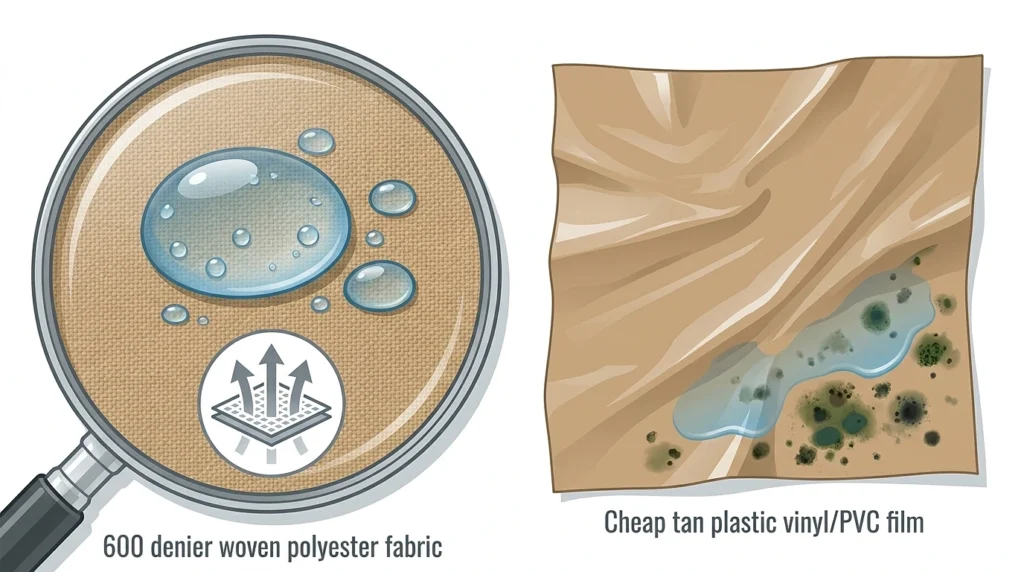
- Woven polyester, 300 to 600 denier, with a polyurethane or similar coating on the inside face. That construction sheds rain while the weave still passes vapor.
- Solution-dyed if you can get it, meaning the color is locked into the fiber rather than printed on. It matters for fade resistance later.
What you’re avoiding:
- Anything described as vinyl, PVC film, or tarp-like.
- Any listing that leads with “100% waterproof” as its main boast. The cover companies themselves say waterproof covers are the wrong choice for furniture, because moisture beneath them cannot evaporate and turns into mold. When the industry argues against its own stronger-sounding claim, believe it.
Spec 2: Air Vents
Vents look like a small feature and do two jobs.
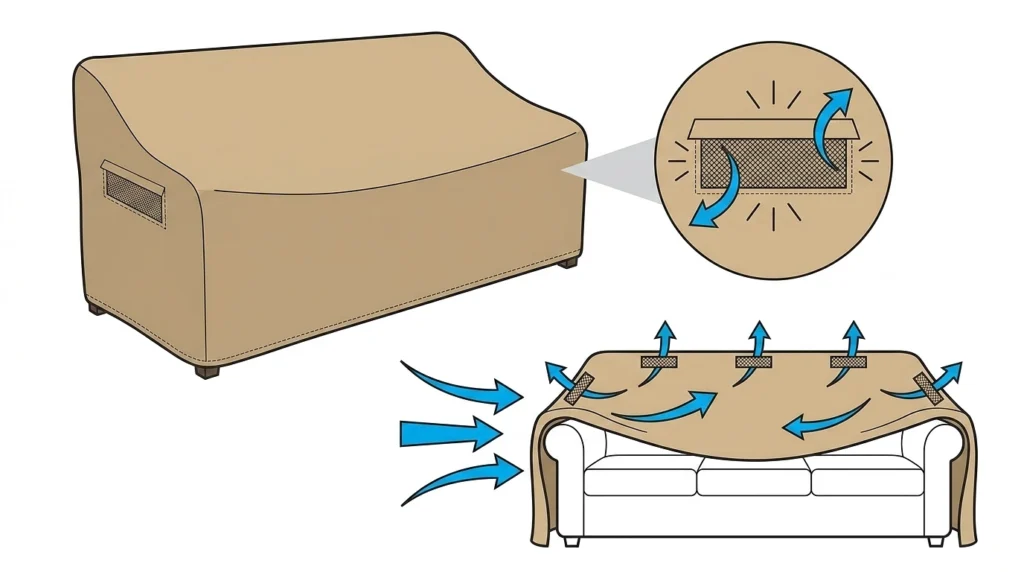
- Airflow. Trapped humid air gets a designed exit instead of having to migrate through the fabric alone.
- Wind behavior. Gusts pass through the vents instead of inflating the cover like a sail, so the cover balloons less and stays put longer.
Mesh-backed vents, usually one on each side panel, are the standard done right. A cover with no vents at all is telling you the manufacturer never thought hard about the problem.
Spec 3: A Fastening System That Holds Without Strangling
Chaise covers fail in wind more than any other furniture cover, because the shape is long, low, and mostly flat. What holds one in place:
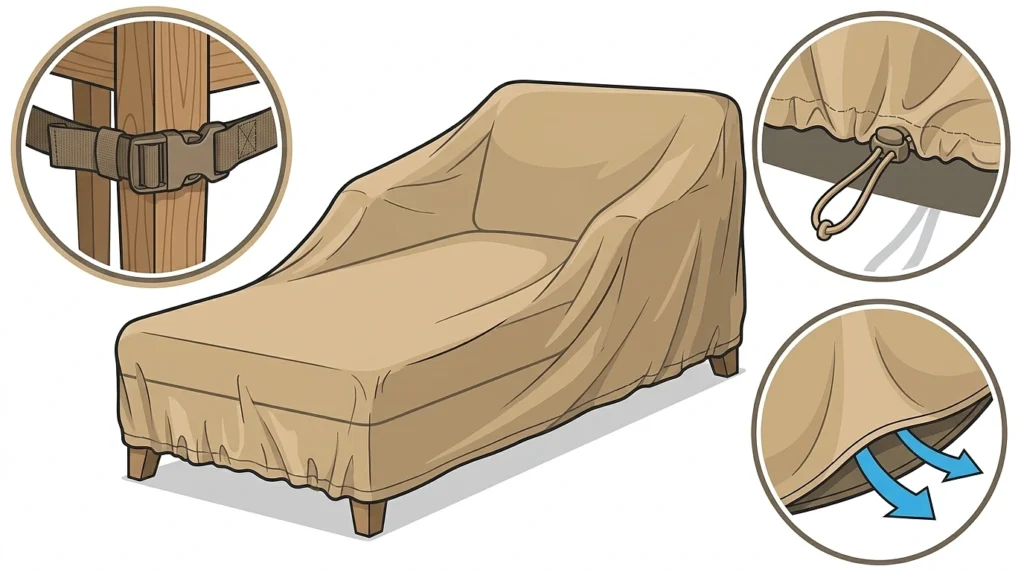
- Buckle straps that clip under the frame or around the legs.
- An elastic or drawstring hem you can snug at the base.
- A size with an inch or two of leeway. A cover two sizes too big pools water in its folds and flaps itself loose.
Here’s the part that catches people: tight is good, airtight is not. Over-tightening the straps chokes off breathability and traps moisture underneath, which quietly recreates the sealed-cover problem you paid to avoid. Secure the straps, snug the hem, and leave the cover sitting with a little air in it rather than shrink-wrapped. If the hem reaches the ground, let it hang rather than cinching it sealed, because ground-level airflow is where a lot of the drying happens.
Spec 4: UV-Stable Fabric That Keeps Its Coating
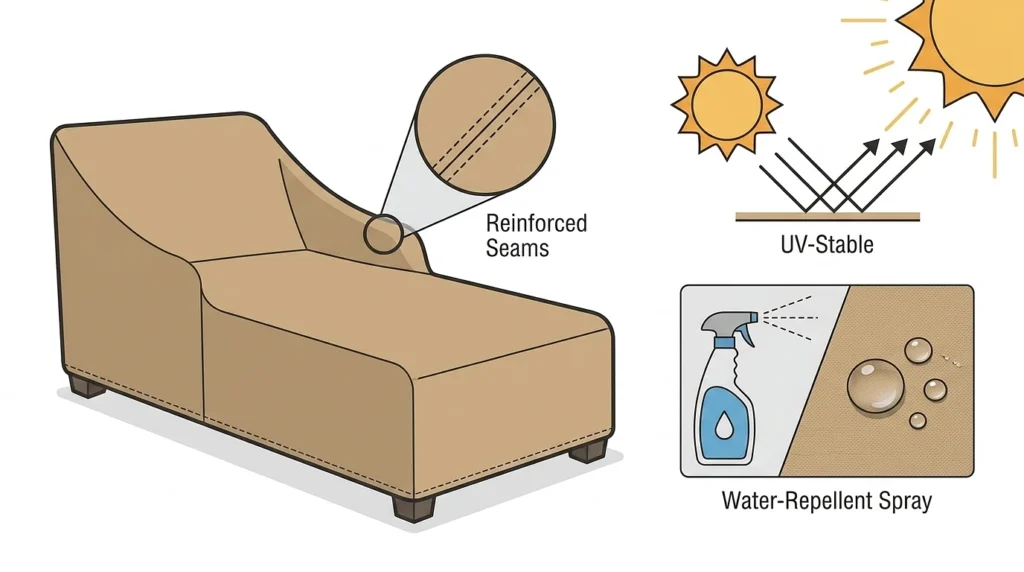
Sun kills more covers than rain does. A cheap cover spends one summer going brittle, the coating cracks, and by autumn it’s a net.
- Solution-dyed polyester resists fading and embrittlement far longer than printed fabric.
- Reinforced or interlocked seams matter more on a chaise than on other furniture, since the flat top lets rain sit on the seams longer than a sloped chair back would.
- The repellent finish wears off after a couple of seasons on any cover. A reapplication of outdoor-fabric water-repellent spray restores it, a ten-dollar fix people mistake for a dead cover.
| Spec | What the listing should say | Walk away if |
|---|---|---|
| Fabric | Water-resistant, breathable, 300 to 600D coated polyester, solution-dyed | “Vinyl,” “PVC,” “100% waterproof” as the headline |
| Ventilation | Mesh air vents on the panels | No vents mentioned anywhere |
| Fastening | Buckle straps plus elastic or drawstring hem, sized with slight leeway | Only a loose elastic edge, or a fit two sizes off |
| Longevity | UV or fade resistant, reinforced seams, a real warranty | No UV claim, no seam detail, one-season pricing |
Two Habits That Do As Much As The Cover
- Cover the chaise dry. Trapping a damp cushion under even the best breathable cover starts the mildew clock, so after rain, let things air out before the cover goes back on.
- Air it out on a schedule. Every couple of weeks in a wet season, pull the cover off on a sunny morning for an hour. It resets whatever humidity has built up and lets you catch problems while they’re still a wipe-down instead of a replacement.
My neighbor’s replacement covers, for what it’s worth, were mid-priced breathable ones with side vents and leg straps, and this spring the cushions came out smelling like nothing at all, which is the entire goal. The vinyl ones are still in his garage. They make decent drop cloths.