


Asked how many books belong in one pile on a coffee table, the people who style living rooms for a living rarely give a long answer. “I do two to three books per stack,” Julia Stevens, an interior stylist in New York City, said when three stylists explained their coffee table habits to Martha Stewart, and she added that her books often face different directions and look a little untidy on purpose.
Because that number comes up so often, it is useful to know the reasons behind it before any book is bought or printed. A low pile of large books gives the table some height, a tray next to it gathers the small things a household really uses, and the open wood between them leaves room for a cup. What follows explains how to choose and order the books, where the tray ought to go, how a book of your own photographs fits in with the bought ones, and how to look after all of it on a table that people use daily.
Two Or Three Books Make A Stack That People Will Still Open


With two or three large hardcovers, a stack rises roughly three to five inches, so a small object can stand on it and the television can still be seen over it.
Once a fourth and a fifth book are added, the pile begins to look like storage, and the books at the bottom are seldom taken out because lifting everything above them is a nuisance. Stevens gave a related warning in that interview: when too many objects are placed on top of the books, guests stop picking them up. A photo book that nobody opens has lost most of its purpose, so the stack should stay low and its top should stay nearly clear, with one small object at most.
The order of the books matters as much as their number. When you build the pile, you can follow this order:
- The largest and heaviest book goes at the bottom, since it keeps the others steady.
- A second book, an inch or two smaller on each side, is laid on it so that a border of the lower cover shows.
- The smallest book is placed last with its front cover facing up, because this cover will be seen most.
For the bottom book, Houzz offers a measurement that is easy to apply in its guide to decorating a coffee table: the book should be about one-third to two-thirds as wide as the table. On a table 24 inches across, a base book between 8 and 16 inches wide would suit. If the table is very large, a single pile may look lost on it, and designer Bobby Berk suggests adding more stacks of two or three to fill the surface instead of building one pile higher.
The Tray Goes Beside The Books So That Small Things Have A Home
Left loose on a table, a remote, two coasters, a candle and a box of matches look like things somebody forgot to put away. Gathered on a tray, they look as though they were placed there deliberately, and Kerrie Kelly of Kerrie Kelly Design Lab made this very point about trays bringing order to candles and coasters when she spoke to Martha Stewart.
Many people set the books on the tray as well, though the arrangement works better when the two are kept apart. A book lying under a candle and a dish cannot be lifted without everything being moved first, whereas a book in its own pile can be taken up with one hand. The tray gains from the separation too. When the table is wanted for a board game or a pizza box, the tray is carried off in one trip and the books follow in a second, and the surface is clear within a minute.
Apartment Therapy describes this layout as the half and half in its list of coffee table styling formulas. You divide the table in your mind into two parts, put a tray of small objects in one, and put a large book or a pile of books in the other at about the height of the tray. The match in height is what makes the two groups look like a pair.
As for the tray itself, it ought to differ from the tabletop in material so that it can be seen. A wooden tray disappears on an oak table, while brass, rattan, marble or black lacquer would stand out against the grain. Its footprint should be close to that of the bottom book. Should the tray be much larger than the stack, the books will look like an afterthought beside it.
A Book Of Your Own Photos Belongs On Top Of The Bought Ones
Books about architecture, travel or fashion tell a visitor what the household likes to look at. They say very little about the people who live there, and this is where a printed book of family photographs earns its place. It is also likely to be the book a guest reaches for first, since faces they know are more interesting to them than a stranger’s villa in Tuscany.
Size decides where such a book should lie. A coffee table photo book from Mixtiles, for example, measures 8 by 8 inches with a hard matte cover and silk-finish pages, and its price starts at $39. Most art and design books are a good deal larger than that. An 8-inch square book would therefore make a poor base, but it sits well as the top book of three, with a border of the larger covers showing around it.
One subject per book works better than a mixture: a single trip, a wedding, a child’s first year, or the year just gone.
Because that format prints one photo on each page, the choosing has to be done before the ordering. Although a year-in-review book can hold up to 200 photos, a guest turning pages on a sofa will give it perhaps five minutes, so 40 to 60 strong pictures would serve better than the full camera roll. You might begin and end with wide shots of a place and keep the close portraits for the middle pages.
The cover needs a thought as well, because it faces the room all day. A cover photo with calm colors that agree with the cushions or the rug will look settled on the table, and a busy group shot can go inside. People who are preparing a house for sale usually do the opposite and put personal pictures away, for reasons that become clear from what a home stager notices in a living room. In a home you intend to stay in, there is no need to hide them.
How Should The Stack And The Tray Sit On Your Table?
The answer depends on the shape of the table and on how much of it the household needs for daily use. In the Martha Stewart piece, the stylists noted that a table used for dinner most nights needs more open surface than one that is rarely touched, so the first step is to decide how much room you must keep clear.
A Rectangular Table Can Be Split Into Two Or Three Parts
On a common table of about 48 by 24 inches, the stack can go toward one end and the tray toward the other, with a clear strip in the middle for cups. If the table is longer, you may treat it as three parts and leave the third one empty or give it a low bowl. The books should lie square with the edges of the table, while the tray may be turned slightly to keep the arrangement from looking stiff. Before settling on any layout, see that knees and shins have room to pass, and the clearances given with these modular lounge layouts are a useful guide for the gap between seat and table.
A Round Table Takes One Group Placed Off Center
Since a round top has no ends, the stack and the tray are better placed close together, a little to one side of the middle, so that they form a single group. Rectangular books already contrast with the curve of the table, and a round tray beside them would repeat the outline of the top.
A Small Table Has Room For One Stack And A Dish
Where the table is under 30 inches or so, two books are enough, and a small dish for the remote can stand in for the tray. If the table has a lower shelf, the stack might go there and leave the top free. With very large tables the difficulty is the reverse, and Stevens advised a few big items over many little ones because a wide surface filled with small objects soon looks cluttered. The proportions of the table to the sofa matter here as well, and they are covered in this piece on modern living room furniture.
Sunlight And Wet Glasses Do The Most Harm To A Book Left Out

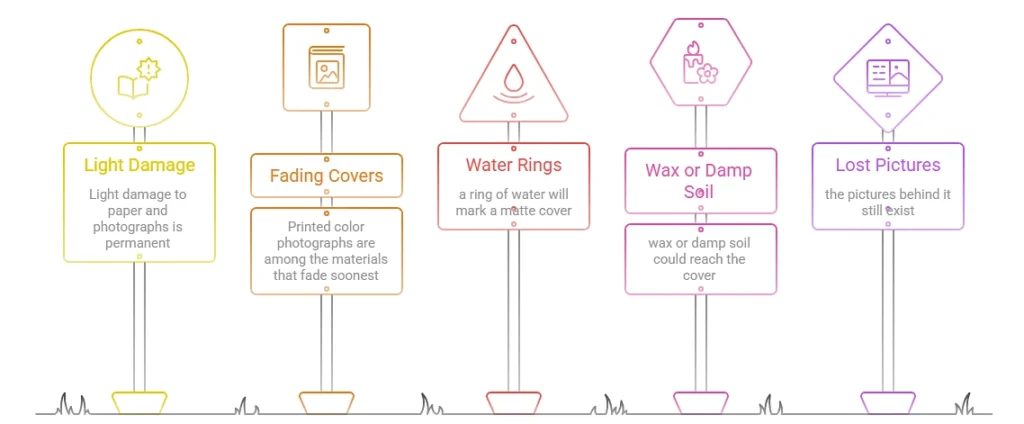
Unlike a book on a shelf, a book on a coffee table lies face up under the window for months. Conservators warn that light damage to paper and photographs is permanent and that it adds up over time, so weak light over a long period can fade a cover as surely as strong light over a short one. They advise keeping direct sun off anything that fades, and printed color photographs are among the materials that fade soonest.
A household cannot keep its living room dark, of course, but a few habits would slow the wear considerably:
- Change the top book every two or three months so that no single cover takes all the light.
- Move the stack to the shaded end of the table if the afternoon sun falls across one side.
- Keep cups and glasses on the tray or on coasters, since a ring of water will mark a matte cover.
- Put a candle or a plant pot on the tray and never straight on a book, where wax or damp soil could reach the cover.
- Wipe the table dry before the books go back after cleaning.
As a last precaution, keep the photo files and the book design saved in the app or in a backed-up folder after the book arrives. A bought art book that gets a coffee ring can usually be purchased again, whereas a family book can only be reprinted if the pictures behind it still exist.