


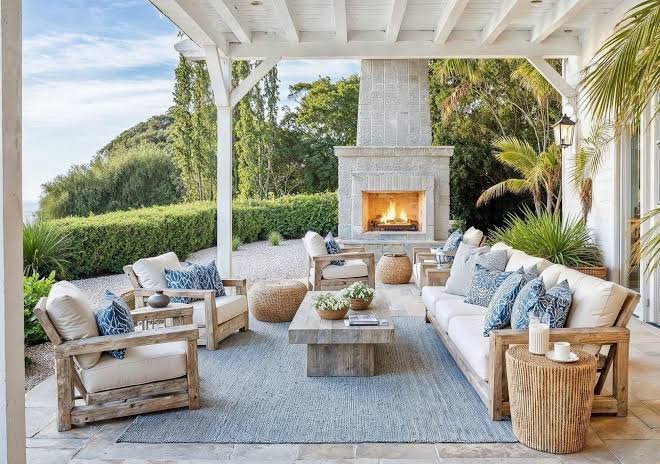
The most common patio regret I hear isn’t about the color of the stone or the brand of the pavers. It’s four words. “We made it too small.” Someone measured a space that looked huge when it was empty, poured or paved it, and then dragged out a table, six chairs, a grill, and a couple of loungers, and suddenly nobody can walk behind a seated guest without turning sideways. The patio didn’t shrink. It was never big enough to begin with. It just looked big with nothing on it.
That gap, between how a space reads empty and how it works full, is where most patio projects quietly go wrong. So this is less a pretty-pictures guide and more a walkthrough of the decisions that actually determine whether you use the thing every weekend or avoid it because it’s cramped and awkward.
1. The Patio Runs the Whole Yard Now
Somewhere along the way the patio stopped being the leftover slab by the back door and became the organizing element of the entire outdoor space. It sets the traffic patterns. It decides where the grill lives, where people gather, where the yard transitions from “house” to “outside.”
Designed with that in mind, it reads like a room that happens to be outdoors rather than a surface bolted onto the back of the building.
For a home that means usable square footage you actually spend time in. For a business, a restaurant, a cafe, an office courtyard, it often means revenue, because outdoor seating that works is seating you can fill.
2. Size Is the Decision That Makes or Breaks It

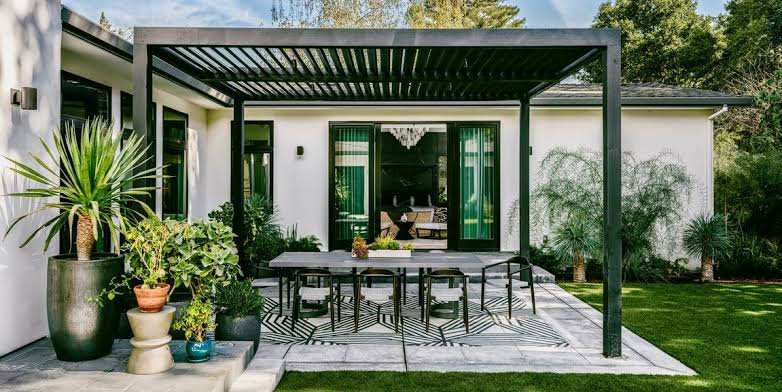
This is the one to get right, because it’s the one you can’t fix later without ripping everything out.
Undersizing is the default mistake, and it happens because empty space lies to you. Real numbers help. A dining setup for six needs roughly 12 by 12 feet as a floor, and that’s just the table and chairs. It doesn’t count the room a person needs to push their chair back and stand up, and it definitely doesn’t count anyone walking past while people are seated. Add circulation and you’re realistically wanting more like 14 by 16 before it stops feeling tight.
The fix isn’t just “make it bigger,” it’s zoning. A patio built for entertaining should have distinct areas that do distinct jobs. A cooking zone near the kitchen door so you’re not hauling food across the yard. A dining zone with real clearance. A lounge or fire zone set slightly apart so the people relaxing aren’t in the traffic lane between the grill and the table. When those zones are defined, even a busy patio flows. When it’s one big undifferentiated rectangle, everyone bottlenecks in the same three feet.
Design for the space at capacity, not at half-full. A patio that feels perfect with two people and dismal with ten was designed for the wrong night.
3. Picking a Surface That Fits the Job
Material choice touches everything downstream, looks, upkeep, how long it lasts, and for commercial spaces, whether it’s even legal.
| Surface | Best for | The catch |
|---|---|---|
| Natural stone (bluestone, travertine) | High-end look, homeowners who want character | Premium cost, some stone needs sealing and can etch |
| Concrete pavers | Most versatile, mimics stone/brick/wood well | Mid-range cost, quality of install matters a lot |
| Stamped concrete | Tight budgets, large areas | Cracks over time, and a crack in stamped concrete is hard to fix invisibly |
| Porcelain pavers | Modern look, low water absorption, heavy use | Less forgiving install, needs a skilled crew |
For a business there’s a whole second layer to this. Slip resistance isn’t optional when the public walks on it wet. ADA compliance dictates smooth transitions and specific slopes. And commercial foot traffic chews through surfaces that would last decades in a backyard. A material that’s perfect for a family patio can be a liability outside a restaurant, which is a distinction homeowner-focused advice tends to skip entirely.
4. Where the Patio Meets Everything Else

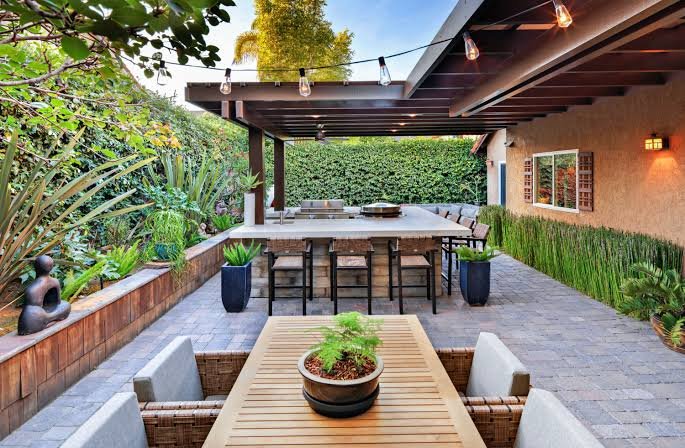
A patio that ends in a hard line at the edge of the stone always looks like it was installed, never like it belongs. The good ones bleed into their surroundings.
That means soft edges where pavers step down into a planting bed or lawn, pathways that connect the patio to the rest of the yard instead of stranding it, and a relationship to whatever else is out there, a fire feature, water, a pergola. The eye should travel from house to patio to garden without hitting a wall.
Lighting is the piece that quietly doubles your usable hours.
Low-voltage fixtures along the paths, small recessed lights in step risers so nobody misses a step in the dark, and softer overhead light in any covered zone. Get it right and the patio pulls people outside after sunset instead of emptying the moment the sun drops. Get it wrong, or skip it, and a beautiful patio simply stops existing at 8 p.m.
5. The Part You Pay a Pro For
Everything above is design. This is execution, and it’s where the money is actually won or lost.

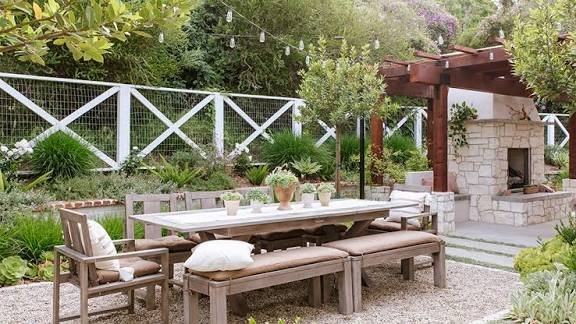
Under the surface sits the work you’ll never see and can’t easily judge from a quote: excavation to the right depth, a properly compacted base, edge restraint that keeps the whole field from spreading outward, and drainage graded to move water away from the house. That last one isn’t just about the patio. Water pushed the wrong way can end up against your foundation, which turns a patio problem into a house problem.
Good patio contractors know that the lifespan of the finished surface is decided down there, in the boring layers nobody photographs. They also catch the design mistakes before they’re permanent, the traffic flow that dead-ends, the zone that’s too tight, the material that won’t hold up to how you’ll actually use it. Paying for that judgment up front is a lot cheaper than paying to redo a patio that was wrong from the first day.
Where to Begin
Start with the honest question, not the aesthetic one. How many people, how often, doing what. Answer that and the size, the zones, and half the material decision fall out of it naturally.
From there, prioritize the install quality over the surface upgrade if you have to choose, because a mid-range material laid correctly outlasts a premium one laid badly every time. Build it around real use and real numbers, and the patio stops being the space you meant to enjoy and becomes the one you actually do.