


An orthodontic evaluation at age 7 is one of the few pediatric appointments that is frequently free, takes about twenty minutes, and produces information you cannot get any other way. What it produces is a measurement and a baseline, not a treatment plan, and the distinction between those two things is where most parents get confused and where a fair amount of money gets spent unnecessarily. The evidence sorts cleanly into three tiers. Strong support exists for treating protruding front teeth early, where randomized trials show risk of broken incisors dropping 33 to 41%. Timing driven support exists for crossbites and lost baby teeth, where the growth window genuinely closes. And there is no good evidence for routine early treatment of everything else, where trials found two phase treatment finishing exactly where one phase treatment finished. This piece walks all three tiers and what each one should mean for your kid.
The thing that made me start reading the actual research was being told the first evaluation was free. Free pediatric anything makes me suspicious, so I wanted to know what the practice got out of it and whether the visit was worth the drive. What I found is that the visit is genuinely worth it and that a chunk of what commonly follows it is not, which is a more useful answer than either the marketing or the skeptics offer.
What Twenty Minutes In That Chair Actually Produces

The recommendation to have a child seen by age 7 comes from the American Association of Orthodontists, and the timing has a specific rationale behind it. By that age the first permanent molars and the incisors have usually come in, so an orthodontist can finally read how the adult bite is developing, while the jaw is still growing enough that a few problems remain easy to influence.
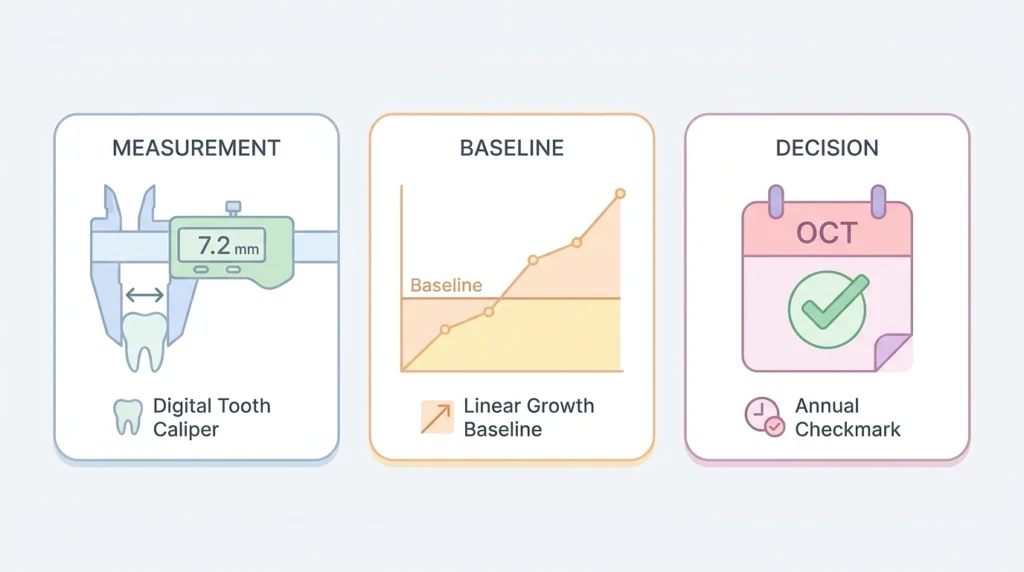
The visit produces three things.
- A measurement. How far the upper front teeth sit ahead of the lowers, whether the bite crosses anywhere, how much room the incoming teeth have.
- A baseline. A record of your child’s growth pattern that makes every later comparison meaningful.
- A decision, which for most seven year olds is to check again in a year.
The AAO recommends that initial screening by age 7, and the clinical literature reporting that recommendation notes in the same passage that evidence supporting routine early treatment remains limited. Those two facts belong together, though they almost never appear together in the same article.
So the honest framing is that the evaluation is information gathering. Whether anything gets done with the information depends entirely on what turns up, and for most kids the answer is nothing yet.
Tier One, Where The Evidence Is Strong Enough To Act On
There is one finding at that age with randomized controlled trial support behind acting early, and it is worth knowing by name.
If your child’s upper front teeth stick out well beyond the lower ones, that gap has a name, overjet, and it correlates with broken teeth. An overjet beyond 5 millimeters in children aged 7 to 14 carries more than double the risk of dental trauma. Teeth that lead the way arrive first at the pool deck, the pavement and the handlebars.
The Cochrane review pooling trials of early versus adolescent treatment found no significant difference on any outcome except new incisor trauma, which came out meaningfully lower in the children treated early.
| Approach | Effect on new incisor trauma |
|---|---|
| Early treatment, functional appliance | 33% risk reduction |
| Early treatment, headgear | 41% risk reduction |
| Headgear trial, raw counts | 24 injuries in 117 children treated early against 44 in 120 treated later |
Reading Those Numbers Honestly
Around 19% of the children who received early treatment still had some incisal trauma, so this moves odds rather than removing risk. The numbers needed to treat work out to roughly one injury prevented per 6 to 10 children treated, which lands very differently depending on how prominent your own child’s teeth are.
For a kid with a genuinely large overjet, that trade looks worthwhile. For a kid whose overjet is 3 millimeters, it does not, and the orthodontist should be telling you which situation you are in with an actual number rather than an impression.
Tier Two, Where Biology Sets The Deadline

The second group has less trial data behind it and a stronger anatomical argument, which is a different kind of justification and worth treating as such.
Crossbites And The Suture That Fuses
A posterior crossbite means the upper teeth are biting inside the lower ones, and it often comes with the child sliding the jaw sideways to find a workable bite without anyone noticing.
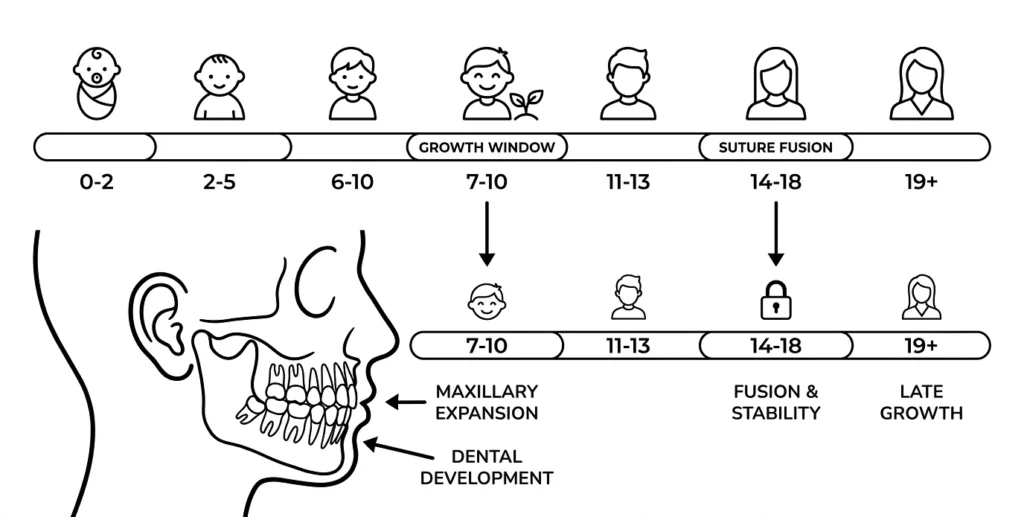
The seam running down the middle of the palate stays flexible through childhood and matures during the mid teens. Widen the upper jaw at eight with an expander and it is routine appliance work. Wait until that suture fuses and the same correction becomes slower, harder and occasionally surgical. This is the clearest case in the whole field where waiting genuinely costs more, so it is worth asking about directly if a crossbite gets mentioned.
Space That Closes On Its Own
When a baby molar comes out years ahead of schedule, the teeth on either side drift into the gap, and the permanent tooth underneath arrives to find its parking spot taken. A space maintainer holds the gap open and costs a fraction of what resolving the crowding later runs.
Same logic applies to thumb sucking continuing much past age four, where sustained pressure genuinely reshapes a bite that is still forming.
Tier Three, Where The Evidence Runs Out
Now the part that annoyed me most while reading, because it contradicts a lot of what gets said in consultation rooms.
Outside those specific findings, trials comparing early two phase treatment against a single phase in adolescence produced matching results. Same final overjet, same skeletal measures, same peer assessed scores. The review states that there appear to be no other advantages for providing treatment early compared with adolescent treatment.
The Class II literature adds detail worth having in your head. Early correction produces mostly dentist change rather than genuine skeletal change, whatever skeletal gain occurs tends to relapse unless reinforced during puberty, and treatment timed to the pubertal growth spurt achieves more mandibular advancement and holds it better. Which means a child who starts phase one at eight often lands in full braces at thirteen anyway, having spent five extra years wearing things to reach the same finish.
The Question That Sorts Tier One From Tier Three
When a plan gets handed to you for a second grader, one question does most of the work.
What specifically are we treating right now that becomes harder, riskier or more expensive if we wait two years?
A measured overjet, a crossbite with a functional shift, a molar space closing behind a lost baby tooth, those produce specific answers. Getting ahead of things does not, and an orthodontist worth paying will draw that line for you without being pushed to it.
What The Monitoring Visits Are Actually Doing
Most parents leave the first appointment with a recommendation to come back annually and read that as nothing happening. Something is happening, though.
Growth changes are easier to catch as changes than as snapshots. An orthodontist comparing this year against last year sees a crossbite developing, a space starting to close, or an eruption pattern going sideways, at the point where the fix is still small. Without the baseline, the same problem gets found later by whoever eventually looks, usually when it costs more to address.
Practically, that means:
- Keep the annual visits even when nothing is wrong, since the value is in the comparison.
- Ask each time what changed since last year, because that answer is the whole point of going.
- Ask for the overjet measurement in millimeters, so you can track it yourself.
Picking Someone To Do This
Experience with early intervention specifically matters more than a practice’s adult aligner volume, and digital scanning beats impression trays that kids fight about. Both of those are easy to check.
The real filter is different. Ask how often the practice recommends waiting. An orthodontist reading children individually says not yet fairly regularly. An office where every seven year old somehow qualifies for phase one is running a different calculation, and you can usually tell within one appointment which kind you are sitting in.
Will an early evaluation spare your child braces later on? Usually not, and anyone promising that has oversold it. What it buys is narrower and still worth the drive, a number on the overjet if there is one, a crossbite caught while the palate still cooperates, and a growth record that makes every decision after it better informed.
I ended up going to the free evaluation with a health and wellness amount of suspicion and left with a measurement, a monitoring schedule, and no treatment plan at all, which as far as I can tell is exactly what the evidence says should happen for most kids that age.