


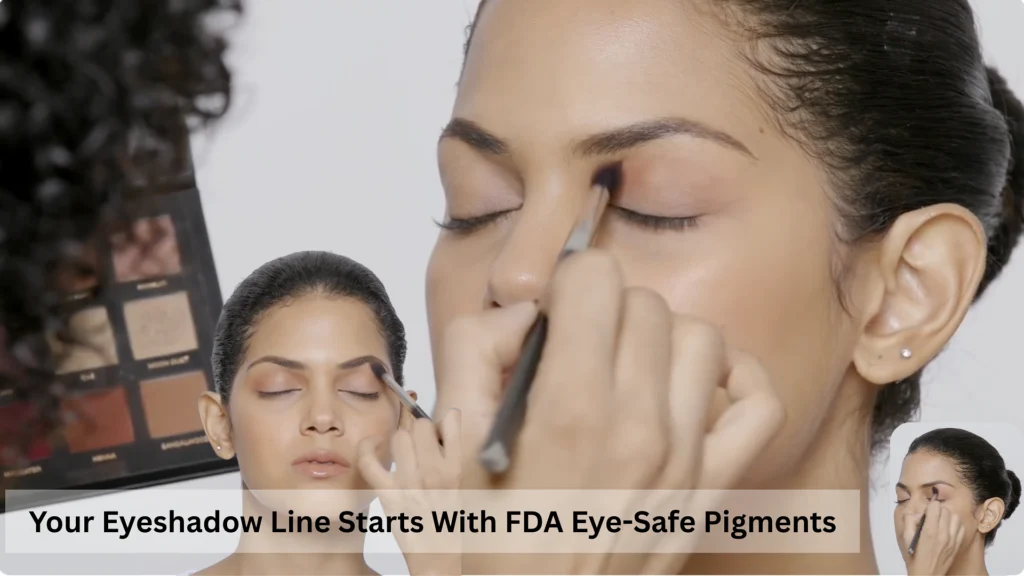
Ask a contract manufacturer for a sample palette and the shade card that comes back will have a pink on it you can’t legally sell. It’ll be beautiful. It’ll also be built on D&C Red No. 27 or one of its cousins, pigments the FDA lets you put on lips and nails but has never cleared for the skin around the eye. The lab isn’t trying to trick anybody. Their catalog serves lipstick brands too, and the shade card doesn’t know what you plan to do with it.
This is the part of launching an eyeshadow line that nobody puts on a mood board, and it comes before the brand name, the compact design or the first influencer mailer. You learn which colors are allowed near an eye, and then you make the manufacturer prove, in writing, that your formula uses only those.
An eyeshadow is legal to sell in the US only when each colorant in it has FDA approval for the eye area, and a good share of the pigments behind lipstick and nail polish shades don’t have it.
What The FDA Means By The Eye Area And Which Colors Can Go There
The FDA’s definition is wider than the lid. It takes in the whole zone inside the bony ridge above and below the eye, so the lids, the lashes, the brow bone down into the socket, and the eyeball itself. Approval for lips or face doesn’t transfer to this zone. A pigment with no approval anywhere, like the liquid crystal colors you’ll see offered for a color-shift finish, is out for cosmetics altogether.
The FDA publishes a table of color additives permitted in cosmetics with a column for the eye area, and you’ll end up knowing that column by heart. Two kinds of color pass it.
Minerals And Earth Pigments
These need no batch certification, and they’re what a neutral palette is mostly made of:
- Iron oxides for browns, rusts, blacks and warm neutrals.
- Titanium dioxide and zinc oxide for white and for lightening a shade.
- Mica, which gives shimmer and carries the coated pearl pigments.
- Ultramarines for blue, violet and pink.
- Chromium oxide greens and chromium hydroxide green.
- Ferric ferrocyanide and ferric ammonium ferrocyanide for deep blues.
- Manganese violet.
- Carmine, the red made from cochineal insects.
- Bismuth oxychloride, aluminum powder, bronze powder and copper powder for metallics.
Certified Synthetic Dyes

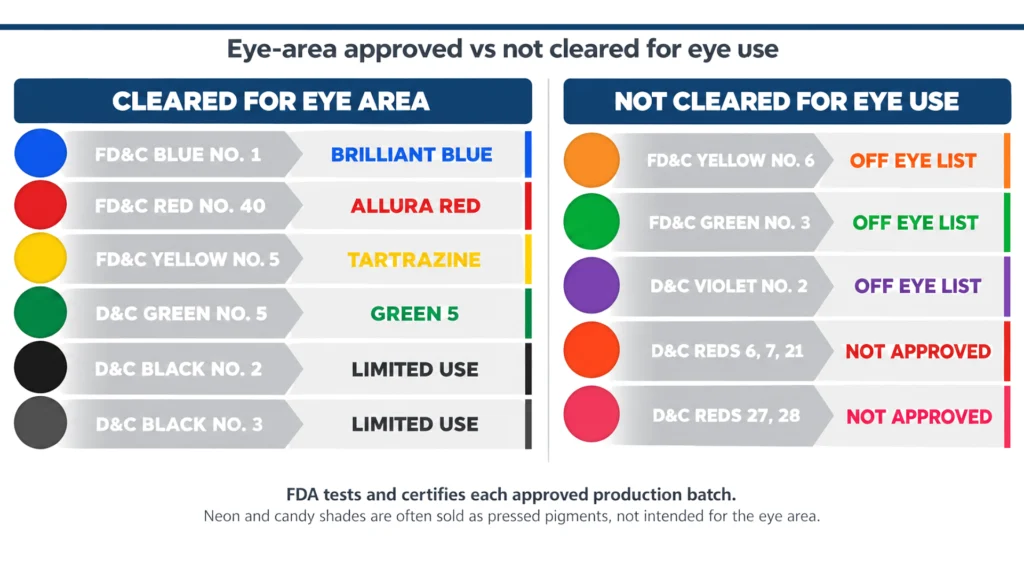
FD&C Blue No. 1, FD&C Red No. 40, FD&C Yellow No. 5 and D&C Green No. 5 are cleared for the eye, along with their aluminum lakes, and D&C Black No. 2 and No. 3 are cleared with limits. The FDA tests and certifies each production batch of these, so a supplier using them should have a certification lot number for your file.
What didn’t make the column tells you more than what did. FD&C Yellow No. 6, FD&C Green No. 3, D&C Violet No. 2, the oranges, and the long run of D&C Reds, 6, 7, 21, 27, 28 among them, are all off the eye list, and those happen to be the dyes behind neon and candy shades. US brands sell those shades anyway by printing “not intended for use in the eye area” on the pan and calling it a pressed pigment. Legal, yes, but it moves the risk onto whoever buys it, and a brand with no lawyer yet has no business starting there.
Why The Manufacturer’s Ingredient List Matters More Than Its Shade Card

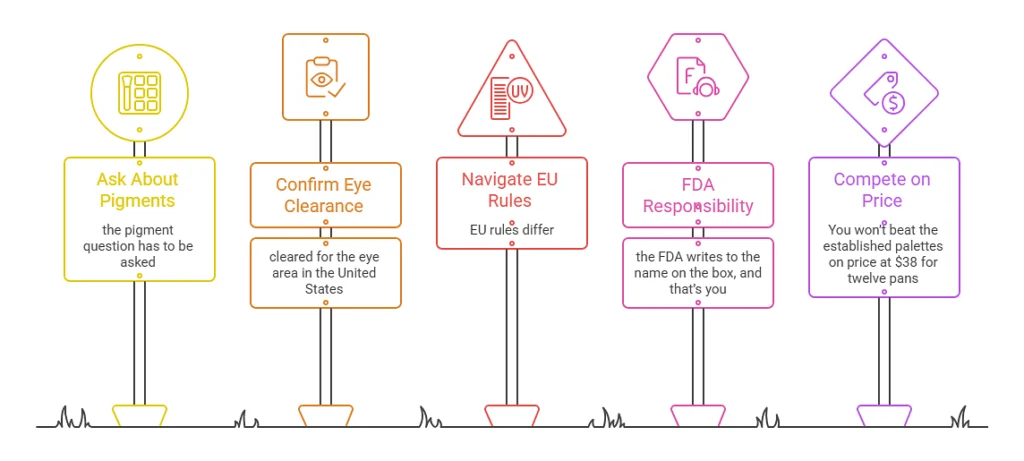
Hardly anyone mixes their own shadow. You pick a base formula from a contract lab’s catalog, choose the shades, put your name on the compact, and they press, fill and box it. Private label, in other words, and the suppliers run from small US labs to large Italian and French houses. M Plus Cosmetics is a fair example of the European kind: a family company in Inzago, east of Milan, that began with mascara more than 20 years ago and now offers private-label eyeshadow palettes along with liners, brow products and brushes. Prices and minimum orders aren’t posted; you get them from an area manager after a consultation. Most labs at that level work the same way, and that first conversation is where the pigment question has to be asked, because once a sample has been approved, the formula is yours.
In practice the first email asks for three things: a full ingredient list for each shade with each colorant under its FDA or INCI name, written confirmation that each one is cleared for the eye area in the United States, and certification lot numbers for any synthetic dye. A European lab will sometimes push back on the second point, since EU rules differ, allowing a few eye colors the US doesn’t and blocking a few it does. Their formula is legal where they are. Once it’s on a US shelf, though, the FDA writes to the name on the box, and that’s you. Apparel brands have the same experience with bamboo pajama production when a sample gets signed off on feel alone and the fiber content turns out to be something else.
All of this is happening in a category with money in it. Fortune Business Insights sizes global eye makeup at about $13.1 billion in 2025 and expects $23.1 billion by 2034, with Asia Pacific holding close to half of sales, mascara the biggest segment and eyeshadow growing at what the firm calls a considerable rate. For a new label that’s less a target than a warning. You won’t beat the established palettes on price at $38 for twelve pans, so the shade range has to be built for a particular face the big brands get wrong, and that choice, made early, is what settles your pigment list anyway.
Registration, Labels And The Exemption You Lose By Making Eye Products
Under the Modernization of Cosmetics Regulation Act, a cosmetics company registers its facility and lists its products with the FDA, and the smallest companies get an exemption from registration, listing and the good manufacturing practice rules. The FDA’s summary of the act takes that exemption away for products that regularly touch the mucous membrane of the eye. Mascara and eyeliner clearly do. Pressed shadow on the lid is arguable, but a brand that also sells a liner or a lash glue loses the exemption across the whole business, so budget for registering from the start rather than finding out later.
A brand that sells any product touching the eye’s mucous membrane, like liner or mascara, can’t rely on the MoCRA small business exemption, even for its eyeshadow.
Then the label. The FDA’s summary of labeling requirements wants the product’s identity, the net weight, your name and place of business, and the ingredient list in descending order by amount, with colorants permitted at the end in any order. If the compact ships in a paper sleeve, the ingredient list goes on the sleeve. Small brands slip on this more than on the pigments, usually because the designer laid out the sleeve before anyone had the final formula.
The Tests Nobody Posts About And Why They Come Before The Launch Party

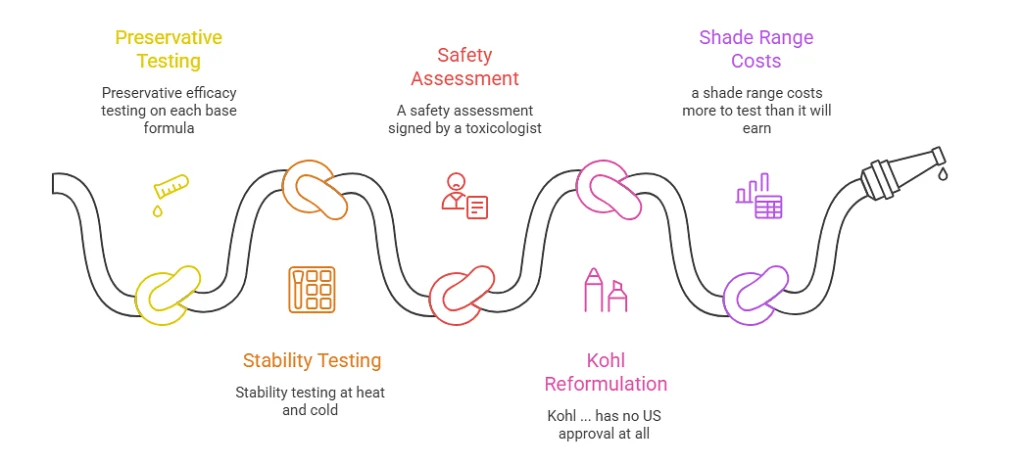
The FDA’s eye cosmetic safety page is aimed at shoppers, and it still reads like a to-do list for a founder. Products used near the eye need a preservative system that survives months of brushes and fingers, because bacteria from repeated use cause the infections that get a product pulled from shelves. Testers at a launch event need single-use applicators. Kohl, the traditional lead-based liner, has no US approval at all, so a line built on a heritage look has to be reformulated before it’s sold here.
- Preservative efficacy testing on each base formula, a few hundred dollars per formula.
- Stability testing at heat and cold, so a shimmer doesn’t sweat oil in a hot mailbox.
- A safety assessment signed by a toxicologist.
Those three line items go into the cost sheet for each palette before packaging, freight or the first influencer box. Treating each palette as its own job with its own margin, the way project accounting does it, shows early when a shade range costs more to test than it will earn, and it’s a lot cheaper to drop a shade in a spreadsheet than from a warehouse.
The First Palette Mistake Shows Up On Deep Skin And Oily Lids
Twelve shades that look distinct on a fair inner arm can collapse into three on medium and deep skin. Iron oxide neutrals go flat, ultramarine pinks go chalky. Oily lids crease a soft shadow by lunchtime, and the people with oily lids are often the people dealing with enlarged pores elsewhere on the face, so a swatch test means real people, a range of skin tones, and a full day of wear rather than a stripe on paper. A palette made for one group, and made well, sells better than one that tries to please everybody.
Keep a folder per shade with the colorant list, the manufacturer’s certificates and the label proofs in it. A retailer, a marketplace or an FDA inspector will ask one day what’s in the product and why it’s allowed near the eye, and the folder answers that for you.