


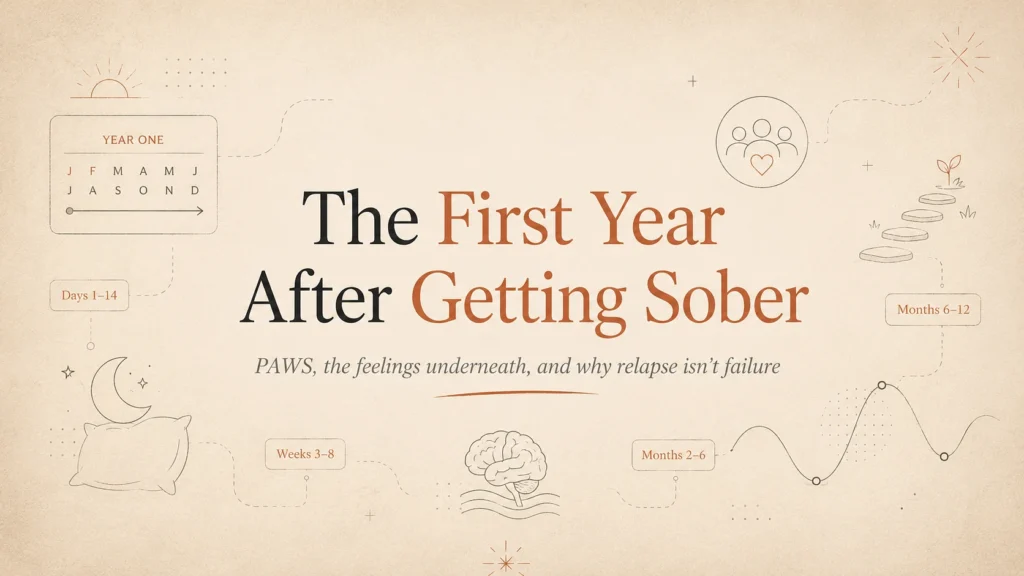
| Roughly when | What a lot of people report | What’s usually happening |
|---|---|---|
| Days 1 to 14 | The physical health part. Shaking, sweating, sleeplessness, and for alcohol and benzodiazepines, genuine medical danger without supervision | Acute withdrawal |
| Weeks 3 to 8 | The “why do I feel worse now” stretch. Flat mood, no motivation, sleep still wrecked | The pink cloud fading, protracted symptoms starting |
| Months 2 to 6 | Waves. Three good days, then a day that feels like week one. Irritability, brain fog, cravings out of nowhere | Post-acute withdrawal, and the majority of relapses land here |
| Months 6 to 12 | Longer stretches of steady, punctuated by ambushes. Grief and anger showing up about things you thought were settled | Emotions coming back online |
That table is an average of averages, and almost nobody moves through it on schedule. Some people feel decent at month two and get hit hard at month seven. Some substances, particularly benzodiazepines and alcohol, drag the timeline out considerably longer. But the shape of it is worth seeing on paper before you’re inside it, because the single most demoralizing thing about early sobriety is the part nobody warns you about: it often gets harder before it gets easier, and people read that as evidence they’re failing at recovery when it’s actually evidence their brain is doing exactly what recovering brains do.
Post-Acute Withdrawal Is Real, And The Science On It Is Genuinely Unfinished

Here’s where I’ll be straight with you rather than tidy, because you’ll find a hundred articles insisting PAWS is a well-defined medical syndrome with a clean timeline, and that’s not quite true.
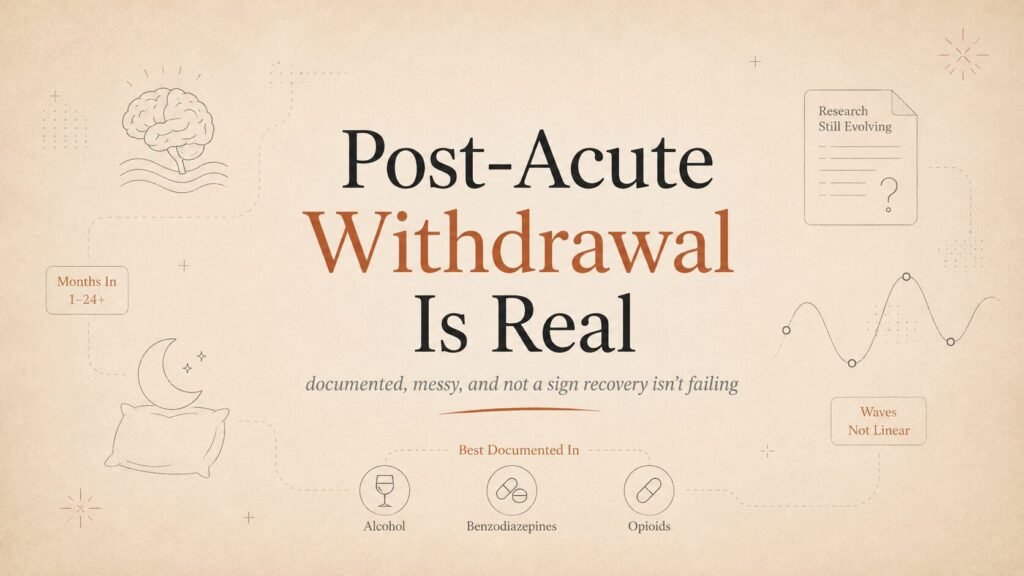
Post-acute withdrawal syndrome describes the cluster that follows detox mood swings, anxiety, depression, foggy thinking, exhausting sleep problems, low tolerance for stress, cravings that arrive without a trigger, and anhedonia, the inability to feel pleasure from things that used to deliver it. It’s psychology where acute withdrawal was physical, and it comes in waves rather than a steady decline.
The complication is that PAWS is not recognized as a disorder in the DSM-5, and no clinical practice guidelines for treating it exist. That objection goes back decades. Researchers argued against including protracted withdrawal in earlier DSM editions, not because the symptoms weren’t consistently described, but because the studies had methodological limits and nobody could agree on a definition of the term itself.
So what does hold up? Protracted withdrawal from alcohol is well documented, with sleep disturbance in particular measurable well past the one-year mark in sleep-lab studies. Benzodiazepine discontinuation produces some of the longest and most severe protracted symptoms clinicians see. Opioid-related protracted symptoms center on persistent depression, anxiety, and anhedonia. Beyond those three, the evidence thins out fast and leans heavily on clinical observation rather than controlled research.
Why does this distinction matter to someone living it? Because “PAWS lasts two years” gets repeated as a fact, and it’s a lot closer to an estimate. If your fog lifts at month four, you’re not doing it wrong. If it’s still around at month eighteen, you’re not broken either. And the practical takeaway survives the scientific messiness completely intact: feeling bad months into sobriety is common, documented, and not a sign the sobriety isn’t working.
The Feelings Underneath, Which Is The Part The Timeline Can’t Chart
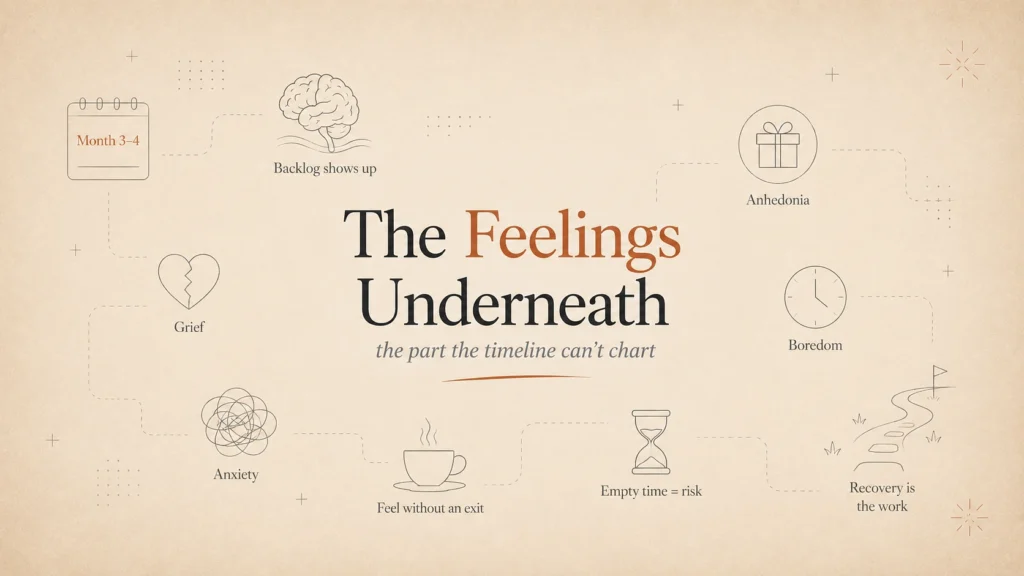
Something happens around month three or four that catches almost everyone off guard. The substance stops being the problem, and whatever the substance was covering shows up.
Think about what heavy drinking or using actually does functionally. It’s an off switch. Anxiety, grief, rage, boredom, shame, social terror, the memory you don’t visit, all of it gets turned down on demand. Take away the switch, and every one of those arrives at full volume, often about things you assumed were long resolved. People describe crying about a breakup from six years ago, or being furious at a parent who died, or feeling social anxiety so raw they can’t order coffee. That isn’t relapse-adjacent weakness. That’s the backlog.
Two specific ones deserve naming because they blindside people:
- Anhedonia. Nothing is enjoyable. Not food, not music, not sex, not your kids’ company. The brain’s reward system spent a long time being flooded and it recalibrates slowly. This one is brutal precisely because it removes the payoff you were promised for getting sober, and it does lift, though on its own schedule.
- Boredom. Underrated as a relapse driver and almost never taken seriously. Using structures a day. Remove it, and you’re left with enormous unmapped hours, which is why the unglamorous advice about routines, jobs, meetings, and hobbies isn’t filler. Empty time is the risk.
The counterintuitive part is that this stretch, awful as it is, is where the actual work happens. Sobriety isn’t the removal of a substance. It’s building the capacity to feel things without an exit, and that’s built by feeling them, which is exactly as fun as it sounds and exactly as necessary.
Relapse Isn’t Failure, And Here’s The Case For That Beyond Reassurance
This gets said constantly by people trying to be kind. The reason to believe it is the data.
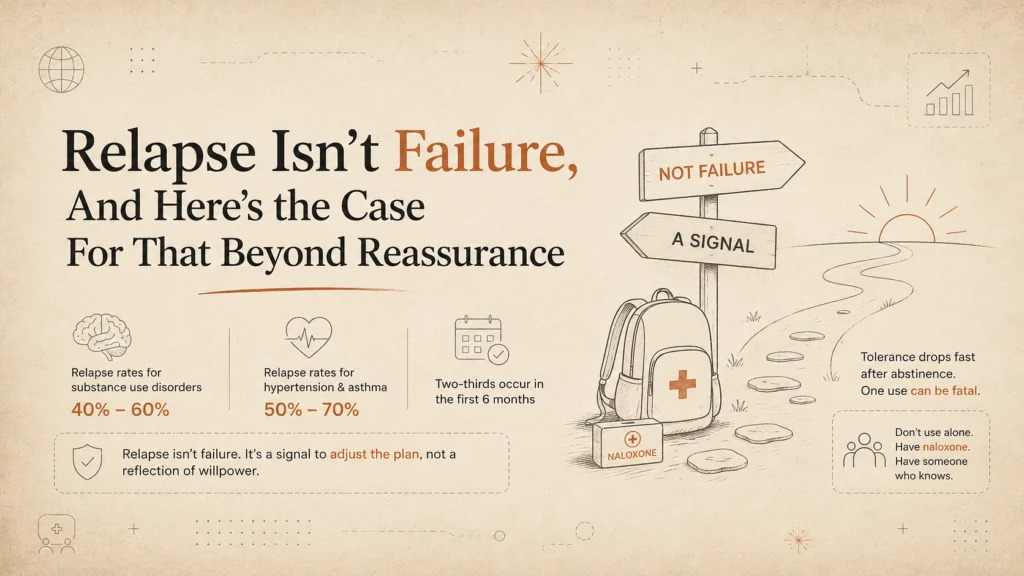
The National Institute on Drug Abuse puts relapse rates for substance use disorders at 40% to 60%, and the comparison that matters is what sits next to it relapse rates for hypertension and asthma run 50% to 70%. Nobody says a person with asthma failed at asthma when they need their treatment adjusted. The clinical meaning of a return to use is the same, that the treatment plan needs revisiting, not that the person lacked willpower. Timing follows a pattern too, with roughly two-thirds of relapses occurring in the first six months, which maps almost exactly onto the hardest stretch of the timeline at the top of this page. Risk drops substantially with sustained time, falling to well under 15% after five years.
Underneath the statistics, though, is where I’d push back on the soft version of this message. “Relapse isn’t failure” is true and it is not the same as “relapse doesn’t matter.”
One thing has to be said plainly, because it saves lives. After a period of abstinence, tolerance drops fast. A dose that was routine during active use can be fatal after weeks or months clean, and this is the mechanism behind a large share of overdose deaths following treatment, incarceration, or hospitalization. If someone in early recovery returns to use, that first time carries a genuinely elevated risk of death. Anyone with opioid history should have naloxone accessible and someone who knows about it, and nobody in that position should use alone. Treating relapse as a normal part of a chronic condition and taking that risk seriously are not in conflict. They’re the same realism.
What Actually Helps, Based On What Holds Up
No secret here, and the honest list is shorter and duller than the wellness industry would like:
- Medication, where it applies. For opioid and alcohol use disorder, medication treatment has the strongest outcome evidence available, and it is chronically underused. This is a prescriber conversation, and it’s the highest-leverage one available.
- Structure. Sleep, food, work, appointments. Boring, and it directly attacks the empty-time problem.
- People who’ve done it. Peer support has real evidence behind it, and it also solves the isolation that early sobriety produces on its own.
- Treating what’s underneath. Depression, anxiety, trauma, and ADHD are enormously common alongside substance use disorders, and leaving them untreated is leaving the reason in place.
- Time. Not inspirational, just accurate. Brain recovery is measured in months and years, and the impatience is the hardest symptom of all.