


Postmortem Of An Average Goal
Date of birth: January 1. Date of death: the second Friday in January, statistically. Cause of death listed on the certificate: lack of willpower. Actual cause of death: no plan for the first Tuesday it rained.
So if you stop reading here you have the useful part. Goals do not usually die of weak character. They die at a specific moment, on a specific obstacle, that nobody decided anything about in advance, and the research on fixing that is far better than the research on motivating yourself harder.
The Failure Timeline Is Documented, And It Is Faster Than People Admit

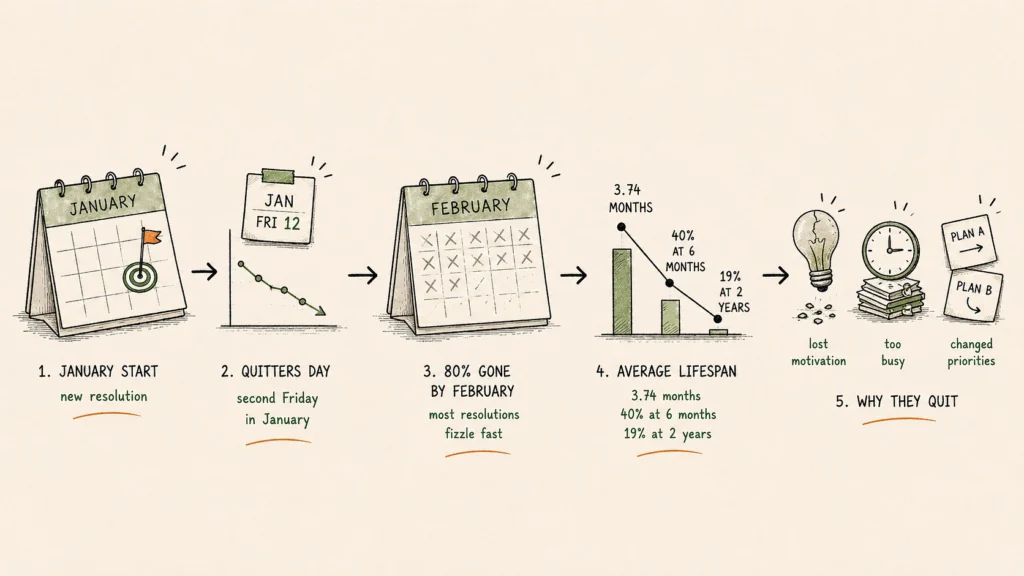
Strava analyzed hundreds of millions of logged user activities and identified a reliable annual pattern, the second Friday in January, when abandonment spikes hard enough that they gave it a name, Quitters Day. By February, roughly 80% of resolutions are gone. A Forbes Health and OnePoll survey of a thousand adults put the average lifespan of a resolution at 3.74 months, with only about 6% surviving past a year.
The older academic work is a little kinder and still sobering. John Norcross, who has studied resolutions since the 1980s, found about 40 percent of his volunteers still holding on at six months, dropping to 19 percent at two years.
Now the number that reframes everything, and it comes from asking people why they quit rather than counting how many did. When surveyed, 35% blamed lost motivation, 19 percent said they were too busy, and 18 percent had changed priorities.
Look at what tops that list. Not failure. Not difficulty. The absence of a feeling, which is the least reliable thing a person owns.
The Intention Behavior Gap Is The Actual Problem, And It Has A Measured Size
Definition, since the whole system rests on it: the intention behavior gap is the distance between deciding to do something and actually doing it. It is not laziness. It is a documented and quantified feature of how humans work.
Webb and Sheeran measured it directly. A medium to large improvement in someone’s intention, d equals 0.66, produced only a small to medium change in their actual behavior, d equals 0.36. Roughly half the intention evaporates on the way to the body.
So every January, millions of people work on the wrong variable. They pump up the intention, the vision board, the motivating video, the ambitious number written in a new notebook, and intention was never the bottleneck. Wanting it more does not close a gap that exists after the wanting.
What does close it?
If Then Plans Are The System, And The Effect Size Is Unusually Strong For Behavioral Research


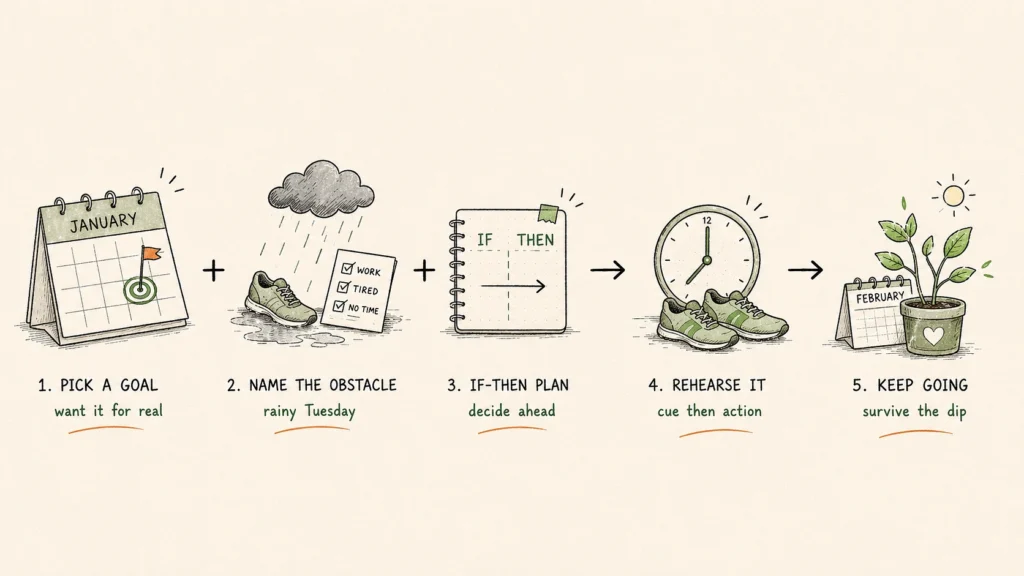
The technique is called an implementation intention, and it is almost annoyingly simple. Instead of stating the goal, you specify the situation and the response in advance. If situation Y happens, then I will do X.
Not “I will exercise more.” Instead: if it is Tuesday at 6 p.m., then I put on my shoes and walk out the door before checking my phone.
Peter Gollwitzer and Paschal Sheeran’s meta-analysis of 94 independent tests found forming these plans had a medium to large effect on goal attainment, d equals 0.65. The subtler finding is the one I find genuinely exciting, because it targets exactly the death described in the postmortem above. Implementation intentions had an effect of d equals 0.77 on preventing derailment, meaning they work best not at starting things but at surviving the moment things go wrong.
And the evidence base got bigger rather than smaller, which does not happen often in psychology students. A 2024 meta-analysis by Sheeran, Listrom, and Gollwitzer aggregated 642 independent tests and found the technique effective across cognitive, affective, and behavioral outcomes, with effects ranging from d equals 0.27 to 0.66 depending on how the plan was made.
Three Conditions Decide Whether Your If Then Plan Works
That range is not noise. The 642 test analysis identified what moves a plan toward the strong end.
- The plan uses a genuine contingent format. If X, then Y. A vague schedule is not an implementation intention, and writing “exercise Tuesdays” in a planner does not qualify.
- You actually want the goal. These plans amplify motivation, they do not manufacture it, and a plan attached to a goal you feel nothing about will do very little.
- The plan gets rehearsed at least once. Mentally running through the cue and the response beats writing it down and closing the notebook.
Plan For The Obstacle, Not Only For The Action
Most people, told to write an if then plan, write the happy path. If it is Monday morning, then I go to the gym. Fine, and incomplete, because Monday morning was never the problem.
Gollwitzer’s own guidance is to start by identifying the self regulatory problem, meaning the thing that actually stops you. Then write the plan against that. If it is raining and I do not want to go, then I do ten minutes indoors instead. If I get home past eight, then tomorrow becomes the session and I do not count it as failure. If someone offers me a drink at the office thing, then I say I am driving.
Chase Something Rather Than Avoid Something, Because The Framing Changes Outcomes
One more finding worth building into whatever you set, and it is more actionable than it first sounds.
A large scale experiment on New Year’s resolutions compared approach oriented goals, meaning goals framed around what you will do, against avoidance oriented goals framed around what you will stop. The approach framing produced meaningfully better success rates.
Same underlying aim, two framings, different survival odds:
- Avoidance: stop eating junk. Approach: cook dinner four nights a week.
- Avoidance: stop wasting evenings on my phone. Approach: read twenty pages before bed.
- Avoidance: quit being disorganized. Approach: clear the desk every Friday at five.
There is a mechanical reason the right column outperforms. Approach goals tell you what to do at the moment of decision, which means they can be written as if then plans, and avoidance goals leave a vacuum where a behavior should be. It is difficult to schedule an absence.
So the system, in full, fits in a paragraph. Pick something you actually want, frame it as an action rather than a prohibition, name the two or three obstacles that will genuinely show up, and write a specific if then response for each one before January ends. Then rehearse them once. That is not inspiring, and honestly the unglamorous quality is the point, because motivation was the variable that failed 35% of people and a decision made in advance is still sitting there on the rainy Tuesday when the feeling is long gone.