


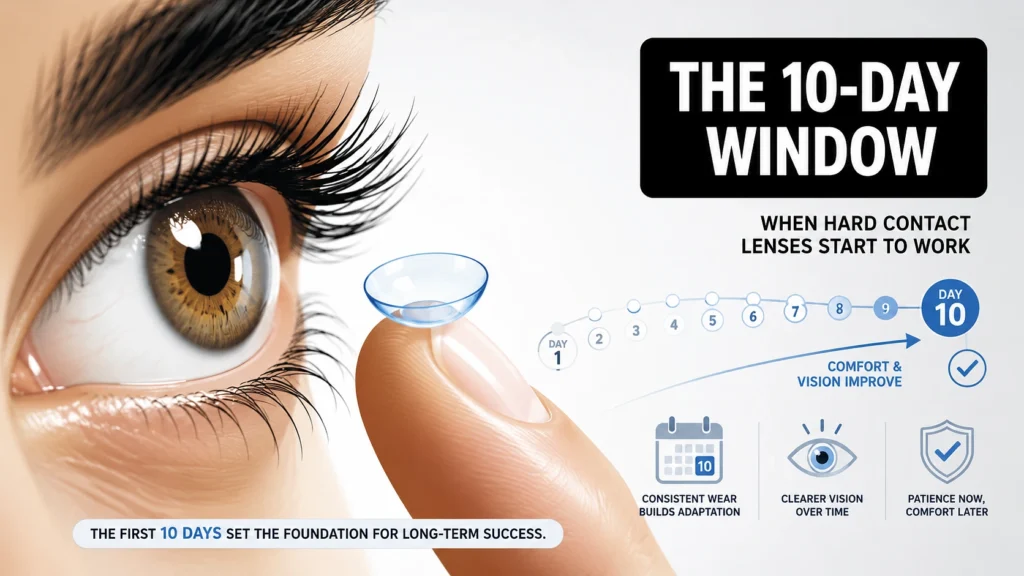
How bad your first day in rigid lenses feels tells you almost nothing about whether you will still be wearing them next year.
What predicts that is a comparison. How they felt on day one, against how they feel on day ten. The direction between those two points is what matters, and it has been measured.
People Who Quit Rigid Lenses Were Less Comfortable
A study in Eye & Contact Lens tracked new rigid gas permeable wearers through their first month, with checks at 1, 7, 15 and 28 days.
Twenty-two started. Six quit from discomfort inside the month, a 27% dropout rate. The sixteen who stayed reported high comfort and were wearing their lenses 10.12 hours a day on average by week four.
The ones who quit did so after the first 10 to 15 days. By then their comfort scores and wearing times had fallen below where they were on day one.
Not below the successful group. Below their own starting point.
Adaptation that is working means the lens bothers you less each week. When it fails, the line runs the other way, and it starts running the other way early enough to catch.
Schirmer And Tear Break-Up Tests Split The Two Groups Inside The Same Ten Days

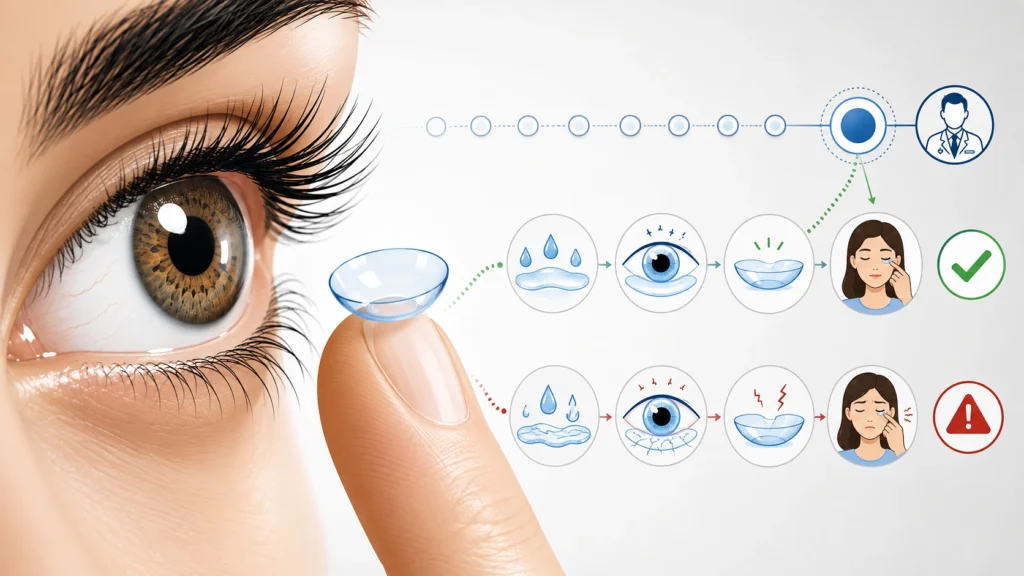
The researchers measured tears as well as opinions, and the numbers tracked the same divide.
- Schirmer results rose significantly at 10 days, p less than 0.001, showing reflex tearing as the eyeshadow line reacted to the lens.
- Tear break-up time fell after week one in the unsuccessful group only. Their tear film was destabilizing while the successful group’s stayed intact.
The authors concluded that dryness and discomfort symptoms in those first 10 days may let a clinician predict who will fail to adapt.
Most of contact lens fitting is trial and adjustment. An early measurable signal that forecasts a later outcome is rare, which is why day ten deserves a booked appointment rather than “call us if there’s a problem.”
Adaptation Takes One to Four Weeks Because Your Eyelid Adjusts, Not Your Cornea
Practices report different windows and the spread is genuine:
- One to two weeks at many practices.
- Two to four weeks of consistent wear at others.
- Up to a month for a minority.
Soft lenses are usually comfortable within days, sometimes minutes. The difference is mechanical. A rigid lens has an edge, and the thing that has to change is your eyelid learning to pass over that edge without setting off a blink reflex.
That is also why the next section is the most practical instruction in this whole subject.
Skipping Days During Adaptation Loses Ground Your Eyelids Already Gained
Wear them daily. Not most days.
An incremental schedule starts at a few hours and builds, and the mechanism runs on repetition. Take three days off in week one and your lids go backwards. Patients who follow a formal incremental schedule show significantly higher long-term success than those who wing it.
Most fitters book a progress check at one week, using a slit lamp to look for corneal staining and early neovascularization before clearing you for longer wear. Go, whether things feel good or bad.
Rewetting drops help during the day and using them is not a sign you are failing.
Dropout Was Zero Out Of 13 When the Fitter Presented The Lenses Positively

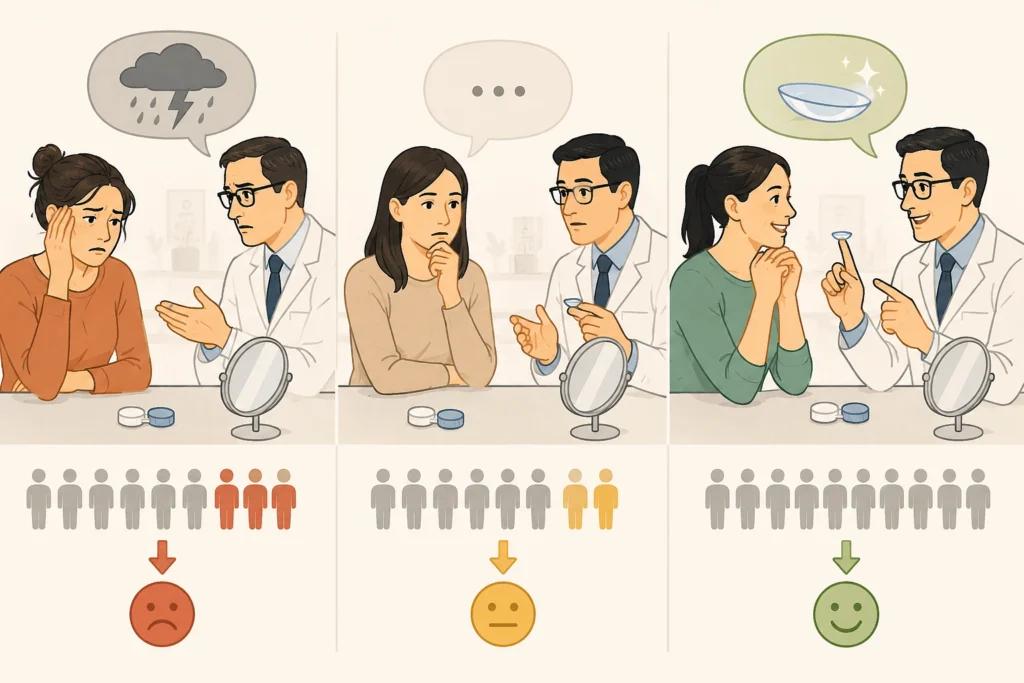
Researchers compared three wayO of introducing RGP lenses to new wearers. The dropout numbers:
- Fear-arousing, unenthusiastic: 6 out of 19 quit.
- Neutral content, unenthusiastic: 2 out of 17.
- Neutral content, enthusiastic: 0 out of 13.
Compliance differed significantly too, best in the neutral-and-enthusiastic group. The conclusion was that presenting the process with genuine interest and a positive, realistic attitude makes patients more likely to succeed through the critical early period.
Talk cannot make eye doctor comfortable. What it can do is change whether someone rides out a rough week nine, and a fitter who dwells on how hard this will be is working against you.
If rigid lenses seem to be something your practice offers reluctantly, find one that fits a lot of them.
Rigid Lenses Give Sharper Vision And Are Often The Only Option for Keratoconus
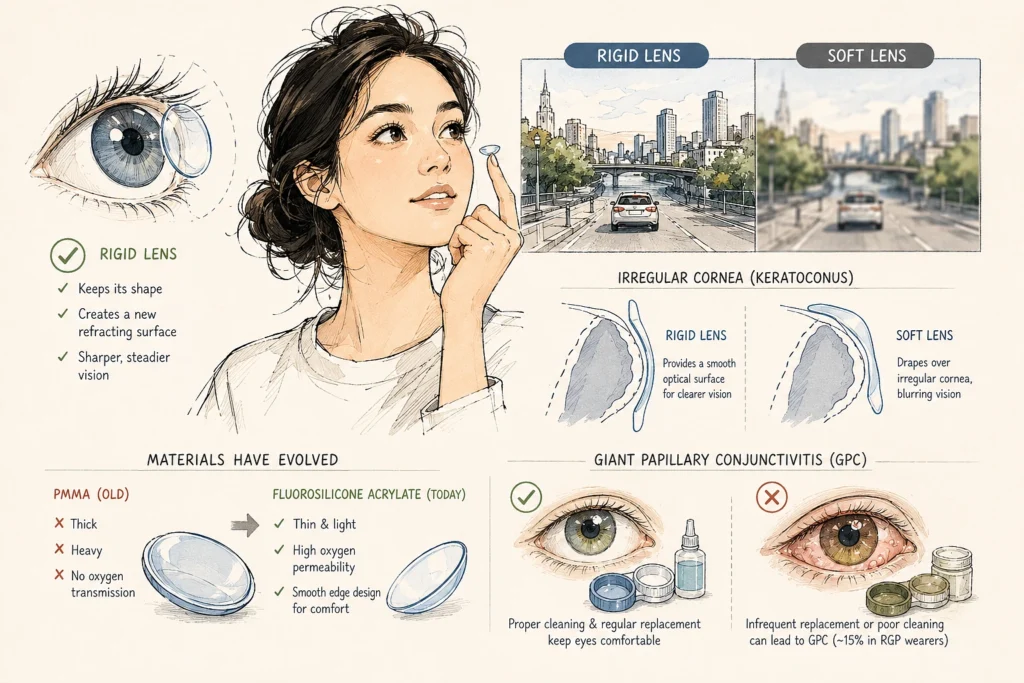
A rigid lens keeps its shape instead of draping over the cornea, so the lens becomes the refracting surface. For most people that means sharper, steadier vision than soft lenses, and it does not drift through the day because the lens cannot dehydrate.
On irregular corneas, keratoconus included, rigid or specialty lenses are frequently the only lenses that deliver usable vision at all.
Materials have moved on too. The hard lenses people remember as unbearable were PMMA, which transmitted no oxygen at all. Current fluorosilicone acrylate lenses are thinner, lighter, far more permeable, and shaped with edge profiles designed to reduce lid friction.
Giant papillary conjunctivitis runs around 15% in rigid lens wearers, lower than in soft lens wearers, and it usually traces to infrequent replacement or poor cleaning rather than to the lens itself.
Pain, Worsening Redness or One-Eye Symptoms
Lens awareness, mild watering and feeling the edge on a blink should all ease week by week.
Actual pain, redness that is getting worse, vision that blurs more rather than less, or any of these in one eye only, means take the lens out and contact your eye care provider.
Those are not the adaptation curve. They point at fit problems, damage, deposits, a lens in inside-out or on the wrong eye, or infection, and none of that gets better by being tolerated.
Nothing here replaces the optometrist or Ophthalmologist who fitted you and can examine your cornea under magnification. What the research gives you is one fair question for the ten day visit: are these better or worse than they were on day one? Your honest answer is among the better predictors available.