


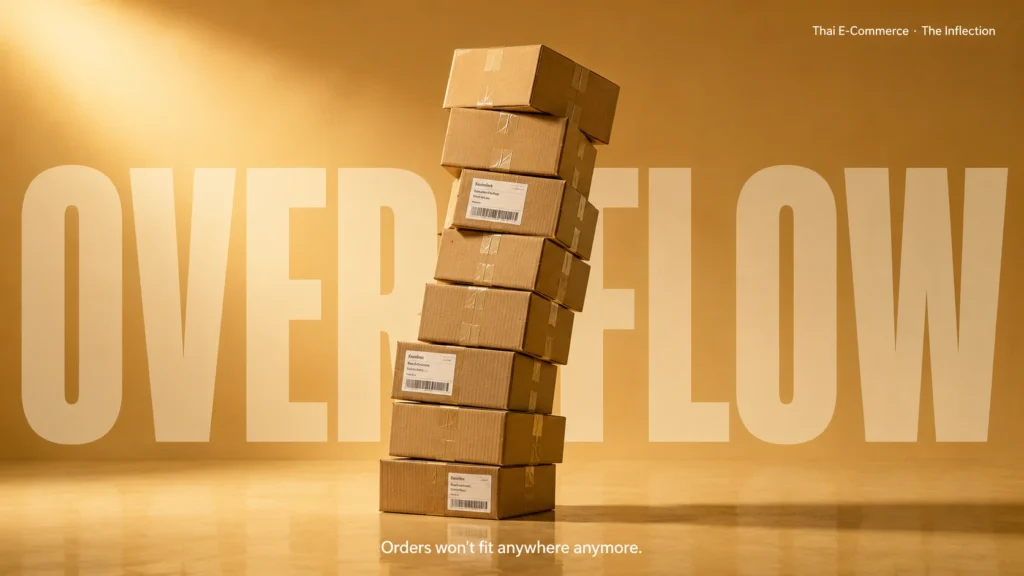
There’s a moment that hits every successful Thai e-commerce brand at some point, usually somewhere between two and four years in. The Shopee orders that used to fit in a spare room start spilling into the hallway. The Lazada Live promo that did well last month did three times as well this month, and the team is hand-packing boxes at midnight to meet the next-day fulfilment SLA. Someone walks into the office and says the sentence that every founder dreads. “We need a real warehouse.”
The decision that gets made in the next two weeks shapes the next three years of the business.
Get it right and the company keeps growing without breaking. Get it wrong and you’re locked into a fixed cost that doesn’t flex when the market does, which in Thai e-commerce, where category trends shift on a quarterly basis and platform algorithms change without warning, is the single most common reason fast-growing brands stall.
I’ve watched a few brands go through this transition. The ones that handled it well had something in common that most articles about warehousing don’t talk about.
The Problem Isn’t Storage. It’s Optionality.

When founders frame the warehouse question, they almost always frame it as a storage problem. How much square metreage do we need, where should it be, how do we equip it. Those are real questions, but they’re the second order questions. The first order question is different.
The first order question is: what does our business look like in 18 months, and how confident are we in that picture?
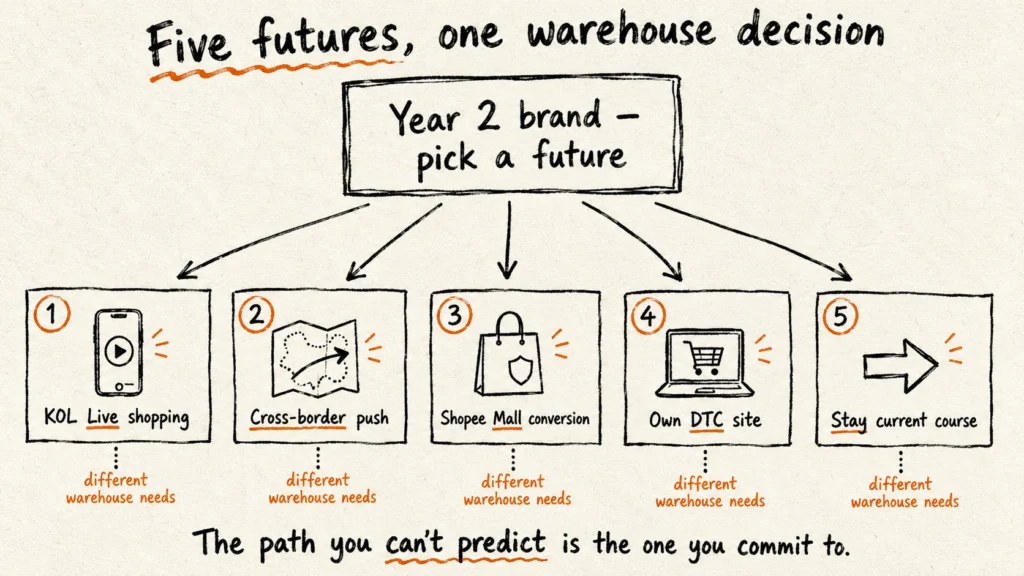
Most Thai e-commerce brands at the inflection point cannot honestly answer that. They might be riding a category that’s hot right now (skincare, supplements, mom-and-baby, men’s grooming, pet products have all had their moments in the past three years on Shopee and Lazada). They might have a strong Live shopping presence that depends on one or two specific KOLs. They might be experimenting with cross-border into Malaysia or the Philippines. They might be looking at Shopee Mall conversion or starting their own DTC site. Each of those paths changes the warehouse equation significantly.
A brand that signs a five-year lease on 1,500 square metres in Bang Na, kits it out with permanent racking, hires a team, and gets the operations dialled in for their current SKU mix is making a five-year commitment based on a current picture that almost certainly won’t be accurate in 18 months. When the picture shifts, and it always shifts, the fixed costs don’t move with it.
This is the version of the warehouse mistake that kills more growing Thai brands than the more obvious mistake of waiting too long to scale up.
What Actually Works at the 5,000 to 50,000 Orders a Month Stage

The brands that get this right tend to follow a similar pattern, even if they didn’t plan it that way.
In the early growth phase, when you’re doing somewhere between 5,000 and 50,000 orders a month, the goal is to buy capacity without buying commitment. Rented warehouse space, ideally in a facility that’s set up for multi-tenant flexible usage, is the answer. Not because it’s cheaper in pure rent-per-square-metre terms, because often it isn’t. It’s the answer because it preserves your ability to change your mind.
The specific things that matter at this stage:
- The ability to scale up and down within the same facility. Going from 200 square metres to 500 should be a contract change, not a relocation. Going from 500 back to 300 should also be possible if a category underperforms.
- Location that works for both inbound (from your suppliers, often China via Laem Chabang) and outbound (to the courier hubs that pick up daily for Shopee, Lazada, and Kerry). Eastern Seaboard or outer Bangkok properties tend to thread this needle better than central Bangkok ones.
- Loading and unloading that can handle your peak day, not your average day. Mega Sales weeks (9.9, 11.11, 12.12) compress two weeks of normal volume into 48 hours. If your warehouse can’t handle that pace, you’re paying overtime and renting trucks to compensate.
- Operational support if you’re not running your own team yet. Some Thai logistics parks offer in-house labour pools, fork-lift services, and basic 3PL functions that let a small team punch above their weight.
Brands that find this kind of setup tend to find it not by searching for “warehouse for rent” generically, but by looking specifically for industrial parks and logistics facilities that have built their offering around the flexibility that growing brands need. The Thai property market has matured into this gap over the past few years. Facilities offering ให้เช่าโกดัง with proper SME-focused terms are no longer rare in the way they were a decade ago, and the better ones combine industrial-zone access, flexible contract terms, and the kind of operational infrastructure that lets a brand scale without rebuilding their logistics every year.
The Mistake That Burns Founders
The mistake I’ve watched the most often is the one where a founder, flush from a successful campaign or a funding round, decides to “do it properly” and signs a long-term lease on a large permanent facility before the business has stabilised at a scale that justifies it.
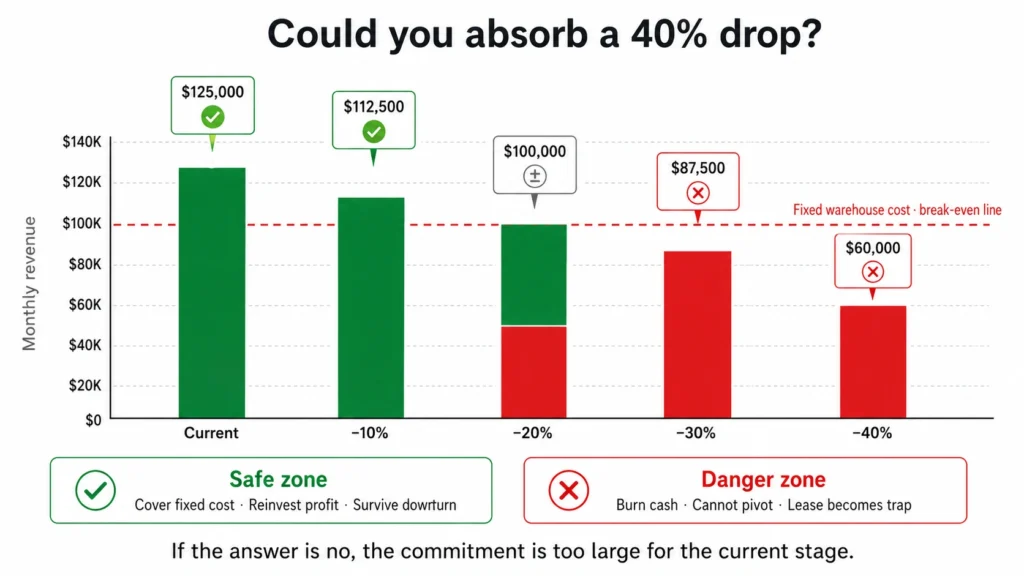
What happens next is predictable. The category cools. A competitor enters. The platform changes its algorithm. The KOL who drives 30% of sales moves to a different brand. Whatever the trigger, demand drops 20 to 40% over a quarter or two, and the warehouse is suddenly half empty and entirely paid for. Now the founder is in the worst possible position. They can’t easily unwind the lease. They can’t sublet without complications. They can’t pivot the business model because the fixed cost structure won’t let them.
The brands that survive this kind of demand shock are almost always the ones that kept their warehouse arrangement flexible enough to shrink with the business when needed. Not because they planned for the downturn, but because they didn’t over-commit during the upswing.
The Question to Ask Before Signing Anything
The honest question every founder should sit with before committing to a warehouse is this. If our orders drop 40% next quarter, can we still afford this space? If the answer is no, the commitment is too large for the current stage of the business, regardless of how confident you feel about the next quarter being a record.
E-commerce in Thailand is one of the most opportunity-rich and most volatile retail environments on the planet right now. The brands that compound their growth over five and ten years are not the ones that bet the biggest on the upswings. They’re the ones that stayed agile enough to absorb the shocks that come with operating in a market this dynamic.
Warehouse strategy is a much bigger part of that than founders realise until they’ve been through it once.