



According to the U.S. Census Bureau, millions of children in the United States live in single-parent households or shared custody arrangements. In fact, about 15 million children under 18 live exclusively with their mothers.
Filing for child custody is a legal process used to establish parental rights. This is where the court determines where a child will live, how decisions will be made, and how parenting time will be shared after separation or divorce.
Here’s how to file for custody of a child in Oklahoma or other states in the US.
Know What You Are Asking For Before You File


The court demands that you define your desired custody arrangement through your custody petition. The court system divides custody into two distinct types, which are legal custody and physical custody.
Legal custody allows parents to decide their child’s important life choices which include education and medical treatment and religious training. Physical custody establishes the child’s residence and determines how parents share their time with the child.
When parents decide to separate, they also have to decide on several other factors regarding their children. They must address whether they will share custody of their minor children, who will make decisions for their children, and how much time each parent may spend with their children, says child custody lawyer Diana P. Zitser, CFLS.
You can seek joint or sole custody in either category. The children receive benefits from both parents’ participation according to the court’s initial assumption. Sole legal or physical custody requires proof that one parent endangers the child’s safety or welfare.
You must establish your request and its benefits to your child before you start completing any forms. The clarity you provide determines the content of all your submitted documents.
Gather Your Documents Before You Walk into the Courthouse

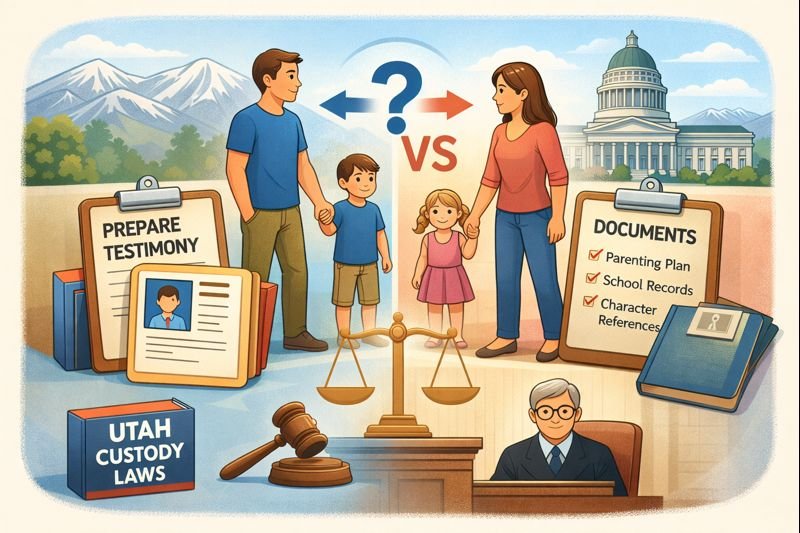
You must present specific documents that the clerk’s office requires.
- Your child’s certified birth certificate, establishing the parent-child relationship.
- You need to provide proof of your current address through any of these documents: a utility bill or lease agreement or bank statement.
- You must provide all existing court orders that relate to custody or support or divorce matters.
- A draft parenting plan, if you have one, contains your proposed custody schedule and decision-making framework.
- You need to provide school and medical records that show your child’s current needs and circumstances.
Every state and county establishes its own filing fee structure. The clerk’s office provides fee waiver applications for individuals who demonstrate financial need. Most courts have one available.
File the Petition and Serve the Other Parent
To begin the process, you must first submit a petition to the family court in the county where the chid resides for a minimum of six months. The Uniform Child Custody Jurisdiction and Enforcement Act (UCCJEA) establishes this requirement to determine which state holds custody jurisdiction rights.
The other parent becomes aware of your filing only after you complete the service of process procedure. In this case, a neutral third party will be needed. They are typically the sheriff’s deputy or a professional process server. Their task is to deliver copies of your petition and a summons. This is because you cannot perform the service yourself.
The completed Return of Service form gets submitted to the court as proof of delivery, which establishes a specific time frame for the other parent to answer the court documents.
Formal service methods can be avoided by you if you filed your case together with your partner. Inquire about the requirement for service when you present your case to the clerk.
Why 90% of Cases Never Go to Trial
Most parents filing for custody imagine a courtroom confrontation. The actual situation develops differently. According to family law research that Clio compiled, approximately 90% of custody cases resolve without a trial. The primary reason for this outcome exists.
Most states require parents to attempt mediation before a judge will hear contested custody issues. Mediation achieves success in 70 to 80 percent of cases when parents reach mutually accepted parenting agreements according to existing custody research.
The U.S. Department of Health and Human Services supports state-level mediation programs as part of broader family stability initiatives.
When parties reach successful mediation, both parents approve a parenting plan, which a judge evaluates to become a legally binding court order. The beginning of a custody petition process does not mark the start of a legal conflict.
What Goes Into a Parenting Plan That Courts Approve
A parenting plan serves as the essential document that establishes all custody arrangements between parents. The courts reject any agreement that lacks clear and specific terms. Instead, it needs to address the regular parenting schedule. This should include all weekdays, weekends, and school holidays.
The plan must also specify how the child will spend major holidays and vacations. In addition, there must be a clear document about which parent has decision-making authority on medical, educational, and religious matters. Also, the plan should indicate how the parents will communicate with each other and exchange the child.
The document should contain a clause that defines how disputes will be resolved. Life changes; parents enter into schedule changes while their relationships enter into conflict. Pre-established methods for conflict resolution, which include direct negotiation and involvement of a parenting coordinator and return to mediation, work to stop minor conflicts from escalating into fresh court battles.
A child custody attorney assists you in creating legal wording that local courts commonly accept, thus decreasing the chances of the plan needing changes.
What to Focus On from the Start
Applying for child custody involves more than just its legal aspects. The process establishes a parenting choice, which becomes official through legal procedures. Every form you fill out, every document you gather, and every choice you make in mediation should be grounded in the same question: what arrangement genuinely serves my child?
The question receives judicial examination as well. In every state, the standard is to ensure the best interest of the child. They guide every custody decision from the initial hearing through any future modification request.
Parents who enter the process with that objective achieve better results and focus on reaching agreements instead of trying to defeat or punish their former partner.