


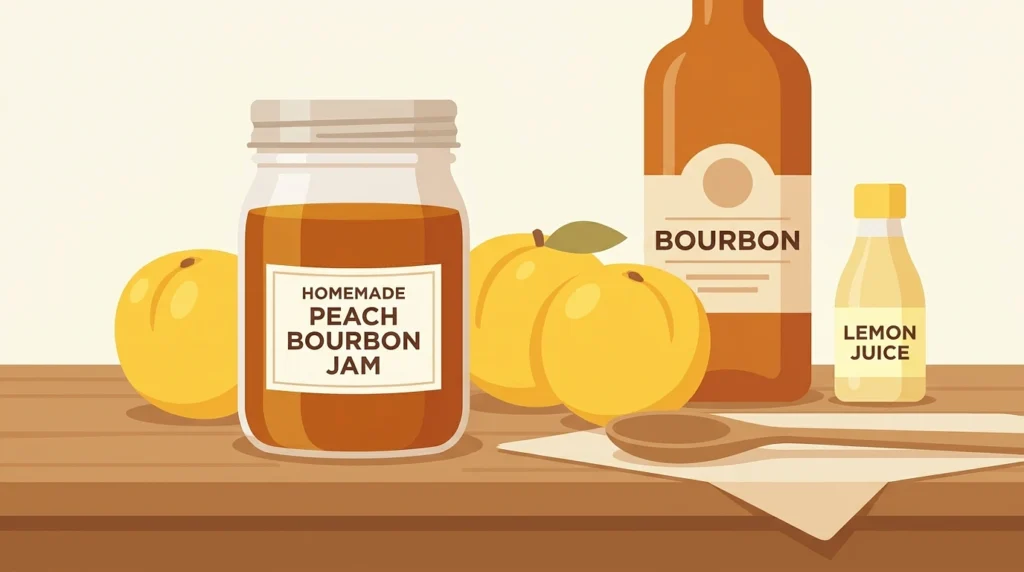
Before anything else, one rule that decides whether this jam is safe to put on a shelf.
Use yellow peaches, not white ones. Yellow peaches sit at a pH of roughly 3.4 to 3.6, comfortably acidic enough for boiling water canning. Some white flesh varieties are higher in pH, which makes them a low acid food for canning purposes, and as Ball states outright in its own peach bourbon jam recipe, there are currently no tested acidification procedures for white flesh peaches. America’s Test Kitchen says the same thing in one line before its ingredient list. White peaches are delicious. Eat them fresh, or make a fridge jam, and keep them out of your canner.
Peaches Are Low in Pectin, So You Either Add Some or You Cook Much Longer
Pectin, defined simply a carbohydrate in fruit that forms a gel network when it meets sugar and acid under heat, trapping liquid and turning it into jam. Peaches carry very little of it compared to apples or citrus, which is why peach jam has a reputation for staying syrupy.
You have two honest paths.
With commercial pectin. Faster, more predictable, and it lets you keep the fruit tasting fresh because the boil is short. The National Center for Home Food Preservation’s own peach jam recipes work this way, and the powdered pectin version calls for 3¾ cups crushed peaches, ¼ cup lemon juice, one package of powdered pectin and 5 cups of sugar, boiled hard for exactly one minute after the sugar goes in. That one minute is not a suggestion. Overboiling pectin set jam breaks the gel rather than strengthening it.
Without pectin. Longer cooking, deeper caramelised flavour, softer set. You are boiling off water until the natural pectin concentrates enough to gel, which at sea level means reaching 220°F, and you subtract 2°F for every 1,000 feet of altitude above that. Expect somewhere between 20 and 40 minutes of active boiling and stirring, and expect a looser result than a pectin jam, which plenty of people prefer.
A middle route worth knowing. Grate half a peeled Granny Smith apple into the pot. Apples are naturally high in pectin, it is what ATK does in their version, and the apple flavour disappears entirely into the peaches.
Whichever path you take, the lemon juice is not optional. It drops the pH so pectin can bond, and for canned jam it is part of the safety margin. Use bottled lemon juice rather than fresh for anything going into a canner, because bottled juice has a standardised acidity and a lemon off your counter does not.
Add The Bourbon At The End, Know What it Does And Does Not Do

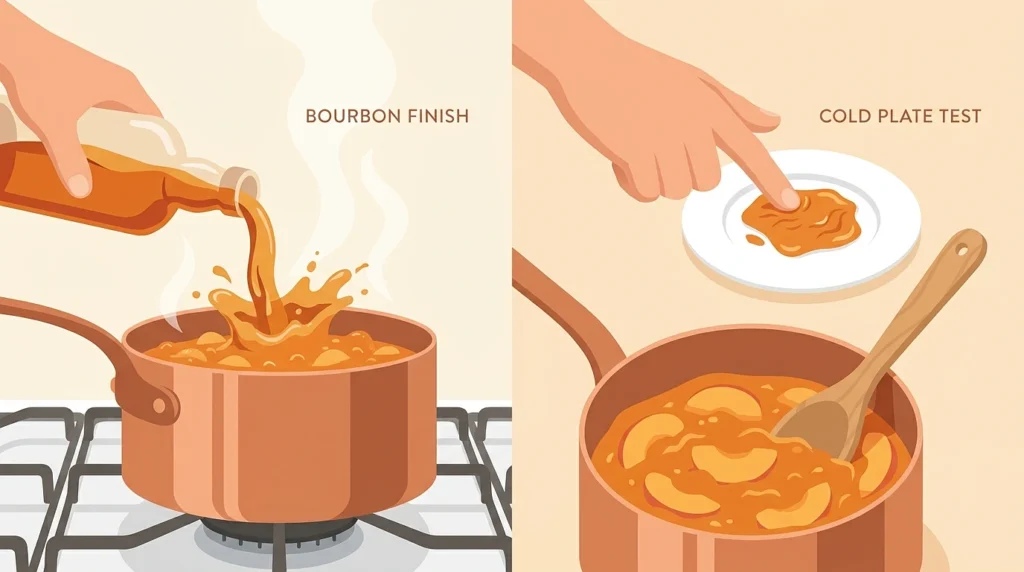
Bourbon goes in during the last five minutes of cooking. Add it at the start and you boil away the aromatics you paid for, leaving a vague sweetness rather than the caramel and vanilla notes that made you want bourbon jam in the first place.
Two things worth being straight about.
Most of the alcohol cooks off during a long boil and a water bath process, leaving trace amounts and the flavour compounds behind. That said, “most” is not “all,” and if you are making this for someone who avoids alcohol entirely, for whatever reason, leave it out rather than assuming it has vanished.
And the bourbon does nothing for safety. It is not a preservative in this quantity, it does not acidify the jam, and it does not extend shelf life. Alcohol in canning recipes adds flavour, and the acidification and processing do the preserving. If you are adapting a tested recipe, add the bourbon without altering the fruit, sugar or lemon juice proportions.
How Do You Know When It Is Set?
Two tests, and use both. A thermometer reading 220°F at sea level, adjusted for your altitude. And the cold plate test, where you put two small plates in the freezer at the start, drop a spoonful onto a cold one, wait thirty seconds, then push it with a finger. If it wrinkles and holds the gap, it is done. If it floods back, keep cooking and test again in a few minutes.
Fridge Jam And Canned Jam Follow Completely Different Rules
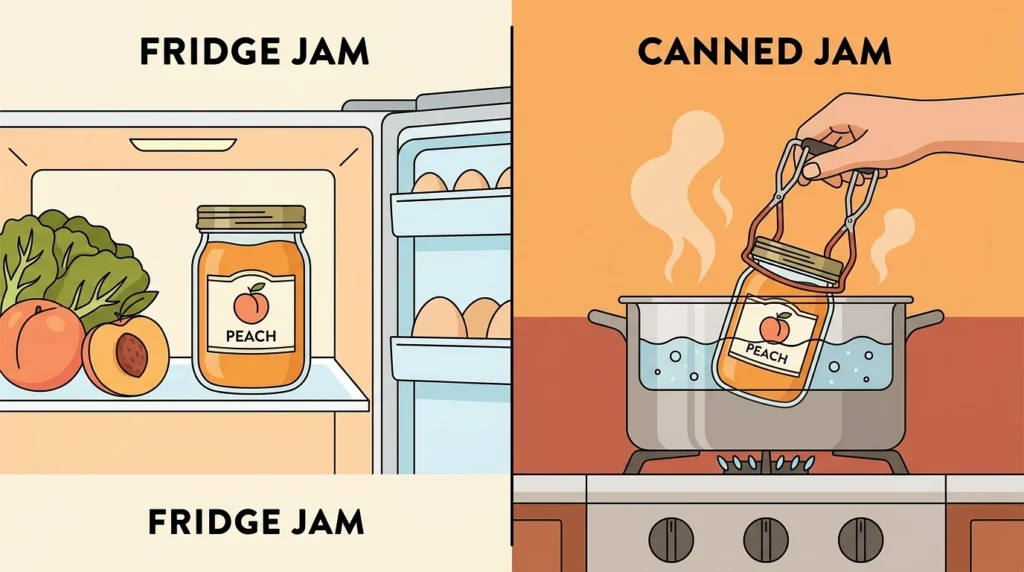
This is where recipes get vague and people get into trouble, so the two methods stay separate here.
Fridge and freezer jam is the low stakes version. Ladle the hot jam into clean jars, cool on the counter, refrigerate. It keeps roughly three weeks in the fridge, or up to six months frozen with at least half an inch of headspace since jam expands as it freezes. You can adjust sugar downward, use white peaches, skip the bottled lemon juice rule, and generally improvise, because nothing is being stored at room temperature.
Canned jam is a different discipline and it is worth doing properly.
- Use a tested recipe rather than improvising ratios, since the pH of the whole jar is what matters.
- Heat jars in simmering water before filling, and do not boil them.
- Leave ¼ inch of headspace, remove air bubbles, and wipe the rims clean before the lids go on.
- Tighten bands to fingertip tight, not as hard as you can manage.
- Process half pints in a boiling water canner for 10 minutes, adjusted for your altitude.
- After processing, turn off the heat, remove the canner lid, and let the jars stand five minutes before lifting them out.
- Cool undisturbed for 12 to 24 hours, then check the seals. A sealed lid does not flex when you press the centre.
Anything that failed to seal goes in the fridge and gets eaten within a few weeks. Sealed jars keep about a year in a cool dark cupboard, and they stay safe beyond that while the colour darkens and the flavour flattens.
One last thing about the set, because it saves a batch. If the jam is still runny after it cools properly, which takes a full day, you can return it to the pot and cook it a little longer, or accept it as a peach and bourbon syrup that is genuinely excellent over ice cream and yoghurt. Runny jam is a disappointment. It is not a failure, and nobody has ever complained about the syrup.