



Do joint supplements actually work?
Some do, some don’t, and the label will never tell you which is which. Curcumin has genuinely good trial data behind it right now. Glucosamine and chondroitin, the two most famous names in the aisle, have a twenty year record that is far messier than their sales numbers suggest. Collagen looks promising with an asterisk. And a few shelf regulars are riding on almost nothing. So instead of another list that blesses every bottle, this piece goes ingredient by ingredient through what the studies found, because the gap between the best and worst products in this category is enormous and the packaging is designed to hide it.
First, Set the Bar for What Counts as Working
Living an active lifestyle with minimal discomfort is a goal many people strive to achieve, but joint stiffness can often serve as an impediment. Whether caused by aging, injury, or underlying health conditions, stiffness in the joints can significantly affect one’s quality of life. To tackle this issue, many are turning to joint health supplements as a natural alternative to support their mobility. Let’s delve deeper into how these supplements can aid in maintaining joint wellness and improving overall mobility.
And a quick word on the phrase that inspired this article’s title. “Supports joint health” is legally meaningless. Supplement companies use it precisely because it claims nothing testable, so the same two words appear on products with strong evidence and products with none, and the only way to sort one from the other is the trial data.
Curcumin Is the One Earning Its Spot Right Now
If the evidence race has a current leader, it is curcumin, the active compound family in turmeric, and the recent numbers honestly surprised me when I went through them. A systematic review covering eleven randomized controlled trials and 1,258 knee osteoarthritis patients found curcuminoids beat their comparators on standard pain scores, and in the trials that ran curcumin head to head against NSAIDs, the ibuprofen and diclofenac family, curcumin matched or edged the drugs on pain relief while producing fewer side effects. Later review work has landed in the same place, better than placebo, comparable to NSAIDs, easier on the stomach.
Picture what that means for one common situation, a person in their fifties who has been quietly taking ibuprofen four or five days a week for a cranky knee. For that person, an ingredient that can deliver similar relief without the gut and kidney concerns of daily NSAID use is not a small finding, it is the difference between managing the knee and slowly buying a second problem.
The honest caveats plain curcumin absorbs poorly, so the trials mostly used enhanced formulations or curcumin paired with piperine from black pepper, meaning a cheap plain turmeric capsule is not what was studied. Doses in the trials generally sat near 1,000 mg of curcuminoids per day. And curcumin has mild blood thinning activity, so anyone on anticoagulants needs a doctor in this conversation before a bottle.
Glucosamine and Chondroitin, the Famous Names With the Messy Record

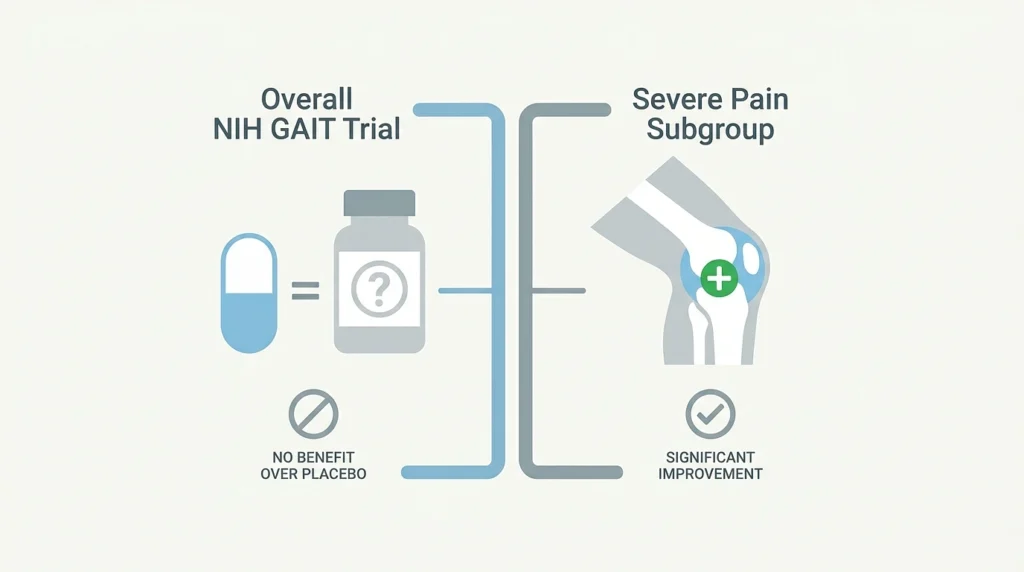
Now for the awkward one, because these two are the category. Decades of loyalty, shelves of combo products, and the biggest test they ever faced did not go their way.
The NIH funded a trial called GAIT, over 1,500 knee osteoarthritis patients, randomized and double blinded, comparing glucosamine, chondroitin, the combination, a prescription drug, and placebo over 24 weeks. The drug beat placebo. The supplements, overall, did not. That is the headline result, published in the New England Journal of Medicine, and the full history is laid out on the National Center for Complementary and Integrative Health’s GAIT page if you want the source rather than my summary.
But the record refuses to stay simple, and I think the nuance is genuinely interesting rather than cope. Inside GAIT, the subgroup with moderate to severe pain did show a benefit from the combination, which is why the research did not just end in 2006. European studies using prescription grade crystalline glucosamine sulfate have reported better results than American trials using shelf products, and the 2019 European expert guidance goes as far as recommending pharmaceutical grade chondroitin while telling patients to distinguish it from ordinary supplements. Meanwhile the American Academy of Orthopaedic Surgeons lists chondroitin as possibly helpful for mild to moderate knee arthritis while flagging the evidence as inconsistent, and for hip arthritis the data is flatly negative, a two year trial found glucosamine no better than placebo on pain, function or joint structure.
So the fair verdict is narrow. If you buy these, buy glucosamine sulfate rather than hydrochloride, at the studied 1,500 mg dose, know that the strongest case exists for worse knee pain rather than mild aches, and give it a defined trial period instead of a lifetime subscription. One hard safety note, glucosamine can interact with warfarin, and that combination belongs on your doctor’s radar, not just your shopping list.
Collagen Peptides, Promising With an Asterisk
Collagen is the newer money in this aisle, and the pooled data is more positive than I expected. A 2023 meta analysis of randomized trials found collagen peptides produced a moderate reduction in knee osteoarthritis pain compared with placebo. That is a real signal.
The asterisk is everything around the signal. The reviewers themselves flagged risk of bias in the underlying trials, short follow up periods, and big differences between studies, and imaging outcomes tell a humbling story, cartilage thickness and joint space stay basically unchanged in the high quality trials, so nothing here suggests collagen is rebuilding a joint. What the evidence supports is a possible leg pain and function benefit over a few months. What the influencer version claims, drink this and regrow cartilage, the evidence does not support at all, and that gap between the data and the marketing is wider for collagen than for anything else in this article.
The Rest of the Shelf, Quickly and Honestly
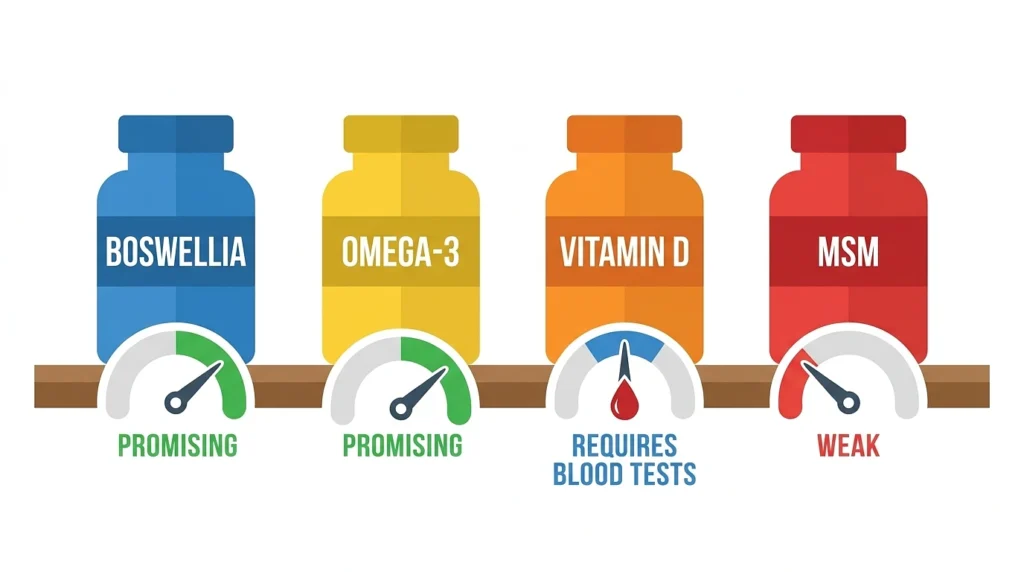
- Boswellia serrata has a handful of small positive trials in knee osteoarthritis and deserves the “promising, needs bigger studies” label people wrongly give to everything.
- Omega 3 fish oil has its best joint evidence in rheumatoid arthritis, the autoimmune disease, where it shows real anti inflammatory effects. For ordinary wear and tear osteoarthritis the data is much weaker, so know which condition you are actually buying it for.
- Vitamin D matters if you are deficient, which plenty of people are, and does little for joints beyond that. A blood test answers this question better than a supplement bottle does.
- MSM shows up in nearly every combo formula on the strength of thin, small studies, and it is fair to say it rides along on the label more than it earns the space.
Exercise and Weight Loss Beat Every Bottle in This Article
What frustrates me about this entire product category is that the two interventions with the strongest evidence for joint pain and mobility are not in the supplement aisle at all. Strengthening exercise, especially for the muscles around the knee and hip, improves pain and function in trial after trial, and weight loss multiplies its effect through simple mechanics, each pound off your body takes roughly four pounds of load off your knees with every step. No capsule in this article comes close to what those two do together. The supplements with real evidence can support that work. They cannot replace it, whatever the marketing implies.
How to Buy Without Getting Played
The FDA does not test or approve supplements for effectiveness before sale, so quality control is on you, and a few rules cover most of it:
- Look for third party verification, USP or NSF marks, so the bottle at least contains what the label says at the dose it says.
- Match the studied doses, around 1,000 mg of curcuminoids, 1,500 mg glucosamine sulfate, because half doses of studied ingredients are unstudied products.
- Run a defined trial, 8 to 12 weeks, and if nothing changed, stop paying. The subscription model counts on you forgetting this step.
- Loop in your doctor if you take blood thinners, diabetes medication, or anything else daily, because the interactions above are the documented ones, not the only ones.
And if you want to go one level deeper than any blog post, read the source material yourself, the collagen meta analysis is open access here, and following its citation trail will teach you more about this aisle than a hundred product pages ever will.