


I have been four different gym members in my life. There was January Me, who signed a contract on the 2nd with the confidence of a man who had clearly never met himself. There was Guilt Me, who drove past the gym for months feeling the membership fee leave his account like a small monthly apology. There was Cancellation Me, who finally called, got offered a discount, and took it, which resurrected Guilt Me for another quarter. And once, briefly, there was the fourth guy. The one who actually went. He lasted about ten weeks, and I still think about him.
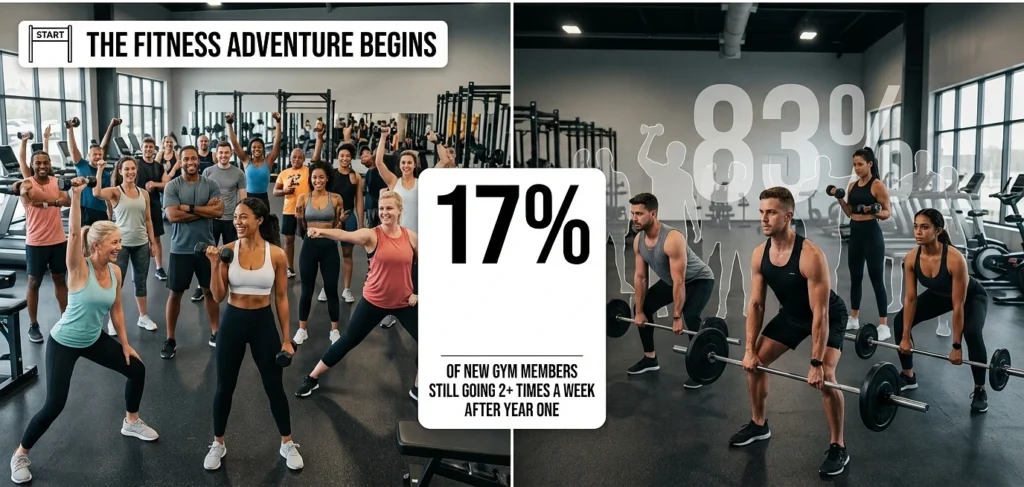
It turns out my four selves are not a personal failing. They’re the industry, measured. A team of Norwegian researchers followed brand-new fitness club members through their entire first year, checking in at intervals instead of just asking people to remember, and the number that made me put my coffee down is right there in the published follow-up in Frontiers in Psychology: only 17% of new members used the gym twice a week through their first year. Not “went hard.” Not “transformed.” Twice a week. Eighty-three out of every hundred people who sign up cannot clear a bar that low for twelve months.
And the same study contains a second number that turns the first one from sad to genuinely strange.
The 86.6% Problem

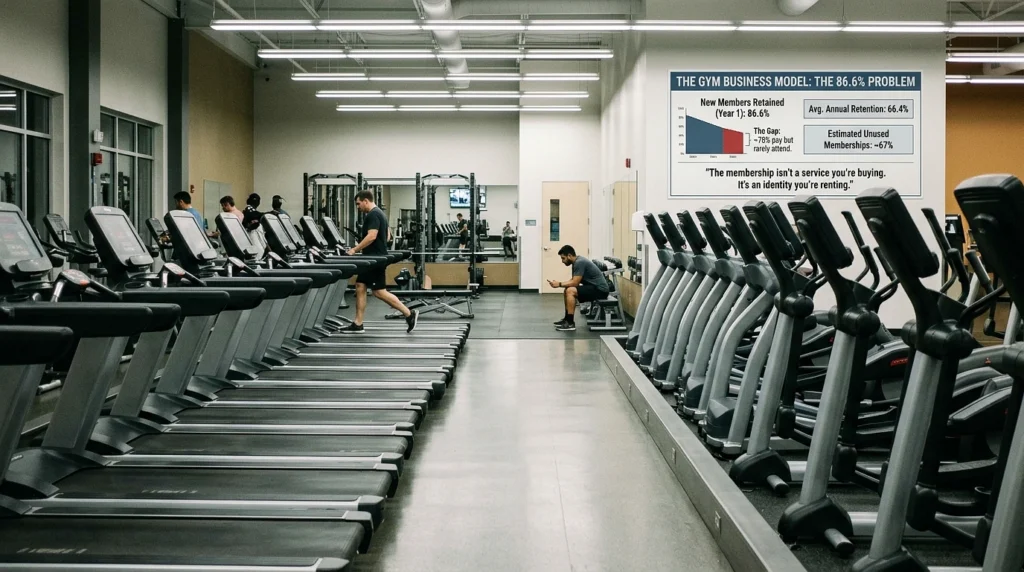
Here’s the sentence from that research I’d frame and hang in every gym lobby if I owned one, which is precisely why no owner ever would: at the end of that first year, 86.6% of those new members still had their memberships. Sit with the arithmetic. Seventeen percent going twice a week. Nearly eighty-seven percent still paying. That gap, the seventy-ish percent of people funding a building they don’t enter, isn’t a bug in the fitness industry. Follow the money and it starts to look like the business model. Industry-wide numbers say the same thing from a different angle: the most recent benchmarking data puts average annual member retention at 66.4%, with the average member visiting just 1.5 times per week, down from 2.1 visits before the pandemic, and an estimated 67% of memberships going unused or barely used.
The researchers put it drily people paid a monthly fee to a club without using its facilities. I can translate the dry version, because I’ve lived it. The membership isn’t a service you’re buying. It’s an identity you’re renting. Canceling doesn’t feel like ending a subscription, it feels like signing a confession, so Guilt Me keeps paying because the fee is cheaper than the admission. Multiply me by a few million and you get an industry where the treadmills are available at 6 p.m. in March despite everyone in the zip code technically belonging.
What the 17% Are Doing Differently
The useful part of the Norwegian research isn’t the body count. It’s that they also measured what separated the people who kept showing up from the people who evaporated, and the answers are not what the motivation posters say.
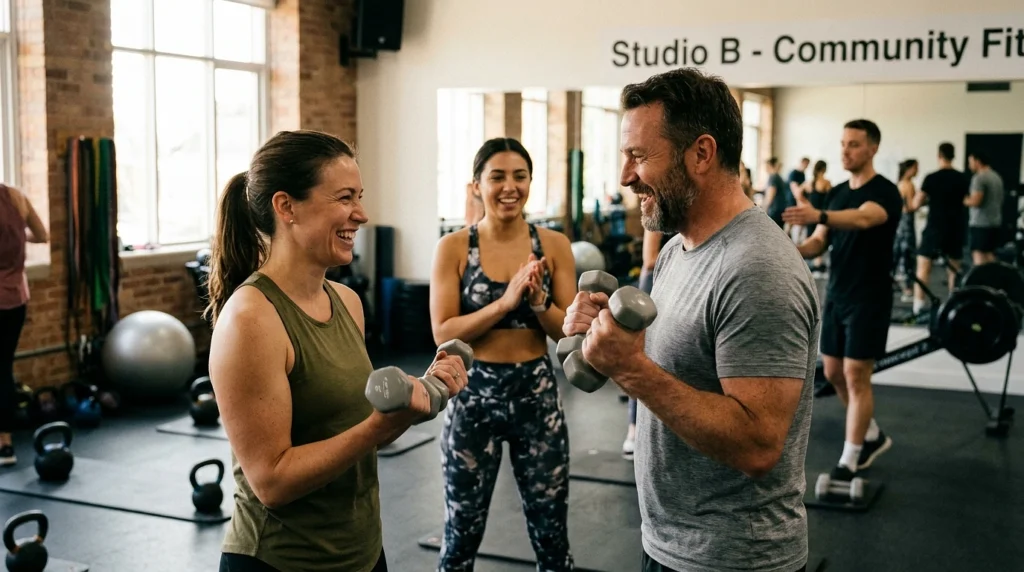
The regular exercisers scored higher on three specific things enjoyment of the exercise itself, self-efficacy, which in this context basically means confidence in their own ability to stick with it when it’s raining or boring or Tuesday, and social support. Read that list again and notice what’s missing. Discipline isn’t on it. Willpower isn’t on it. Goals, vision boards, before-photos, none of it. The people still going at month twelve weren’t grinding through workouts they hated with superior character. They’d found versions of exercise they didn’t need character to survive.
The supporting numbers around the industry rhyme with this:
- The first month predicts the first year. Members attending less than once a week in their first thirty days overwhelmingly cancel within six months, per the retention research the industry itself circulates. The pattern sets before the motivation fades, not after.
- People beat programs. Members doing group classes are dramatically less likely to cancel than solo floor exercisers, and members who get real onboarding, an actual human showing them what to do, retain at far higher rates than the ones handed a key fob and a wave.
- Frequency beats intensity. The twice-a-week bar from the study is the whole game. The industry’s own data shows attendance, not effort or results, is the leading indicator of who’s still there next year.
The Honest Playbook, From an 83-Percenter
I’m not going to write you the standard ten-tips listicle, partly because you’ve read it and partly because I’m statistically unqualified. What I can offer is what the research says, filtered through someone who has failed at this expensively. Three things, and the first one sounds like a joke but isn’t.
Aim for twice a week, forever, instead of five times a week, briefly. The study’s own bar is the target. January Me scheduled six sessions a week, which meant that by week three, missing two days felt like the plan was dead, and a dead plan is very easy to stop paying attention to, if not to stop paying for. Twice a week survives a cold, a work trip, a bad month. The 17% aren’t heroes. They’re people whose plan had slack in it.
Buy the version with humans in it. Every retention statistic points the same direction: classes, training partners, an instructor who notices you’re gone. My ten good weeks, back when the fourth guy existed, were the weeks a friend and I had a standing Tuesday-Thursday arrangement, and the arrangement did all the work my willpower was supposed to do. He moved cities. The fourth guy moved out with him.
And do the cancellation math out loud. If you’re three months into not going, the noble move isn’t a re-commitment, it’s a decision. Either book the onboarding session and become someone who goes twice a week, or cancel and put the fee toward something you’ll actually use, dumbbells, a bike, shoes. The one unacceptable option is the one 70% of us choose, paying indefinitely for absolution. The gym doesn’t need your penance. It’s doing fine on everyone else’s.
The title of this piece says let the fitness begin, and I mean it a little crookedly, because for most new members what actually begins is the membership, a different thing entirely. The fitness begins the second week you show up when you don’t feel like it, with a plan small enough to survive you. Seventeen percent manage it. The bar, I promise you, is not the problem.