


A few weeks back I was talking with a friend after church, one of those parking lot conversations that goes on twice as long as the sermon did, about the second greatest commandment. The sermon that morning had been on Matthew 22:39, love your neighbor as yourself, and my friend pointed out something I hadn’t really noticed before. The preacher spent forty minutes on the first four words and about forty seconds on the last two.
And once you notice that, you can’t stop noticing it. Go listen to almost any sermon on this text. Love your neighbor gets the full treatment: the Good Samaritan, the widow down the street, the coworker who drives you crazy. Then “as yourself” gets waved at on the way out the door, as if Jesus had added it for rhythm.
So my friend and I got into it. What is that half of the commandment actually doing there? And why does nobody want to preach it?
The Two-Stage Theory
The most common answer, the one you hear in a lot of churches and in basically all of Christian self-help publishing, treats the verse as a sequence. It goes something like this:
- Stage one: learn to love yourself.
- Stage two: now you’re equipped to love others.
In this reading, self-love is the prerequisite. You can’t pour from an empty cup, the saying goes. Before you can care for your neighbor you have to build up your own self-esteem, practice self-care, heal your relationship with yourself. The “as yourself” is taken as a hidden commandment inside the commandment, and the neglected half of the verse turns out to be an instruction to love yourself more.
In one sense, I get this. I really do. If your view of yourself is catastrophically bad, what looks like love for others is often something else underneath, a fearful, servile need to be needed. Anyone who has done any pastoral care, or any honest self-examination, has seen that dynamic. There are people for whom “take better care of yourself” is exactly the right word, and some of them are sitting in pews being told to give more.
So the two-stage theory isn’t crazy. But I don’t think it’s what Jesus is saying. And the reasons I don’t think so are worth walking through slowly, because this is one of those places where a small misreading quietly reroutes the whole Christian life.
What Jesus Actually Assumes
Here’s the thing about the grammar of the commandment. Jesus doesn’t command self-love. He assumes it.
“Love your neighbor as yourself” takes for granted that you already love yourself, and it uses that existing love as the measuring stick. Paul reads it exactly this way in Ephesians 5:28 when he tells husbands to love their wives as their own bodies, “for no one ever hated his own flesh, but nourishes and cherishes it.” Nourishes and cherishes. That’s the kind of self-love in view. Not self-esteem, which is a modern psychological idea, and a fairly recent one at that. Something more basic. You feed yourself when you’re hungry. You get yourself out of the rain. You take the splinter out of your own hand within about four seconds of noticing it.
And this holds even for people who, by every questionnaire, dislike themselves. A person can have miserable self-esteem and still eat lunch, still flinch away from the hot stove, still want the pain to stop. That wanting is the self-love Jesus is pointing at. It doesn’t need to be taught. It came installed.
Which means the commandment isn’t a two-stage program. It’s a comparison, and a fairly ruthless one.
The Measure Nobody Wants
Read it as a comparison and the verse stops being comforting almost immediately. As you get yourself out of the rain, get your neighbor out of the rain. As instinctively as you feed your own hunger, feed his. As fast as you pull the splinter from your own hand, and nobody has ever formed a committee to consider their own splinter, move toward the thing that’s hurting her.
That’s the half nobody preaches. Not because it’s obscure but because it’s devastating. The two-stage reading gives the congregation homework they’ll enjoy. The comparison reading holds up a mirror: you already know exactly what love looks like, because you perform it for yourself all day long, automatically, without a sermon. The commandment just asks why the person next to you receives it at such a steep discount.
I find I can sit with “love your neighbor” fairly comfortably. It’s the “as” that gets me.
Where That Leaves Self-Care
Later in that parking lot conversation my friend pushed back, and it was a fair push. Doesn’t this reading just re-arm all the people who already run themselves into the ground for others? The exhausted mother, the burned-out volunteer, the pastor who hasn’t taken a day off since the Bush administration?
I don’t think it does, actually, and here’s why. The commandment’s logic cuts both ways. If your self-love is the measure of your neighbor-love, then a person who genuinely neglects herself, no rest, no food, no mercy, is holding a broken ruler. The verse quietly assumes a normal, healthy, creaturely self-care as the baseline. Sleep, sabbath, food, friendship. Those aren’t in competition with the commandment. They’re the units it measures in.
But notice what the verse does not assume, and this is where I part ways with a good deal of what gets published under the Christian living label. It does not assume that the self needs years of dedicated attention before the neighbor can get any. As best I can tell, a lot of us are spending our whole spiritual lives camped out in stage one, working away at loving ourselves, with stage two perpetually scheduled for later. Whole shelves, whole conference circuits, are devoted to the preparation and almost nothing to the thing being prepared for. And that seems backwards to me. The self doesn’t get healed by staring at it. Mostly it gets healed the same way a wound does, by being cleaned, covered, and then left alone while you go do something else.
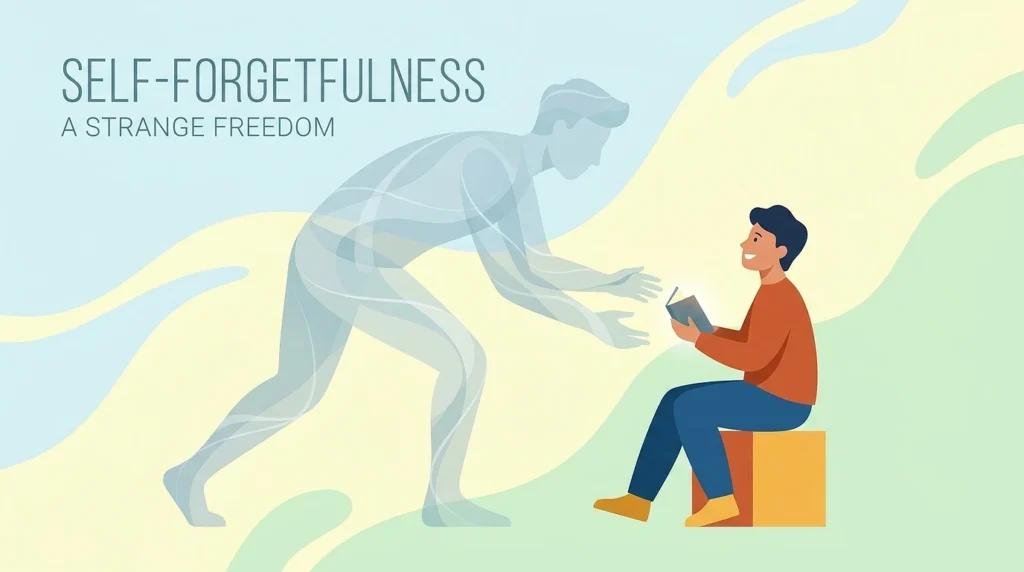
Self-Forgetfulness
So if the neglected half of the commandment isn’t “love yourself more,” what is it?
I’d put it this way. The “as yourself” is an invitation to a strange kind of freedom, the freedom of taking your neighbor’s hunger as personally as your own. The old writers had a word for the destination: self-forgetfulness. Not self-hatred, which is just self-obsession wearing a frown. Something lighter. The state you’re in when you carry a sleeping kid in from the car, or sit up with a sick friend, and it never once occurs to you to check how you’re doing.
You already know this state. You visit it in your best moments. The commandment’s quiet claim is that it could be less of a visit and more of an address.
My friend and I never did settle it that afternoon. The parking lot emptied out around us and we were still going. But I’ve thought about it most days since, usually right around the moment I catch myself pulling my own splinter first.