



Abstract
Michigan is a strict liability state under MCL 287.351, which means a dog owner is on the hook the first time their dog bites someone who was lawfully present and did not provoke it. That sounds like it settles everything, and it does not. Insurers paid out $1.862 billion in dog related injury claims across the country in 2025, with the average claim landing at $65,450, and that average is doing a lot of work hiding thousands of minor bites alongside cases involving reconstructive surgery and traumatized kids. This piece walks through six specific things a lawyer actually changes about your outcome, with the data behind each one, plus the parts of Michigan’s statute that are narrower than people assume.
I got into this because somebody close to me got bitten in a driveway in Macomb County, and the first offer that came back from the homeowner’s insurer was low enough that I went and read the statute myself out of pure irritation. What I found is that the law rules is genuinely generous to victims in Michigan, and that has almost nothing to do with what people end up getting paid.

1. The Statute Makes Liability Easy, So The Fight Moves Entirely to Damages
Michigan does not follow the one free bite rule that still exists in some states. The operative language in MCL 287.351 is short. If a dog bites a person, without provocation, while that person is on public property or lawfully on private property, the owner is liable for damages.
Three questions decide it. Was there a bite, was the person provocation free, and were they somewhere they had a legal right to be. Answer yes to all three and the statute does the heavy lifting. No proving the owner was careless, no digging up the dog’s history, no showing anybody knew the animal was dangerous. Nolo’s breakdown of Michigan dog bite law confirms the same reading.
Here is the part that catches people off guard. When liability is that easy to establish, the insurance company stops arguing about whether they owe you anything and starts arguing about how much. That is a completely different battle, and it is one where an unrepresented person is at an enormous disadvantage, because valuing an injury is a skill and adjusters do it professionally every day of the week.
So the strict liability statute helps you get to the table. It does nothing for you once you are sitting at it.
2. The Average Settlement Number Floating Around is Close to Useless for Your Case


According to Triple-I and State Farm’s 2025 analysis, insurers paid $1.862 billion across 28,450 dog related injury claims, and the average cost per claim was $65,450. That figure was down 5.5 percent from $69,272 the year before, though it still sits 97 percent higher than it was a decade ago.
Now consider what goes into that number. It blends a puncture wound that healed in a week and cost four thousand dollars with a child who needed facial reconstruction. There is no official national settlement database anywhere, which is why firm reported averages swing from around $58,500 to over $97,000 depending on who you ask.
That variation is not a mystery. It is what happens when everybody is averaging different mixes of cases and calling the result a benchmark.
What actually drives your number is injury severity, documented treatment costs, whether scarring is permanent, whether it is visible, your age, lost income, and the owner’s policy limits. State matters too, and it matters a lot. New York had the highest average cost per claim in 2025 at $92,154. A lawyer’s real work here is building the record that moves your case away from the average and toward what your specific injuries are worth.
3. Michigan’s Statute Covers Bites, And Only Bites
This one genuinely surprised me, and it is where cases quietly fall apart.
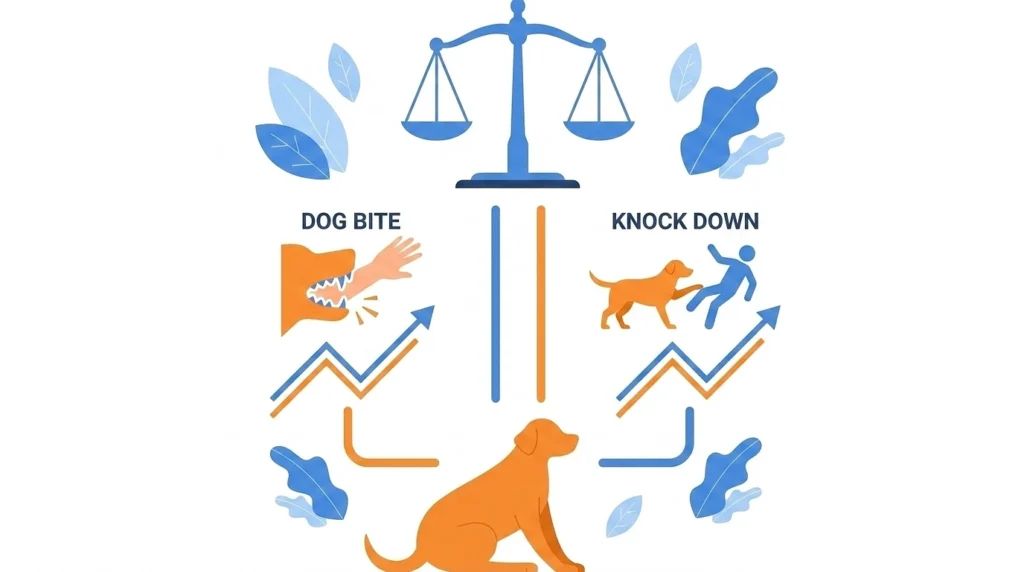
MCL 287.351 applies to bites. If a dog knocks you down, or chases you into traffic, or scratches you badly, the strict liability statute does not cover it. You are now in negligence territory, which means proving the owner had a duty of care, breached it, and that the breach caused your injury.
There is a second route. Under Michigan case law, specifically Hiner v. Mojica, an owner who knew their dog was dangerous can be held strictly liable for non bite injuries too. That requires proving knowledge, which brings you back to gathering evidence about the large animal history.
The practical consequence is that a lot of legitimate injuries get treated as non cases by people who read a summary of the dog bite statute online, concluded it did not apply, and never called anyone. If a dog put you in the emergency room without its teeth touching you, that is still potentially a claim. It just runs on a different track.
4. The Two Defenses Insurers Reach for, And What Michigan Case Law Actually Requires

Owners get two defenses under the statute. Provocation, and the victim not being lawfully present.
Adjusters stretch both of these constantly, and here is where knowing the case law changes the conversation. Under Michigan interpretations, provocation generally requires intentional conduct that would reasonably cause a dog to bite. Hitting the animal, kicking it, seriously tormenting it. Ordinary petting, normal movement, walking past, a kid playing nearby, none of that typically clears the bar.
The lawful presence defense gets stretched the same way. Mail carriers, delivery drivers, invited guests, someone on a public sidewalk, all of these people qualify as lawfully present. The statute does carve out certain police and service dogs engaged in law enforcement work, and that is a real exception rather than an adjuster’s invention.
Watching an adjuster suggest that a six year old provoked a dog by existing near it is the thing that made me angriest in this entire process. It happens because it works often enough on people who do not know that Michigan courts have a specific standard for what provocation means.
5. Non Economic Damages Are Where The Value Sits, And Where Documentation Decides Everything

Since strict liability does not require proving reckless conduct, punitive damages are rarely available in these cases. Everything therefore lives in compensatory damages, split between economic and non economic.
Economic damages are the arithmetic part. Emergency treatment, surgeries, follow up care, plastic surgery, therapy, lost wages, reduced earning capacity.
Non economic damages are pain, suffering, disfigurement and psychological harm, and they are usually the larger number in a serious case. They are also the part insurers work hardest to minimize, because there is no receipt for a kid who will not walk past a fenced yard anymore.
What builds that side of a claim:
- Consistent documented mental health treatment, since insurer narratives in 2025 show that recorded diagnostic criteria and steady psychotherapy raise claim value considerably.
- Photographs of the injuries taken across the healing timeline rather than once at the end.
- Plastic surgery consultations projecting future revision procedures, particularly for scarring that will need work as a child grows.
- Statements from people who knew the person before and can describe what changed.
Age and injury location matter more than most people realize. Facial scarring on a child carries heavier long horizon psychosocial consequences and gets valued accordingly, and that valuation only happens if somebody makes the argument properly.
6. Three Years Sounds Like Plenty of Time, Right Up Until It Isn’t


Michigan’s statute of limitations for personal injury, including dog bites, runs three years from the date of the incident under MCL 600.5805.
Three years feels generous when you are two weeks out and still on antibiotics. The problem is that evidence degrades on a much faster schedule than the deadline. Animal control records get closed out. Witnesses move and forget. Prior complaints about the same dog become harder to trace. Wounds heal, and photographs taken at week three cannot be recreated in year two.
Claims involving minors, government entities or unusual circumstances can run on different timelines, which is another reason not to guess at this on your own.
The counterweight is that you should not settle before your treatment stabilizes either. An offer that looks reasonable in month two looks very different once a surgeon tells you scar revision is coming. Moving fast on evidence and slow on signing is the combination that works.
What I Would Tell Somebody in The Middle of This
Get the medical care documented properly even if the bite looks minor, because infection risk in dog bites is real and because the record you build in week one is the record you argue from later.
Report it to animal control, since that creates an independent record and it is how prior complaints about the same dog surface.
Photograph everything, including the location and anything that shows where you were standing and whether you had a right to be there.
And do not take the first offer. Insurers paid out nearly two billion dollars nationally last year across a rising number of claims, and their whole operating model depends on resolving as many of those as possible before anybody calculates what the case is actually worth.
None of this is legal advice, and I am not a lawyer. It is what I learned reading the statute, the case law and the claim data after watching somebody I care about get lowballed. If you are dealing with a bite in Michigan, the consultation is usually free, and finding out what your claim is worth costs you nothing.