


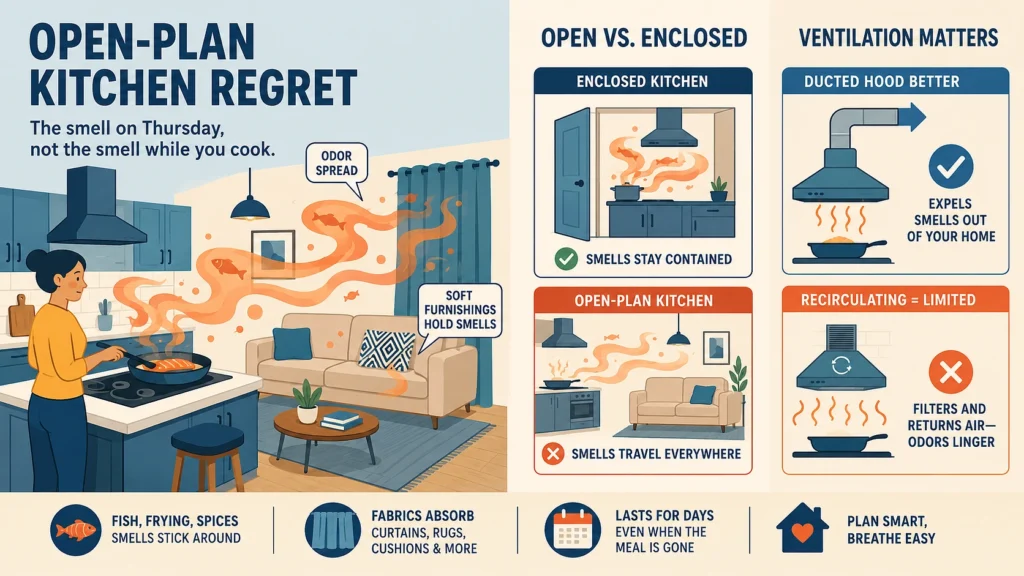
Salmon on Tuesday. By Thursday, the sofa still knows.
Nobody warns you about this at the showroom. The whole pitch for knocking through is light and space and being able to talk to people while you cook, and all of that is true, and none of the brochures get round to mentioning that you have also just removed the only thing standing between a pan of frying garlic and every soft surface you own.
A Wall Was Doing More Work Than You Gave it Credit For

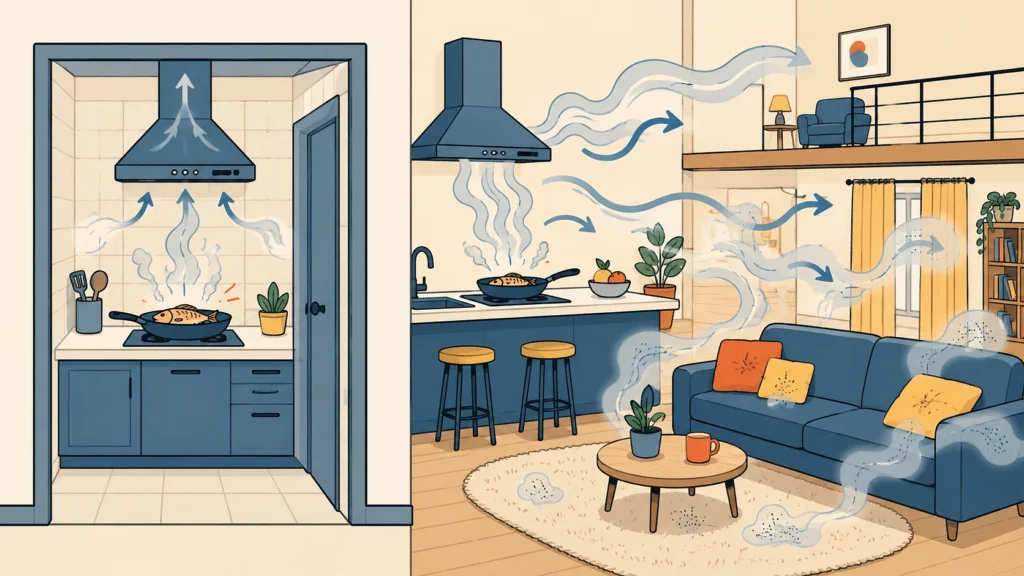
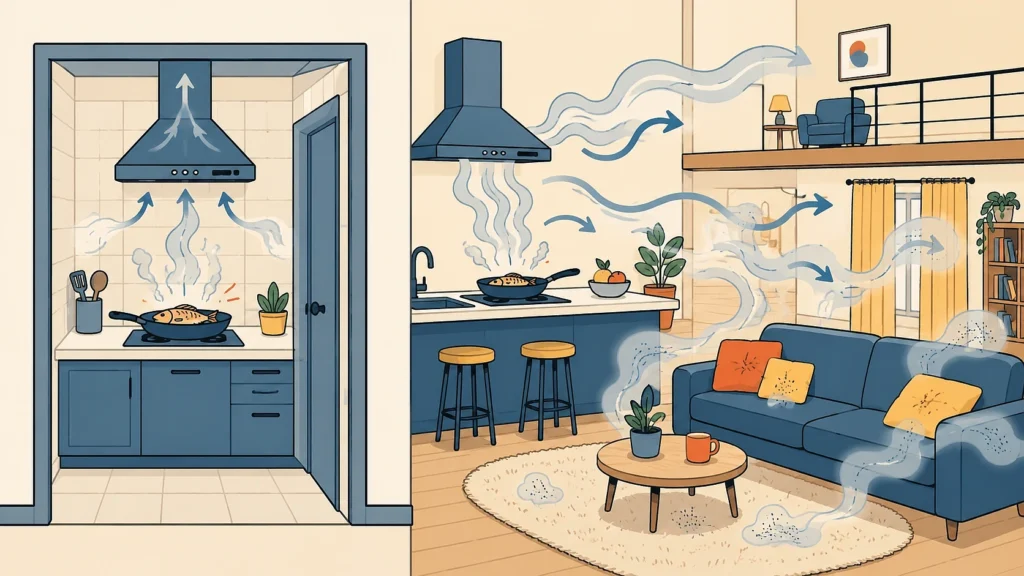
Here is the thing that took me years to properly understand about closed kitchens, and I say this as somebody who spent a long time thinking they were simply outdated. That door was not there for privacy. It was a containment vessel. Cooking odor is fine particulate and volatile compounds riding a column of hot, humid air, and that column rises, hits the ceiling, spreads sideways, and then goes looking for somewhere to land. In a closed kitchen it lands on tile, on painted plaster, on cabinet doors, on a wipeable worktop, and most of it gets pulled out by whatever extraction you have or gets wiped away on Saturday. In an open plan, the same column spreads across forty square meters of ceiling and comes down on curtains, a fabric sofa, a wool rug, cushions, a bed if you have a mezzanine, and every one of those materials is porous, which means the smell is not sitting on the surface where you can clean it, it has gone into the fibers, and it will keep releasing itself back into the room for days while you wonder whether you are imagining it. You are not imagining it. Textiles are excellent at holding onto cooking smells and terrible at giving them up quickly, and that is the actual regret. Not the smell while you cook. The smell on Thursday.
Capture Efficiency, Defined
The percentage of cooking pollutants a hood actually removes before they escape into the room.
That is the number that matters, and almost nobody knows it exists. California’s 2022 Title 24 energy code introduced it deliberately, precisely because focusing on airflow alone was producing hoods that moved a lot of air and still let the plume get past them. A hood with big airflow numbers and poor capture design will happily let smoke and grease spread into the room while its fan roars.
Will a bigger hood fix it?
Not on its own, no. Capture depends on how wide the hood is, how low it sits, and whether the plume ever reaches it. Wider hoods capture better. Mounting height is usually 24 to 30 inches above the cooktop, and hoods hung high for aesthetic reasons let the plume spread before it can be caught, which is a particular problem over islands and for anyone tall enough to lean over the pan.
The Numbers, Since This is Where The Decision Actually Gets Made
Sizing is not complicated, it is just usually skipped.
- Gas cooktops: 1 CFM per 100 BTU of total burner output. A 40,000 BTU four-burner wants 400 CFM as a floor.
- Light cooking, rarely fry: 150 to 300 CFM is enough.
- Heavy cooking, gas, frequent frying: 400 CFM and up.
- Open plan specifically: 600 to 1,200 CFM, because odors disperse freely into adjacent living areas rather than staying put.
Then the part people forget, which is that ductwork eats your rated airflow before it ever reaches the kitchen. Add roughly 1 CFM for every foot of duct run, 25 CFM for each elbow, and 40 CFM for the exterior cap. Real-world performance always lands below the spec sheet. Short, straight, smooth duct is worth more than a bigger fan on a bad route.
The Recirculating Hood is The Specific Mistake That Creates This Regret
If your open plan has a hood that does not vent outdoors, this section is your answer.
A recirculating hood passes air through a grease filter and an activated carbon filter, then puts it back in the room. It captures some grease and reduces some odor. It does not remove moisture, and it does not remove combustion gases, because there is nowhere for them to go. In humid climates or over a high-BTU cooktop, building inspectors describe it as rarely adequate in practice even when it is perfectly legal under IRC 2024.
Legal and adequate are different words. That gap is where a lot of open-plan disappointment lives.
There is a maintenance trap attached, and it is close to universal. Grease filters need cleaning every one to three months, and anyone deep-frying regularly can block one in a few weeks. A blocked filter chokes airflow down to a fraction of the hood’s rated CFM. So the hood that was marginal on day one is doing almost nothing by month four, and because the decline is gradual, nobody connects it to the smell.
Carbon filters have their own schedule and get replaced, not washed. Miss that and you have a fan.
What Actually Helps, Ranked Honestly
Ducted, wide, correctly mounted, properly sized. That is the fix, and everything else is mitigation.
If you can duct, duct. Short run, few bends, terminating outdoors. If the run has to be long, size up the fan to pay for the losses rather than hoping.
Turn it on before you start cooking, not when smoke appears. The hood is capturing a rising column, and a column that has already spread across the ceiling cannot be recaptured.
Leave it running ten to fifteen minutes after you finish. Most people switch off with the hob, which is roughly the moment the room is still full.
Beyond that you are managing rather than solving. Washable covers on the sofa if you are buying new. Curtains that can go in a machine. A window cracked on the far side of the room to give the air somewhere to go, particularly in an airtight modern build where the hood may be fighting for makeup air.
And I will say the unpopular part out loud, because somebody should. If you cook seriously, every day, with a wok or a fryer or a lot of fish, a fully open plan is working against you and no appliance entirely fixes that. A sliding door, a pocket door, a half wall behind the hob, a broken-plan layout that keeps the sight lines and loses the direct air path to the soft furnishings. Any of those buys back most of what the wall was doing, and none of them put you back in a 1970s galley kitchen with the door shut.
The regret is real. It is also mostly solvable at the design stage and mostly not solvable afterwards, which is exactly why it deserves mentioning before the wall comes down rather than on a Thursday, three days after the salmon.