


Two numbers decide everything on a perfume bottle, and only one of them is printed.
The size is on the box. How much comes out per spray is not, and it varies enough between bottles that two identically sized perfumes can differ by three hundred sprays. That is the number worth knowing before you decide whether a bottle is expensive.
Start with the conversion, then the spray maths, then how to measure your own atomizer if you want a real answer rather than an estimate.
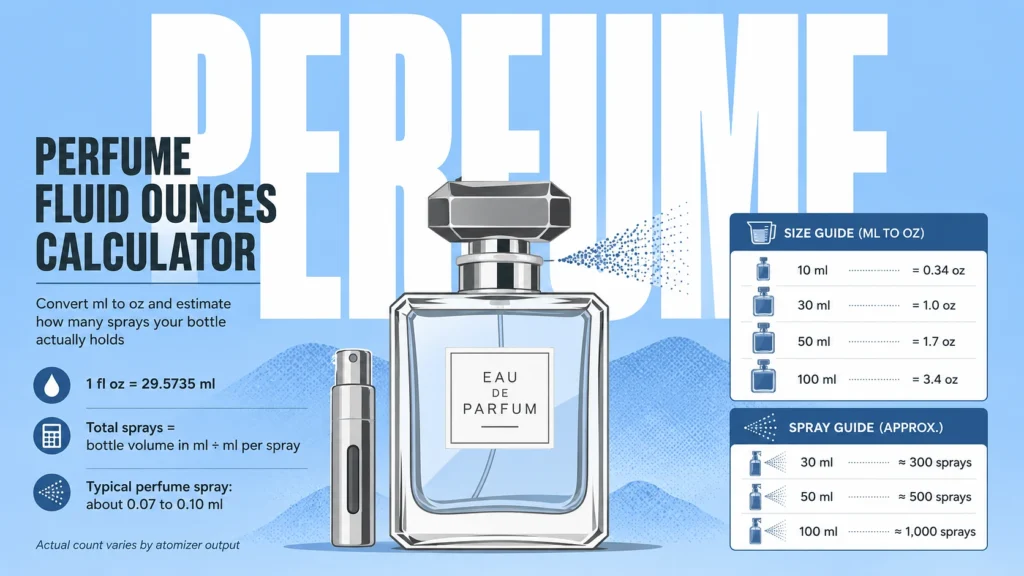
The Conversion: 1 Fluid Ounce Equals 29.5735 ml
That is the US fluid ounce, which is what perfume sold in the US uses. To convert:
- ml to oz: divide by 29.5735
- oz to ml: multiply by 29.5735
The reason perfume sizes look untidy in ounces is that the industry standardised on round metric numbers and then labelled them in imperial.
| Millilitres | Fluid ounces | How it is usually labelled |
|---|---|---|
| 5 ml | 0.17 oz | sample or travel vial |
| 10 ml | 0.34 oz | travel atomizer |
| 15 ml | 0.51 oz | 0.5 oz |
| 30 ml | 1.01 oz | 1 oz |
| 50 ml | 1.69 oz | 1.7 oz |
| 75 ml | 2.54 oz | 2.5 oz |
| 100 ml | 3.38 oz | 3.4 oz |
| 200 ml | 6.76 oz | 6.7 oz |
Note the 1.7 oz row. A bottle sold as 1.7 oz is really 50 ml, which is 1.69 oz, and a bottle sold as a true 1.7 oz would be 50.3 ml. The rounding runs in the retailer’s favour by a fraction, which nobody will ever notice or care about, but it explains why the numbers never quite line up.
How Many Spray Your Bottle Holds
The formula is simple. Total sprays = bottle volume in ml ÷ ml per spray.
The complication is that ml per spray is not standardised. Across the industry, spray mechanisms deliver roughly 0.06 ml to 0.14 ml per actuation. Perfume atomizers sit at the lower end, typically 0.07 to 0.10 ml, and 0.1 ml is the common planning benchmark.
Using that benchmark, plus a low output pump at 0.07 ml and a heavy one at 0.13 ml, here is what the standard sizes give you.
| Bottle | At 0.07 ml (fine mist) | At 0.10 ml (typical) | At 0.13 ml (heavy spray) |
|---|---|---|---|
| 10 ml | 143 sprays | 100 sprays | 77 sprays |
| 30 ml / 1 oz | 429 | 300 | 231 |
| 50 ml / 1.7 oz | 714 | 500 | 385 |
| 100 ml / 3.4 oz | 1,429 | 1,000 | 769 |
A 50 ml bottle can hold anywhere from about 385 to 714 sprays depending on nothing more than the nozzle, and one real-world test of a 50 ml bottle averaged 527 sprays, sitting between the two.
How Long Will It Actually Last?
Divide your spray count by your daily habit.
At two sprays a day, a 50 ml bottle at the typical rate gives you around 250 days, or roughly eight months. At four sprays a day it is closer to four months. A 100 ml at two sprays a day runs well past a year, which is worth remembering, because fragrance does degrade over time and a bottle you cannot finish in a few years may not be the bargain the price per ml suggested.
What Changes The Number
Nozzle Orifice, Which Does Most of The Work
The dominant variable is the size of the opening. One comparison found a discount plastic nozzle delivering 0.13 ml per spray for 384 total sprays from 50 ml, while a precision French nozzle delivered 0.07 ml for 714 sprays.
There is a catch worth knowing. The fine nozzle needed roughly three presses to deposit what the heavy nozzle deposited in one. More sprays does not automatically mean more perfume on your skin, it means the same liquid divided into smaller portions, which is generally better for control but is not free extra product.
Things That Do Not Change It
Concentration does not affect spray volume. An eau de parfum and an eau de toilette in the same 50 ml bottle with the same atomizer dispense the same amount of liquid. Concentration changes how strong and long-lasting each spray is, not how much comes out.
Viscosity has a minor effect, since thicker oil-heavy formulas may dispense slightly less per press, but it is small next to the nozzle.
Why You Will Never Get The Full Theoretical Count
Some liquid is always left behind. The dip tube cannot reach the last of the bottle, incomplete presses dispense partial doses, and slow evaporation happens even in sealed bottles over years. Expect the real figure to land somewhat below the calculation.
Measuring Your Own Battle Properly

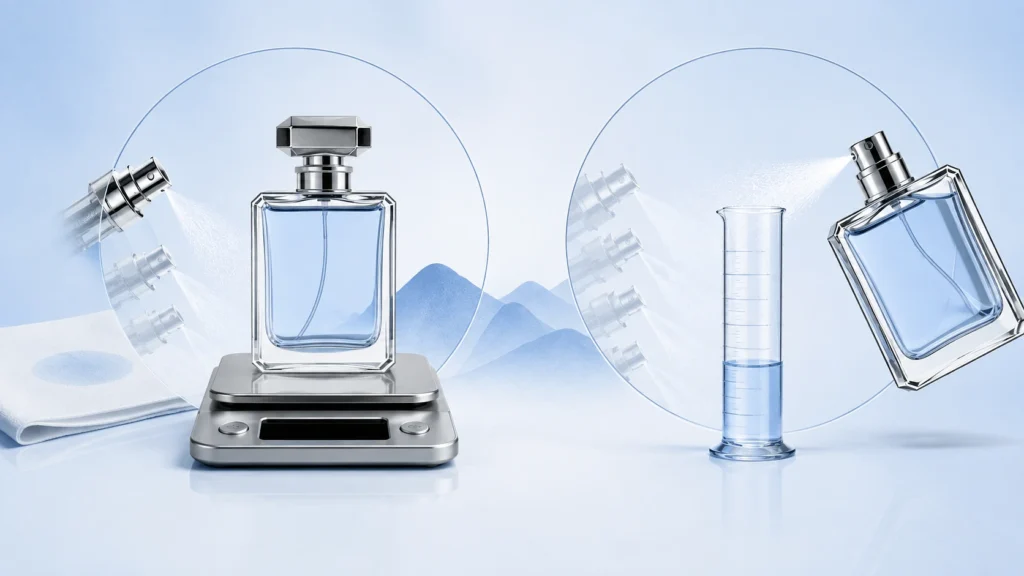
If you want the actual number for a bottle you own, there are two reliable methods.
The scale method. Use a scale with 0.01 g resolution. Weigh the bottle, spray it fully 20 to 50 times into a cloth or the air, weigh it again, and divide the mass lost by the number of sprays. One note on accuracy: perfume is ethanol-rich balancing your energy with scents, so grams do not equal millilitres exactly, and a precise conversion needs the liquid’s density. For planning purposes the error is small enough to ignore.
The collection method. Spray a fixed number of times into a small graduated cylinder or measuring vessel and read the volume directly. Simpler, slightly less precise, and perfectly adequate.
Either way, twenty sprays is enough to average out the variation in how hard you press.
The Useful Version Of All This
If you are comparing two bottles on price, compare per ml rather than per bottle, since 100 ml is almost always cheaper per unit than 50 ml, and the ounces on the label are just the same number wearing a different coat.
If you are deciding whether a bottle will last, run the arithmetic against your own habit rather than an average. Two sprays a day and six sprays a day are completely different purchases.
And if you are choosing between two atomizers on a refillable bottle, the fine one is generally the better buy for expensive juice, because control matters more than raw spray count once you accept that three fine sprays and one heavy spray are roughly the same amount of perfume.