



Between 2011 and 2019, the number of psychiatrists treating Medicare beneficiaries fell by 6%. Over the same period, the number of PMHNPs treating those patients grew by 162%.
That comes from a Health Affairs analysis of Medicare claims covering a full sample of fee-for-service beneficiaries, and the downstream numbers are more striking than the headline. Psychiatrist visits dropped 29%. PMHNP visits rose 111.3%. The share of all mental health prescriber visits delivered by PMHNPs climbed from 12.5% to 29.8%, and in rural areas where nurse practitioners have full scope of practice, it passed 50%.
The same study found psychiatrists and PMHNPs were treating roughly comparable patient populations, with similar services and similar prescriptions.
So the question of whether PMHNPs can carry a meaningful share of psychiatric care has already been answered by what happened, not by what anyone argued.
The Shortage Numbers Explain Why The Shift Happened

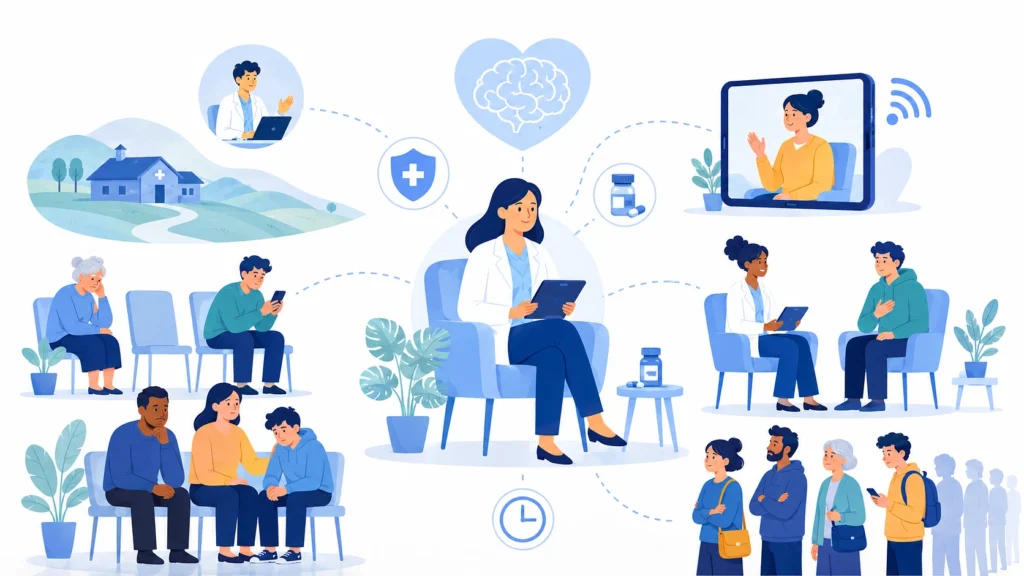
137 million Americans, roughly 40% of the population, live in a federally designated mental health professional shortage area as of HRSA’s late 2025 workforce report. Across those areas, only about a quarter of assessed provider need is being met.
An area qualifies as a mental health HPSA when the population-to-psychiatrist ratio hits 30,000 to 1, or 20,000 to 1 in communities with unusually high need. That threshold is worth sitting with, because it means a county can have a psychiatrist and still be designated a shortage area.
Some further figures from the same body of federal data:
- 69% of rural counties have no psychiatric-mental health nurse practitioner at all, per a 2024 HRSA brief.
- Around 80% of rural counties have no practising psychiatrist.
- Average wait times for behavioural health services have been measured at 48 days.
- SAMHSA’s 2024 National Survey on Drug Use and Health counted 61.5 million adults with any mental illness, roughly 23% of the adult population, with 48% receiving no treatment.
That last figure is the one to correct if you have seen older articles quoting 53 million. The number has moved.
PMHNP is The Fastest-Growing Nurse Practitioner Specialty, And The Pipeline is Still Short

The Bureau of Labor Statistics projects 46% employment growth for nurse practitioners from 2023 to 2033, and psychiatric-mental health is the fastest-growing specialty within that.
Universities responded. AACN’s 2023 to 2024 enrolment report identified 374 PMHNP programmes awarding MSN, MSN-to-DNP and BS-to-DNP degrees, close to a hundred more than a decade earlier.
It is still not enough. HRSA projects the country will be short nearly 15,000 PMHNPs by 2037 if behavioural health demand stays where it is. Their broader 2038 projections estimate shortfalls of roughly 99,840 psychologists, 99,780 mental health counsellors, 77,050 addiction counsellors and 36,780 adult psychiatrists.
What The Role Actually Involves
A PMHNP assesses, diagnoses, prescribes and manages medication, and provides therapy. The last part gets forgotten in comparisons with psychiatry, where therapy has largely moved out of the prescriber’s remit.
The scope covers the full lifespan, from children with behavioural presentations through to older adults with dementia or late-life depression, and it lands across settings that look nothing like each other: hospital psychiatric units, community clinics, schools, correctional facilities, primary care, and telehealth.
In correctional settings and rural schools, the PMHNP is frequently the only behavioural health prescriber anyone will see.
Scope of Practice Varies By State, And It Changes What The Job is

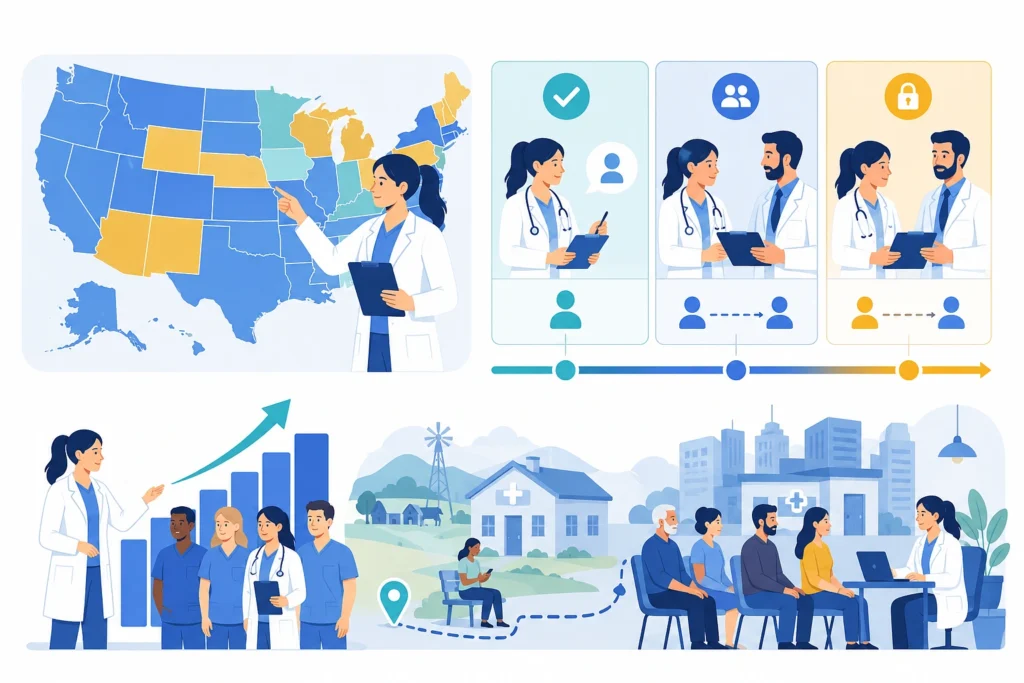
This is the structural fact that determines a PMHNP’s actual authority, and it is not uniform.
States fall into full practice, reduced practice or restricted practice under the APRN Consensus Model framework. In full practice states, a PMHNP evaluates, diagnoses, prescribes and manages treatment independently. In restricted states, elements of that require physician oversight or a collaborative agreement.
The Medicare data shows what that difference produces. PMHNP share of mental health prescriber visits exceeded half in rural, full-scope-of-practice areas, against under 30% nationally.
Supply And Access Are Not The Same Problem
Worth knowing before anyone reads the workforce numbers as a solved problem.
Nurse.org’s 2026 state-by-state workforce analysis found Wyoming combining full practice authority with roughly average PMHNP density, while 96% of its residents still live in designated shortage areas. Adding practitioners does not automatically place them where the gap is.
Distribution, rather than headcount or legislation alone, is the part nobody has fixed.
Education And Credentialing, In The Order It Happens
Bachelor of Science in Nursing first, then a graduate degree, either an MSN or a DNP, with a psychiatric-mental health specialisation. Programmes emphasise supervised clinical hours across acute and chronic psychiatric presentations and across patient populations.
Certification then comes from one of two bodies now. The American Nurses Credentialing Center has long administered the PMHNP-BC credential. As of 2024 the American Academy of Nurse Practitioners Certification Board offers a PMHNP-C credential as an alternative pathway.
State boards of nursing add their own licensure requirements on top, and those vary, which matters if you intend to practise across state lines or via telehealth.
The Workforce Problem Nobody Solves By Graduating More People
A Harris Poll survey of 750 behavioral health workers conducted for the National Council for Mental Wellbeing found 93% reporting burnout and 48% considering leaving the field.
Training new PMHNPs into a system that loses experienced clinicians at that rate produces a slower improvement than the enrolment figures suggest. Reimbursement is a large part of it. Behavioural health has been an economically punishing field for decades, and the workforce projections above reflect that history rather than a sudden shortfall.
Anyone entering this specialty should look at the reimbursement environment and scope rules in their intended state as carefully as they look at programme rankings, because those two things will shape the work more than the curriculum does.
Sources:
- Cai A et al., Trends in Mental Health Care Delivery by Psychiatrists and Nurse Practitioners in Medicare, 2011-19, Health Affairs: https://pmc.ncbi.nlm.nih.gov/articles/PMC9769920
- HRSA, Designated Health Professional Shortage Areas Quarterly Report: https://data.hrsa.gov/default/generatehpsaquarterlyreport
- Nurse.org, 2026 PMHNP Workforce Report, state-by-state analysis: https://nurse.org/education/pmhnp-access-census/
- Nurse.org, psychiatric NP certification growth and HRSA workforce projections: https://nurse.org/articles/nursing-mental-health-certification-trends/
- Becker’s Behavioral Health, mental healthcare provider gaps by state and HPSA methodology: https://www.beckersbehavioralhealth.com/behavioral-health-mental-health/mental-healthcare-provider-gaps-by-state/