


Every April, when the last of the plowed snow finally melts off driveways around the mitten, a lot of homeowners walk out and find the same ugly surprise. The top layer of their concrete has started coming off in flakes and chips, like old paint, and the driveway they paid for four or five years ago suddenly looks twenty years old.
Concrete people call that scaling, or spalling when the chips get deeper. It isn’t bad luck, and it isn’t only the weather. Most of the time it’s the result of something that went wrong on the day the concrete was poured, or in the weeks right after, and by the time you see it, there’s no fixing it short of resurfacing or tearing it out.

Why Michigan Driveways Peel After A Few Winters
Concrete looks solid, but it’s full of tiny pores, and water gets into them. When that water freezes, it grows by about 9%, and it pushes outward against the concrete around it. One freeze doesn’t do much. Michigan gets dozens of freeze-thaw cycles in a normal winter, though, and every one of them works the surface loose a little more.
Then come the salt trucks. Salt melts the ice, sure, but it also means more water sitting on the slab, freezing and thawing over and over, and the brine soaks down further than plain water would.
What saves good concrete is air. Ready-mix plants can add a chemical that fills the mix with millions of microscopic bubbles, so the freezing water has room to expand without cracking anything. The Portland Cement Association says air-entrained concrete normally runs between 4% and 7% air. Any outdoor slab in this state should have it, and if a contractor shrugs when you ask whether the mix is air-entrained, that’s a bad sign.
The Part Of The Job You Never See Again
Once the concrete’s down, the base is buried for good, which is exactly why it’s the easiest place to cut corners.
What Goes Under The Slab
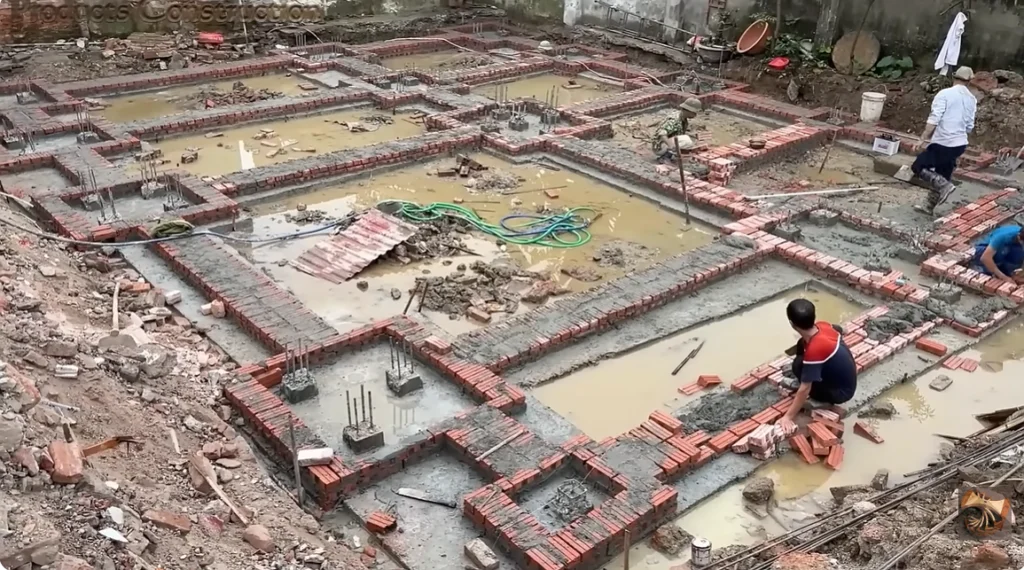
A crew that’s doing it right will dig out the topsoil and anything soft, then put down crushed stone or gravel and compact it with a plate compactor until it’s firm. Skip that, or rush it, and the slab ends up resting on ground that settles unevenly. That’s how you get a patio that tilts toward the house after a couple of years, or a driveway with one corner that’s sunk an inch lower than the rest.
The heavy clay you find across much of southeast Michigan makes this worse, since clay holds water and swells and shrinks with the seasons.
How Deep The Footings Go
For a garage, an addition or anything else that carries a building, the footings have to sit below the frost line. In most of Michigan, that’s 42 inches down from finished grade. Above that depth, the ground heaves when it freezes, and any footing sitting in it rides up and down with it. The building inspector checks this before the pour, which is one of the better reasons not to skip the permit.
What Happens On Pour Day
Concrete crews call the stuff “mud,” and on a hot afternoon, it’s tempting to add water to the truck so the mud spreads easier. It does spread easier. It also comes out weaker, shrinks more as it dries and is far more likely to scale. A good crew orders the right slump from the plant in the first place and works with what shows up.
The control joints get cut or tooled in that same day or the next. These are the straight grooves you see across sidewalks, and their job is to give the concrete a planned place to crack, because it’s going to crack somewhere as it shrinks. The usual rule is to keep them no further apart than two to three times the slab thickness in feet, which works out to roughly every 8 to 12 feet on a standard 4-inch driveway. Leave them out and the cracks wander wherever they like.
After the bull float and the broom finish, the concrete still isn’t done. It needs moisture to keep hardening, so the surface gets kept damp, covered with plastic or sprayed with a curing compound. A slab that dries out too fast in the sun or wind never reaches the strength it should have. It takes about 28 days to get close to full strength, which is why you’ll be told to keep the truck off a new driveway for a few weeks, even though you can walk on it after a day or two.
The First Winter Decides A Lot

New concrete is at its weakest the first time it freezes. Most concrete groups give the same advice for that first season:
- Skip the rock salt. Use sand for grip instead.
- Never use de-icers or fertilizers that contain ammonium nitrate or ammonium sulfate, even on old concrete. They eat into the surface.
- Shovel early, before the snow gets packed into ice.
- Put a penetrating sealer down before the cold sets in, then reapply every few years.
A slab that gets through its first winter in good shape usually has a long life ahead of it.
What To Ask Before Hiring A Concrete Crew
The best way to size up a concrete contractor in Michigan is to ask about the boring stuff. Ask what base they’ll put down and how thick it’ll be. Ask whether the mix is air-entrained and what strength they’re ordering. Ask how they’ll cure it if the weather turns cold, and where the joints are going to go. Someone who’s poured slabs through a lot of Michigan winters will answer without pausing, and probably tell you a few things you didn’t think to ask.
Pricing that comes in well below everyone else’s usually means something is getting left out, and most of the time, it’s the base. Get the thickness, the mix and the base written into the quote, along with the warranty, so you know what you’re paying for before the truck backs up the driveway.