


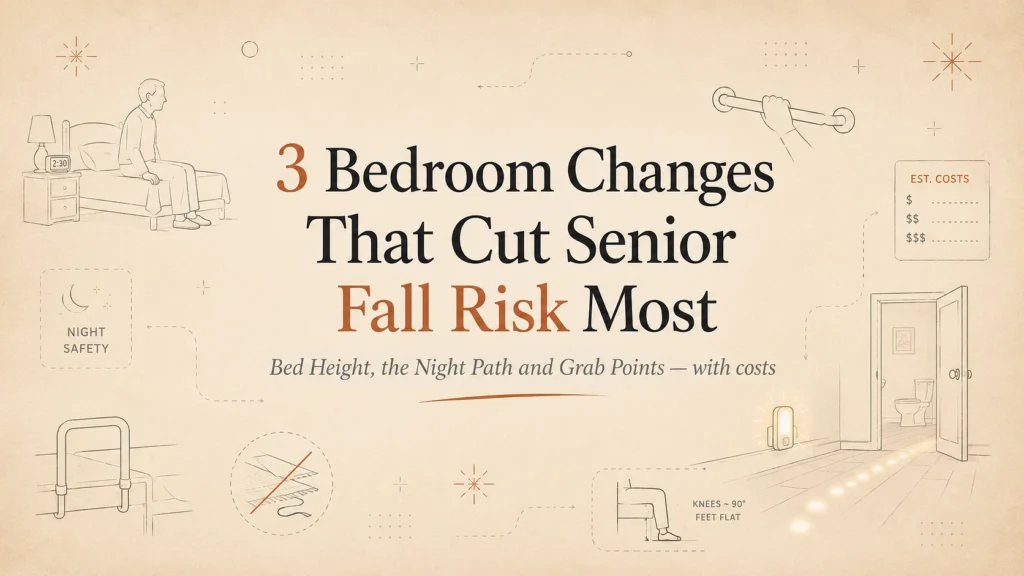
Falls are the leading cause of injury for older adults, and a lot of families pour their energy into the bathroom and the stairs while leaving the one place where trouble often starts untouched. The bedroom at night. Specifically the three or four minutes around a 2 a.m. trip to the toilet, when the body is stiff, the room is dark, and blood pressure has not caught up with the decision to stand.
Three changes matter more than all the others combined, and none of them is expensive or complicated. They line up with the three moments where a nighttime fall actually happens: standing up, walking the path, and reaching for support along the way. Let me walk through the night in that order, because that is the order the risk arrives in.
Standing Up. Fix the Bed Height
The single riskiest instant of the night is the transition from lying down to standing. Here is why, and it is worth understanding rather than just accepting.
When an older adult sits up and stands, blood pressure needs a moment to adjust, and for a few seconds there can be a wave of lightheadedness. That brief window, on a soft surface, in the dark, is exactly when balance fails. A bed at the wrong height makes it worse in two directions. Too high and the feet dangle, so standing becomes a small drop onto legs that are not ready. Too low and the person has to haul themselves up from a deep squat, which is unsteady in its own way.
The target most therapists use is a mattress-top height of roughly 20 to 23 inches from the floor, the point where someone sitting on the edge can plant both feet flat with knees bent at about a right angle. That posture lets them stand by rocking forward over their feet, the stable way, instead of dropping or hauling.
How do you get there without buying a new bed? Cheaper than you would think:
- Swap a tall mattress or thick box spring for a thinner one, or remove a box spring layer entirely. Often free.
- Add bed risers under a too-low frame, or take existing risers out. A set runs roughly ten to twenty-five dollars.
- For a wood bed that is way off, an adjustable frame solves it permanently but costs real money, and most people do not need to go there.
Measure before you change anything. Have the person sit on the edge and look at their feet and knees. The floor and the knee angle tell you more than any number.
The Path. Light It So It Lights Itself


Say the standing went fine. Now there is a dark walk to the bathroom, and this is where the second cluster of falls happens, on the path, over things the person knows are there in daylight and cannot see at 2 a.m.
Two fixes work together. The first is lighting that does not require finding a switch. Motion-activated night lights that turn on the moment feet hit the floor remove the entire fumble-for-the-lamp problem, and they are cheap, roughly ten to thirty dollars for a multi-pack, plugged in along the actual route from bed to bathroom rather than scattered for decoration.
The second costs nothing at all: clear the path. That means the throw rug that slides, the phone charger cord crossing the floor, the basket, the stool, the corner of a bed frame that catches a hip. A walker or a stiff hip needs a genuinely open lane. Walk the route yourself in the dark once and you will feel every hazard the daytime version of the room hides.
Where does clutter hide worst? Usually right at the bedroom side, in the tangle of cords and objects on and around the nightstand, which is the exact spot the feet land first.
The Reach. Give the Hands Something Solid
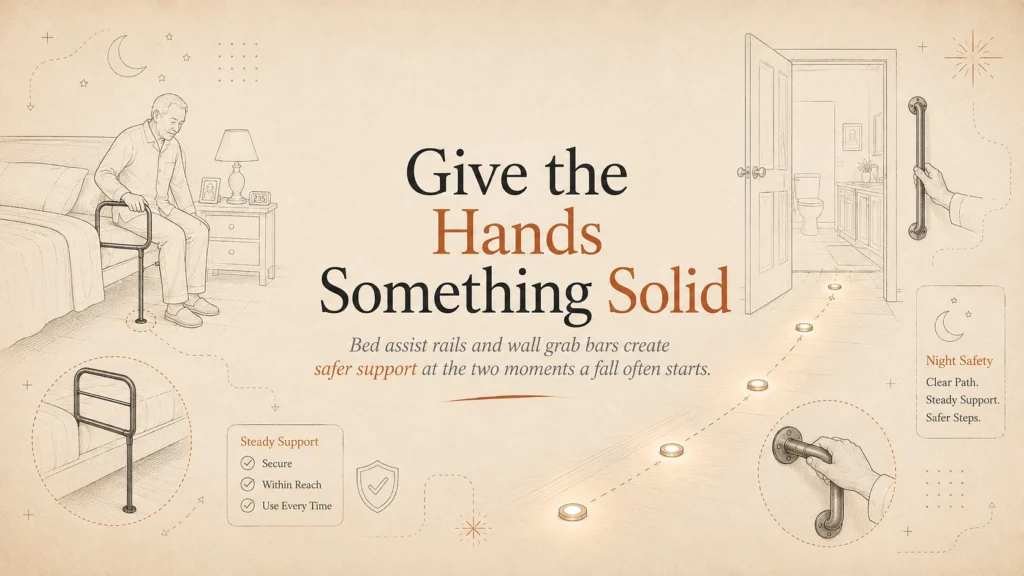
Even with a good bed height and a lit path, there are two points where a steadying handhold prevents a fall: pushing up out of bed, and the walk itself. This is the grab-point layer, and it is where a little money buys a lot of safety.
For getting in and out of bed, a bed assist rail that clamps or slides under the mattress gives a firm vertical grip for that first stand. Prices run something like thirty to seventy dollars, and the numbers that matter on the box are the weight rating and whether it has a floor-support leg, which makes it far sturdier than a bar anchored to the mattress alone. Look for an ASTM-tested rail rated well above the user’s weight.
Along the walk, and especially near the bathroom door, a wall-mounted grab bar gives a fixed anchor. A basic bar is inexpensive, twenty to forty dollars, but this is the one item where installation is the real cost and the real safety, because a grab bar screwed into drywall instead of a stud will pull out under exactly the load it was meant to catch. Either mount into solid framing or use proper anchors rated for the job, and if that is not a confident DIY task, pay someone, because a bar that fails is worse than no bar at all.
One honest note on the whole grab-point layer: match the tool to where the difficulty is. Trouble rolling and pushing up in the middle of the bed points to a rail. Trouble on the walk points to bars and better lighting. Buying the wrong one for the actual problem is the common, avoidable mistake.
| The change | The moment it protects | Rough cost | The detail that matters |
|---|---|---|---|
| Right bed height (about 20 to 23 in) | Standing up from bed | Free to $25, more for adjustable frame | Feet flat, knees near a right angle |
| Motion night lights on the path | The dark walk | $10 to $30 | Trigger on movement, placed on the real route |
| Clear the path | The dark walk | Free | Rugs, cords, and bedside clutter first |
| Bed assist rail | Pushing up out of bed | $30 to $70 | Weight rating and a floor-support leg |
| Wall grab bar near bathroom | Reaching for support | $20 to $40 plus install | Must anchor into studs, not drywall |
Match the Fix to the Struggle
| If the difficulty is | Start with | Not this yet |
|---|---|---|
| Feeling dizzy on standing | Bed height, then a rail to grip | A far-off grab bar |
| Rolling over, pushing up in bed | Bed assist rail | Path lighting alone |
| Seeing the way to the bathroom | Motion lights plus clearing clutter | An expensive bed |
| Staying steady on the walk | Grab bars and a clear lane | A bed rail |
| Getting back into bed safely | Correct height plus the same rail | Nothing, this one gets missed |
What to Do First, and What It Costs Together
If you do nothing else, do the free things tonight check the bed height with the feet-and-knees test, and clear the path of rugs, cords and clutter. Those two cost nothing and remove a real share of the risk before you have spent a dollar.
Then the small purchases, and the total is genuinely modest. Motion lights, a bed rail, and a grab bar together land somewhere around sixty to a hundred and forty dollars depending on what you buy, which is a small number against a single fall. And worth knowing before you pay full price, Medicare and some insurance may cover items like bed rails or grab bars when a doctor documents them as medically necessary, so a quick call before buying can be worth it, though motion lights and similar odds and ends usually come out of pocket.