


Abstract: The single most useful skill in buying a leather handbag isn’t an eye for craftsmanship, it’s the ability to decode the label, because the leather industry’s terminology is quietly designed to mislead. The biggest trap: “genuine leather” sounds premium but is actually one of the lowest grades of real leather. This guide lays out the real quality hierarchy, from full-grain at the top to bonded at the bottom, explains what each grade means for how a bag ages, and gives you a handful of physical tests, smell, surface, edges, weight, to judge a custom bag in your hands regardless of what the tag claims. The honest surprise at the end: even luxury houses often use less than the top grade, so the label is a starting point, not a verdict.
Here’s the trick the handbag industry doesn’t advertise the word stamped on the tag to reassure you is frequently the word designed to fool you. Most people walk into a store believing “genuine leather” is a mark of quality, and walk out having paid a premium for one of the cheapest real-leather grades made. The art of choosing a good leather bag turns out to be much less about taste and much more about translation, knowing what the labels actually mean versus what they’re worded to imply. So let me hand you the decoder, because once you have it, the whole category gets easier and a lot of overpriced bags reveal themselves instantly.
The Hierarchy, Top To Bottom, And The Trap Sitting In The Middle

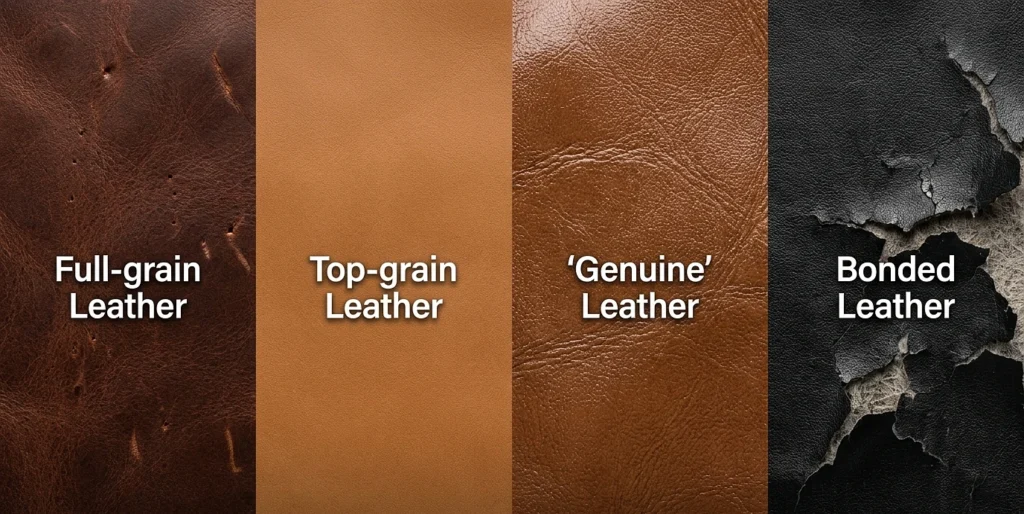
Real leather comes in grades, and they describe which layer of the hide you’re getting and how much of its natural surface survived. From best to worst, this is the ladder every buyer should have memorized:
- Full-grain leather: the top of the ladder. It’s the outermost layer of the hide with its natural grain completely intact, nothing sanded away. That intact grain is the densest, strongest part of the skin, which is why full-grain is the most durable and the only grade that develops a real patina, that rich, deepening character good leather earns over years. It carries the hide’s natural marks, small scars, grain variation, and those are signs of authenticity, not flaws. Highest quality, ages beautifully, lasts decades.
- Top-grain leather: the strong second. The top layer, but lightly sanded and finished to remove imperfections and even out the surface. That sanding costs some durability and some of the patina potential, but top-grain is genuinely good, more uniform, a bit more supple, and, as you’ll see, the grade a lot of expensive bags are actually made from.
- “Genuine leather”: the trap. Here’s the one to burn into memory. Despite the premium-sounding name, “genuine leather” is one of the lowest grades of real leather. It’s made from the lower, split layers of the hide left after the good top layers are removed, often coated in polymer and embossed with a fake grain to look like something better. It’s real leather in the narrowest legal sense and little more. It won’t develop a patina, it can feel slightly plastic from the coating, and it wears out rather than aging well.
- Bonded leather: the bottom, and barely leather at all. Scraps and leather dust glued together with polyurethane onto a backing, then embossed to look like a hide. It’s the particleboard of leather. It peels and cracks, often within a year or two, and in any practical sense it isn’t leather, it’s leather-flavored plastic.
The load-bearing insight is that these terms sound like a quality scale and are one, except the scale isn’t intuitive. “Genuine” doesn’t mean good. It means authenticated-but-low-grade, and, worse, literally everything above bonded on this list can also legally be sold under the vague word “genuine leather.” So when you see “genuine leather” with no other qualifier, the safe assumption is that if the maker had something better, they’d have said so.
Why The Grade Decides Everything About How The Bag Ages
This isn’t snobbery about words, the grade determines what the bag becomes over time, which is the whole reason to buy leather instead of canvas.
A full-grain bag is buying a relationship. It starts a little stiff, maybe with visible natural markings, and over years of handling it softens, darkens at the handles, and develops that lived-in glow that people pay real money to fake. A genuine-leather bag does the opposite: it looks its best in the store, because that polymer coating and embossed grain are as good as it will ever get, and from there it only degrades, the coating scuffing and eventually flaking. A bonded bag is on a countdown to peeling from the day you buy it. Same word, “leather,” on all three tags. Three completely different futures. The grade is the single best predictor of whether year three finds your bag richer or ruined.
How To Judge A Bag In Your Hands, Past Whatever The Tag Says

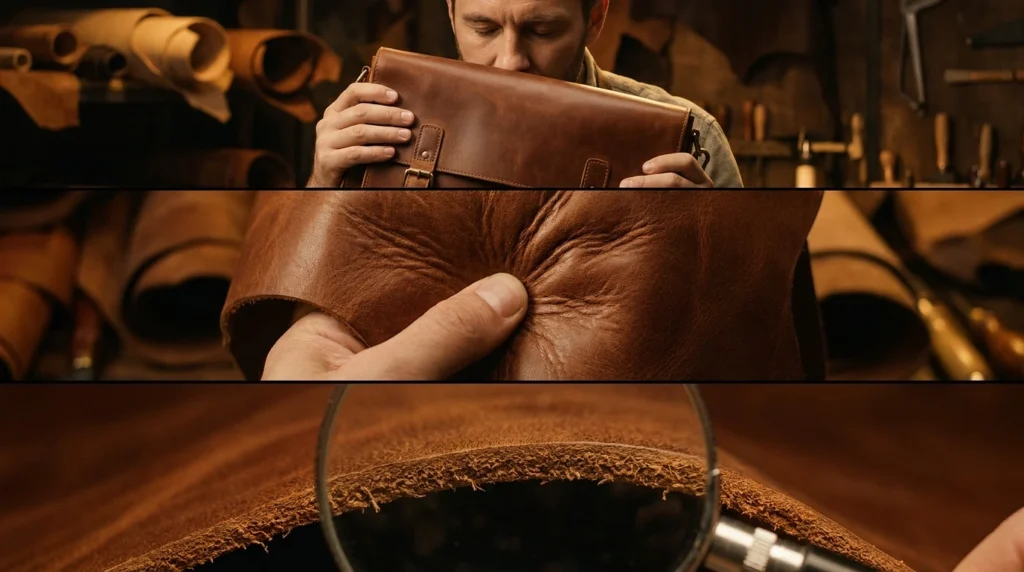
Labels can mislead, but leather itself is harder to fake to your senses than to your eyes. A few quick physical tests cut through the marketing:
- Smell it. Real, higher-grade leather smells like leather, warm, organic, unmistakable. Lower grades and fakes smell of plastic or chemicals. This is one of the most reliable instant tells, adjusting for the fact that heavily dyed leather carries some of that dye smell too.
- Look at the surface closely. Full-grain shows subtle irregularity, natural pores, slight variation, the odd mark. A surface that’s perfectly, monotonously uniform is usually corrected or coated, a sign of lower grade, because real top-layer hide is never that flawless.
- Check the edges. The cut edges of a bag reveal a lot. Solid leather looks consistent through the cross-section; bonded and heavily coated leathers show a fibrous or layered core, a backing material, or a suspiciously clean painted edge hiding what’s underneath.
- Feel the weight and flex. Good leather has a substance and a supple, broken-in flex to it. A stiff, oddly light, or rubbery-feeling bag is often coated split leather or a bonded material trying to pass.
- Press it. Real full-grain creases and wrinkles naturally when bent, like skin. Coated and synthetic surfaces tend to fold stiffly or spring back with a plastic snap.
The Honest Twist: Even Luxury Bags Aren’t Always Full-Grain
Here's the part that keeps this from being a simple "always buy full-grain" sermon, because the reality is more interesting and more useful.
Top-grain, not full-grain, is the grade most commonly used by major fashion houses for their leather goods. A lot of expensive designer bags are top-grain, chosen deliberately, because the sanding gives a smoother, more uniform, more consistently “luxury” looking surface that many buyers actually prefer to full-grain’s natural irregularity, and because it’s easier to work and finish. So a full-grain bag from a small maker can, in raw material terms, out-quality a top-grain bag from a house charging five times as much. The price tag is not the grade, and the logo is not the grade.
This is why the decoder matters more than the brand. What you’re really doing when you choose a leather handbag well is holding two questions apart that the marketing works hard to blur: is this real leather (almost everything says yes) and what grade of real leather is it (the tag usually won’t volunteer this, and the answer is the whole story). A bag worth buying earns it through grade, construction, and how it feels in your hand, not through a reassuring word or a famous name.