



Let’s follow one imaginary check all the way to the bank, because that’s the math nobody shows you until you’re sitting in a disbursement meeting wondering where half your settlement went.
Say a car crash case settles for $100,000. The lawyer took it on contingency at a third, so $33,333 comes off the top. Case costs, the filing fees, the accident reconstructionist, the fee your own doctor charged for writing a report, run another $4,000. Then the part that blindsides people: your health insurer paid $22,000 of your treatment bills and has a legal right to claw a chunk of that back out of your settlement. After your lawyer negotiates that lien down to $14,000, your take-home is about $48,700. Not $100,000. And here’s the uncomfortable twist this entire article turns on that $48,700 is still probably far more than you’d have gotten alone, and the insurance industry’s own research says so. Every case is different and none of this is legal advice for yours, but the machinery works the same way everywhere, so let’s take it apart piece by piece.
The Value Of A Claim Is Built From Two Stacks, And One Of Them Has No Receipts
Every settlement number starts as two piles added together. Economic damages are the pile with paperwork emergency room bills, physical therapy invoices, the paychecks you missed, the future surgery your orthopedist put in writing. Non-economic damages are pain and suffering, and there is no invoice for that, which is exactly why it’s where all the real negotiation happens.
Adjusters and attorneys both use rough frameworks here, a multiplier on the medical bills scaled by injury severity, or a per-day figure across the recovery period. A soft-tissue case might argue for 1.5 to 2 times the medicals. A fracture with hardware, a spine injury, anything permanent, argues far higher. The framework isn’t law, it’s a bargaining anchor, and whoever documents their side better moves the anchor. Which is why the boring advice about keeping records is actually the whole game: the case value isn’t discovered, it’s constructed, receipt by receipt, and gaps in your medical treatment get read by the adjuster as gaps in your injury.
One more input people forget. Fault percentages. Most states run comparative negligence, meaning if you’re found 20% at fault, your number drops 20%, and in many states crossing the 50% line drops it to zero. Adjusters push fault arguments precisely because of that math.
The Insurer’s First Offer Is An Opening Bid, And The Data On This Is Brutal


The thin conventional wisdom says insurance companies “prioritize their financial interests.” Sure. But the numbers are more interesting than the platitude.
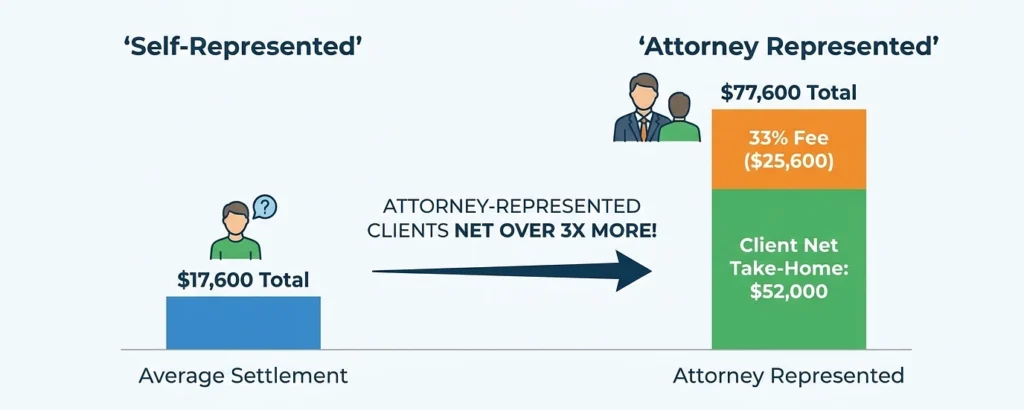
The Insurance Research Council, which is funded by the insurance industry itself, has studied attorney involvement in injury claims for decades, most recently in its 2014 report analyzing tens of thousands of closed claims. Its consistent finding: represented claimants recover on average 3.5 times more than unrepresented ones, with one analysis putting the averages at $16,658 with an attorney versus $4,699 without. The IRC also found that 85% of all dollars insurers pay out on bodily injury claims go to represented claimants. A separate Martindale-Nolo reader survey found an even wider gap in self-reported outcomes, $77,600 average with a lawyer against $17,600 without, and 91% of represented claimants received some payout versus 51% of the unrepresented.
Sit with the source of that first stat for a second. The industry’s own research arm keeps publishing findings that make hiring a lawyer look like the single highest-return decision a claimant can make. When the house tells you the odds favor the other side of the table, believe the house.
Timing feeds into this too. Early attorney involvement preserves the evidence that builds the two damage stacks, scene photos, witness contacts before they scatter, and it puts a buffer between you and the recorded statement the adjuster will ask for in that friendly first call. Those calls are friendly for a reason.
The Contingency Fee: A Third, Sometimes 40%, And What It Actually Buys

The standard American injury fee is contingency, no win, no fee, and the percentage typically runs 33% if the case settles before a lawsuit gets filed, rising to around 40% once litigation starts, because trial prep is where the firm’s real cost lives. Some states regulate this directly. Florida’s bar rules, for instance, put contingency fees on a sliding scale that shifts once the defendant answers the complaint, and require court approval to exceed it.
Is a third a lot? It’s an honest question and the math from the studies above answers it. Take the Nolo survey numbers: $77,600 minus a 33% fee nets about $52,000, roughly three times the $17,600 the average unrepresented claimant kept whole. The fee is real money. The alternative is worse money. Both things are true, and any article that only tells you one of them is selling something.
Two fee questions worth asking any lawyer before signing, because the answers vary by firm and they change your net. Whether case costs come out before or after the fee percentage is calculated, before is better for you. And whether the fee steps up automatically at filing or only at later litigation stages.
Liens: The Third Party At Your Settlement Table Nobody Warned You About
Here’s where the take-home math gets ugly, and where the thin version of every injury article goes silent. If anyone else paid for your accident-related care, they likely have a reimbursement right against your settlement. Health insurers through subrogation clauses buried in your plan. Hospitals through statutory hospital liens in many states. And if Medicare or Medicaid paid, federal and state law gives them recovery rights that must be resolved before anyone disburses a dollar, with Medicare’s process notorious for taking months.
This is, quietly, one of the most valuable and least advertised things injury attorneys do. Liens are negotiable. A health plan’s $22,000 claim can often be cut substantially, sometimes on legal doctrines with wonderfully archaic names like the made-whole rule and the common-fund doctrine, sometimes just through the grinding phone calls you’d never make yourself. Every dollar knocked off a lien lands in your pocket at the same value as a dollar added to the settlement, and lien reduction doesn’t require the defendant to agree to anything.
So when you evaluate any settlement offer, the only number that matters is the net. Run the ledger:
- Gross settlement offer.
- Minus the fee at the current stage’s percentage.
- Minus case costs, and check whether they come off before the fee math.
- Minus every lien at its negotiated figure, not its face amount.
- What’s left is your actual money, and it’s the only figure worth comparing against your future medical needs and lost earnings.
If a lawyer can’t walk you through that ledger line by line before you sign a release, that tells you something about the lawyer.
When It Goes To Trial, And Why It Usually Doesn’t
Somewhere north of 90% of injury claims resolve without a verdict, and both sides prefer it that way, trials are expensive, slow, and genuinely unpredictable. But the credible threat of trial is what moves settlement numbers, which is why adjusters reportedly track which firms actually try cases and price their offers accordingly. Litigation also restarts the clock, discovery and depositions and mediation can stretch a case across years, and that delay is itself a negotiation weapon insurers use against people whose bills are due now. A decent attorney will be blunt with you about that tradeoff instead of promising a courtroom victory lap.
The last thing worth saying is the thing that makes this whole subject uncomfortable. The system pays out based on documentation, leverage, and negotiating stamina, not on how much you actually hurt, and no amount of consumer education fully closes that gap. Knowing the ledger at least means nobody’s math surprises you at the disbursement table. That’s not justice exactly. It’s just the best available version of not getting fleeced.