


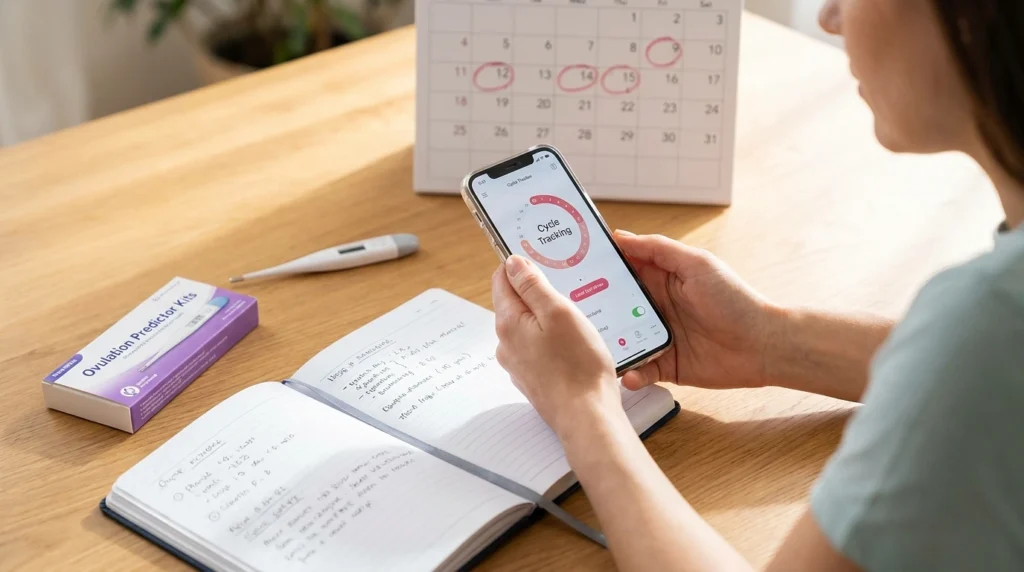
Trying to conceive comes with an avalanche of advice, and a surprising amount of it will quietly cost you months. Not because it’s dangerous, but because it’s mistimed or aimed at the wrong thing. The single biggest waste is couples doing everything “right” while missing the actual fertile window by a day or two, cycle after cycle, because they were told to track the wrong signal. So let me lay out the fundamentals in the order that actually matters, and flag the specific mistakes that eat up months.
The One Piece Of Biology That Decides Everything: The Window Closes At Ovulation
Almost every timing mistake comes from misunderstanding the shape of the fertile window, so start here.
Conception needs sperm and egg to meet, but the two have wildly different lifespans, and that asymmetry is the whole game. Sperm can survive in the reproductive tract for up to 5 days. The egg, once released, survives only about 12 to 24 hours. Put those together and you get a fertile window that opens about 5 days before ovulation and slams shut within a day after it, roughly a 6-day window that ends on ovulation day.
Here’s the counterintuitive consequence that trips people up the best days to have sex are the ones before ovulation, not the day you detect it and after. You want sperm already waiting in the fallopian tube when the egg arrives, because the egg won’t wait around for them. The 1 to 2 days before ovulation, plus ovulation day itself, are the highest-yield days. The day after ovulation, you’ve very likely already missed it for that cycle. Couples who “wait to see the sign and then try” are often a day late, every single month.
The Month-Wasting Mistake: Trusting The Thermometer To Tell You When


Now the specific bad advice the title is warning about, and it’s built right into most basic fertility articles, including the one this is based on. They list basal body temperature (BBT) alongside LH kits and cervical mucus as if the three are interchangeable ways to time intercourse. They are not, and treating them as equal is how people lose months.
Basal body temperature does not predict ovulation. It confirms ovulation after the fact. The small temperature rise you’re watching for is caused by progesterone, which only climbs after the egg is released, so your temperature typically doesn’t shift until 1 to 3 days after ovulation has already happened. By the time your chart shows the rise, the fertile window has closed. Timing sex by your temperature spike is, almost by definition, timing it too late.
This doesn’t make BBT useless, it just means it’s the wrong tool for the job people use it for. BBT is genuinely good for confirming that you ovulate at all, and for spotting your pattern over several months so you can anticipate future cycles. It’s a diagnostic and a pattern-finder, not a real-time timer. Using it to answer “should we try tonight?” is the mistake.
The Methods That Actually Work For Timing, Ranked
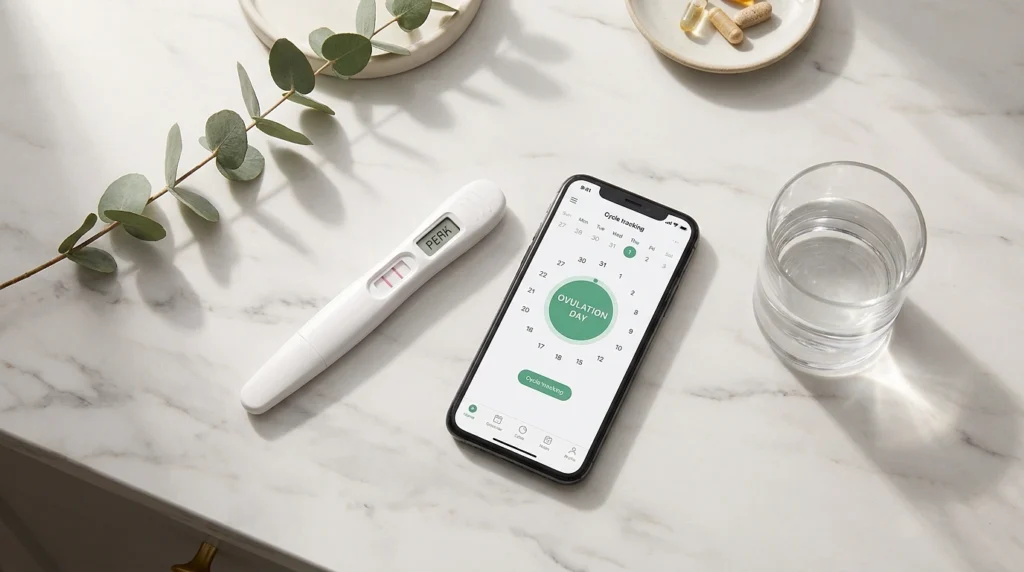
So if you want to catch the window before it closes, here’s the honest hierarchy of what predicts ovulation in advance, which is what timing actually requires.
- Ovulation predictor kits (LH tests): the most reliable predictor. These detect the surge in luteinizing hormone that triggers ovulation, giving you roughly 12 to 36 hours of advance warning, exactly the heads-up you need to time intercourse before the egg drops. This is the single most evidence-supported tool for timing.
- Cervical mucus monitoring: free, and genuinely predictive. As you approach ovulation, cervical mucus becomes clearer, wetter, and stretchier, like raw egg white. That change happens before ovulation, so it’s a true forward signal, and it costs nothing. It’s a strong partner to LH kits.
- Cycle-tracking apps: a starting estimate, not a confirmation. Apps predict your window from historical cycle data, but their accuracy runs only about 70 to 90% and drops sharply with irregular cycles, and crucially they cannot confirm you actually ovulated. Use them to know roughly when to start testing with an LH kit, not as the final word.
- Basal body temperature: confirmation and pattern, not timing. As above, it tells you ovulation happened, not that it’s coming.
The strongest approach combines a predictive method with a confirmatory one, for example, LH kits (or mucus) to time intercourse in advance, and BBT across cycles to confirm you’re actually ovulating. That combination catches both halves of the problem: are you ovulating, and are you timing it right.
When To Stop Trying On Your Own And See A Doctor
This is the guidance the basic articles almost always leave out, and it’s the part that prevents the biggest waste of all, spending years trying alone when a specialist could have helped sooner. The thresholds are age-based for a real reason: fertility declines with age, and time matters more the older you are.
- Under 35: see a doctor if you haven’t conceived after about 12 months of regular, well-timed trying.
- 35 to 40: don’t wait a full year, get evaluated after about 6 months.
- Over 40, or at any age with irregular or absent periods, known PCOS or endometriosis, or a history of pelvic issues: talk to a fertility specialist now, not after a waiting period.
None of this means something is wrong, most couples conceive within a year. It means the waiting-it-out approach has an expiration date, and honoring it is itself a way of not wasting months you can’t get back.
Preserving The Option For Later
One more piece, because fertility planning isn’t only about conceiving now. If you’re not ready but want the option later, freezing eggs, sperm, or embryos is a real and increasingly common path, valuable for people delaying parenthood or facing medical treatments (like chemotherapy) that can harm fertility. The honest caveat worth knowing: these methods work best the younger you do them, because the quality and quantity of eggs and sperm decline with age, so freezing at 30 preserves more options than freezing at 40. It’s a conversation to have earlier rather than later if it’s on your mind.
And for those facing fertility challenges, single parents, or same-sex couples, assisted reproductive treatments like IVF, ICSI, IUI, and surrogacy are well-established paths, each suited to different situations, and a fertility specialist can match the approach to your circumstances.
The reframe I’d leave you with: optimizing conception isn’t about doing more, it’s about doing the right thing at the right time. Track a signal that predicts ovulation instead of one that only confirms it. Aim for the days before ovulation, not the day you spot it. And know the point at which trying alone should become trying with a doctor. Get those three right and you stop donating months to well-meaning but mistimed advice, which is most of the battle.