


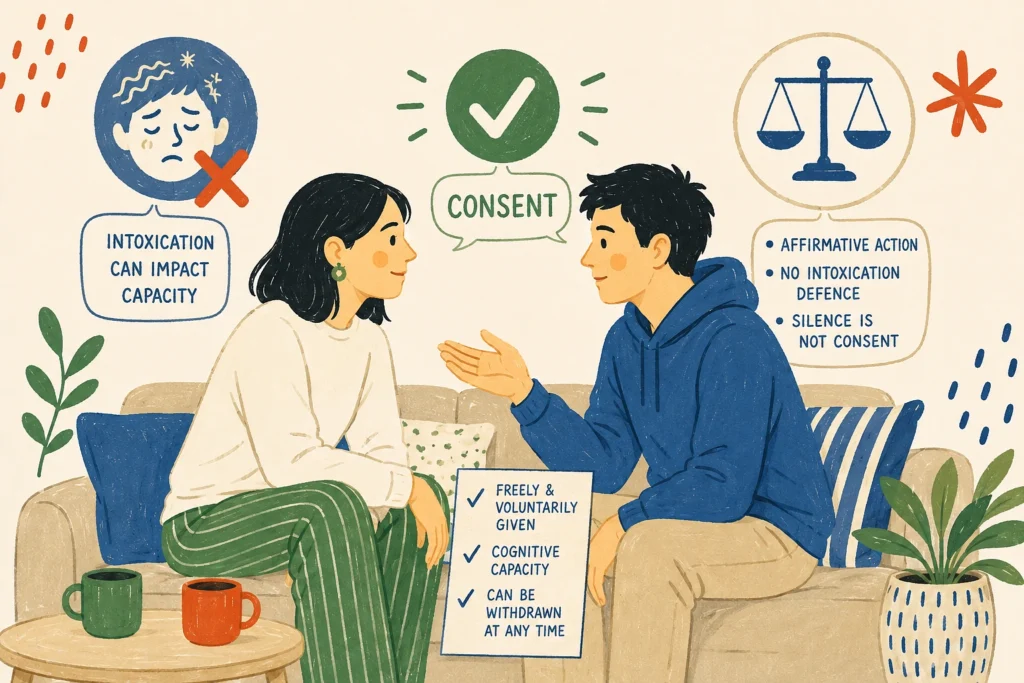
There are two people whose drinking matters in a Queensland sexual offence case and until fairly recently the law treated them quite differently.
The complainant’s intoxication has always been relevant, because consent requires capacity and heavy intoxication can remove it. The accused’s intoxication used to be relevant too, in a way that helped them, because a court could take it into account when deciding whether their belief in consent was reasonable.
That second part changed on 24 September 2024, and it is the single most significant thing to understand about this area of law now.
What The Code Actually Requires Before Anything Else

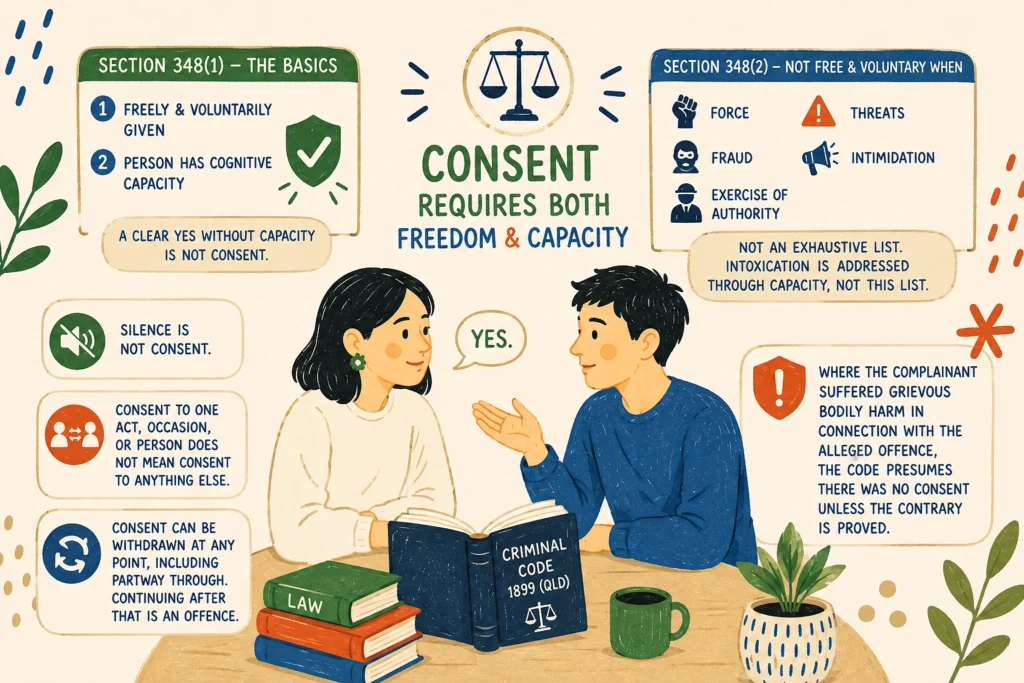
Section 348(1) of the Criminal Code 1899 (Qld) defines consent as consent freely and voluntarily given by a person with the cognitive capacity to give the consent.
Two things have to be present, and people tend to remember only the first. The agreement must be free and voluntary. And the person giving it must have had the cognitive capacity to give it. A clearly spoken yes from someone who lacked that capacity is not consent, whatever it sounded like at the time.
Section 348(2) then lists circumstances where agreement is not free and voluntary, including force, threats, intimidation, fraud and the exercise of authority. That list is not exhaustive, and notably it does not mention intoxication. Intoxication operates through the capacity limb, not through that list, which is a distinction a good deal of secondary commentary blurs.
A few related points sit in the same section and are worth stating plainly, because they come up constantly.
- Silence is not consent. A person is not taken to have consented simply because they did not resist or say no.
- Consent to one act, on one occasion, or with one person, does not establish consent to anything else.
- Consent can be withdrawn at any point, including partway through, and continuing after that is an offence.
- Where a complainant suffered grievous bodily harm in connection with the alleged offence, the Code presumes there was no consent unless the contrary is proved.
The Complainant’s Intoxication, And Why There is no Number
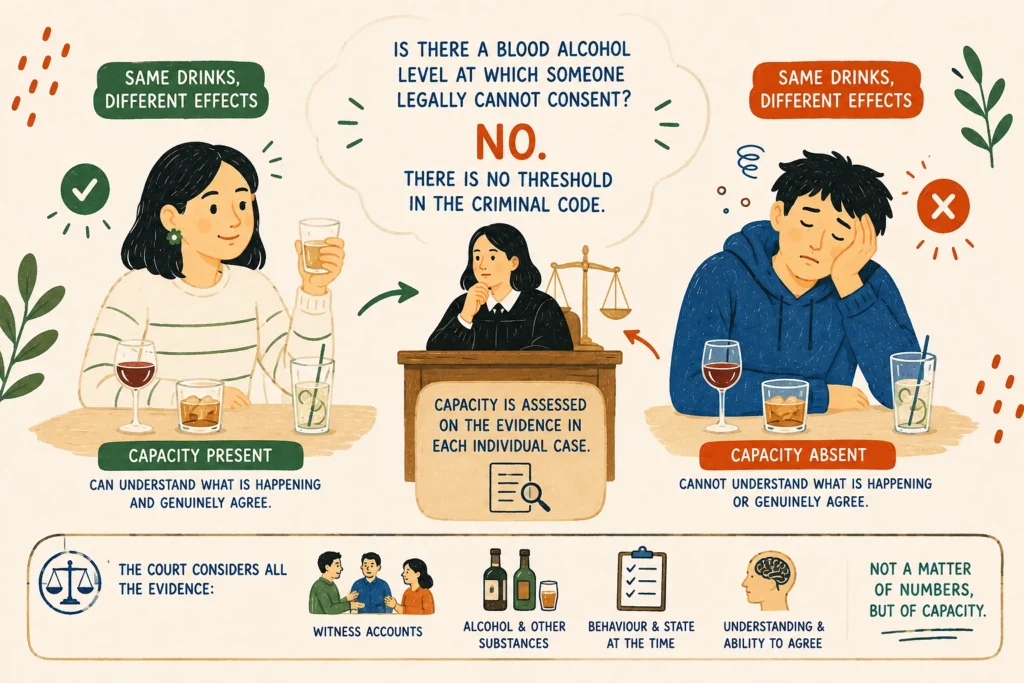
Is there a blood alcohol level at which someone legally cannot consent?
No, and this is the most common misunderstanding of the whole subject. Unlike drink driving, where a reading settles the question, there is no threshold in the Criminal Code. Capacity is assessed on the evidence in each individual case.
That means the same quantity of alcohol can leave one person with capacity and another without it, depending on tolerance, what else was consumed, and how witnesses and other evidence describe their state at the time. What a court is weighing is whether the person could understand what was happening and genuinely agree to it.
So the accurate position sits between the two things people usually assume. Some drinking does not remove capacity. Significant intoxication, to the point where a person cannot understand or genuinely agree, can. Where any real case falls on that line is a question of evidence rather than arithmetic, and it is exactly the kind of question that gets litigated.
The Accused’s Intoxication, Which Used to Help And no Longer Does

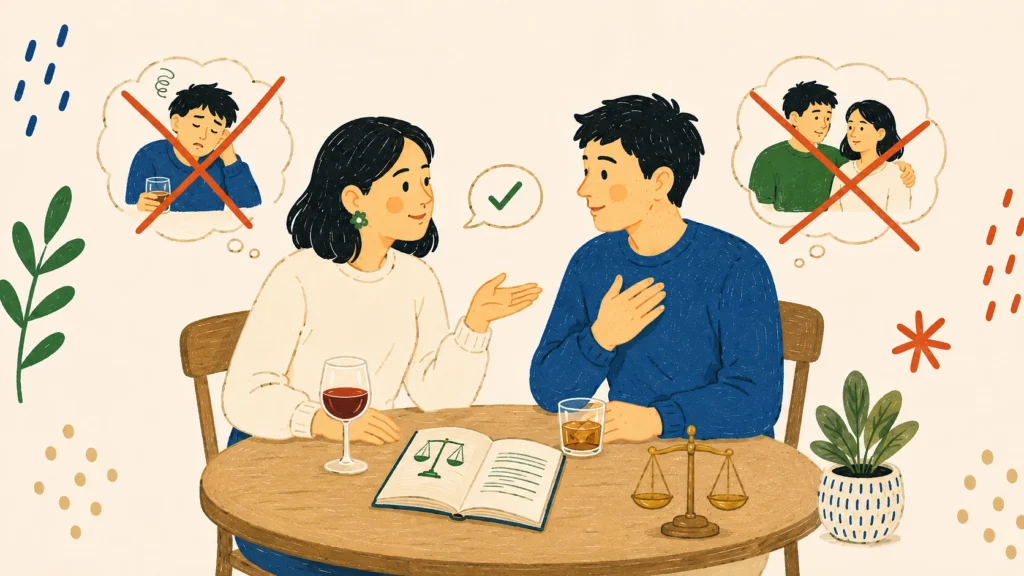
This is where the 2024 reforms did their work, and they did it through the mistake of fact defence rather than by changing the definition of consent.
Queensland law has long recognised a defence where an accused held an honest and reasonable, but mistaken, belief that the other person was consenting. Section 24 of the Code provides the general principle. The amendments inserted a new section 348A giving it specific form for sexual offences.
Two changes matter more than the rest.
An accused’s own voluntary intoxication can no longer be considered. Section 348A provides that in deciding whether the belief was reasonable, regard may not be had to voluntary intoxication of the accused caused by alcohol addiction, a drug or another substance. Before the amendment, an accused could effectively argue that their drinking made their misreading of the situation more understandable. That argument is now unavailable.
Doing nothing is no longer a defence. The provision requires that the accused said or did something, immediately before or at the time of the act, to find out whether the other person was consenting. Passivity now defeats the excuse outright.
That second change is what people mean when they say Queensland introduced affirmative consent. It is reasonable shorthand for the effect, though it is worth being precise the statutory mechanism works through the mistake of fact defence in section 348A rather than by adding a standalone duty into the definition of consent itself.
So What Does That Look Like in Practice?
The practical effect is that assumption is no longer a defensible position. An accused who says they thought the other person was consenting now has to point to something they actually said or did to check, and cannot lean on their own state of mind having been affected by drink.
For anyone trying to understand where the line sits in ordinary life rather than in a courtroom, the shortest version is that consent is something you establish rather than something you infer.
Stealthing, And One Other Provision Worth Knowing
Queensland has separately made clear that consent given on the basis that a condom would be used does not extend to the act if the condom is not worn, is removed, or is tampered with without agreement. The practice is commonly called stealthing, and treating it as a grey area is no longer sustainable in this jurisdiction.
Where To Take an Actual Situation
None of the above is legal advice, and I want to be direct about why that matters more here than in most subjects. Cases in this area turn almost entirely on specific evidence, the accounts of the people involved, and the assessment of capacity at a particular moment.
If you are dealing with something concrete, whether as a complainant or as someone accused, speak with a criminal lawyer. Legal Aid Queensland and the Queensland Law Handbook both provide free general information and can point toward the right kind of help, and doing that early tends to matter a great deal.