


Nobody hands you the map at the start of a pregnancy. You get told to come back in four weeks, then you’re peeing in a cup and stepping on a scale and someone’s pressing a tape measure to your belly, and it all feels routine to them and mysterious to you. So here’s the whole schedule laid out, but more usefully, why each thing happens when it does, because once you know what your OB is actually looking for at each visit, the appointments stop feeling like a conveyor belt and start feeling like the sequence of checks they are, most of them designed to catch a specific problem in the specific window when catching it matters.
The Rhythm: Why The Visits Get Closer Together As You Go

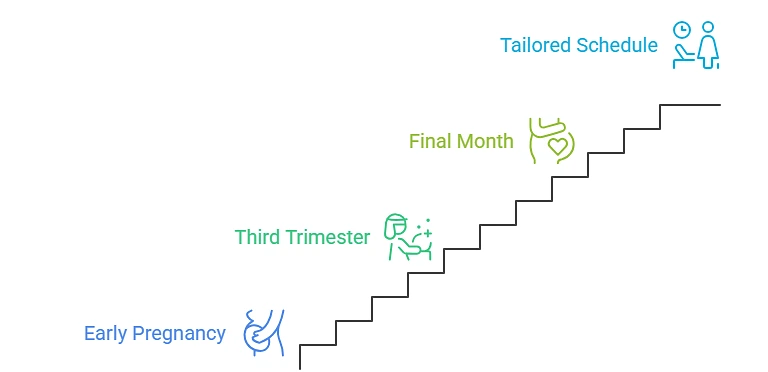
The standard schedule for a low-risk pregnancy, the one ACOG recommends, has a shape worth understanding: every 4 weeks until 28 weeks, every 2 weeks from 28 to 36 weeks, then weekly from 36 weeks until delivery. That’s roughly 12 to 14 visits for a routine pregnancy.
The tightening cadence isn’t arbitrary, it tracks risk. Early on, when the pregnancy is relatively stable and the dangerous complications are rarer, monthly is enough. As you approach the third trimester, the conditions the visits are screening for, high blood pressure, preeclampsia, growth problems, positioning, become both more likely and more time-sensitive, so the check-ins compress. By the final month, weekly, because that’s when the situation can change fastest. One current note worth knowing: ACOG’s 2025 guidance now supports tailored schedules of 6 to 10 visits for average-risk patients as equivalent to the traditional 12-14, so if your provider offers a lighter schedule with some telehealth, that’s evidence-based, not corner-cutting.
What Happens At (Almost) Every Single Visit


Before the milestone tests, understand the routine four or five checks that repeat at essentially every appointment, because these are the quiet backbone of prenatal care and each one is hunting something specific:
- Weight. Tracks whether growth is on a healthy trajectory, too little or a sudden jump can both flag problems.
- Blood pressure. The big one. A rise, especially in the second half, is the earliest warning of preeclampsia, a serious condition that often has no symptoms you’d feel until it’s advanced. This single cheap measurement is one of the most important things done all pregnancy.
- Urine dip. Checks for protein (another preeclampsia signal), sugar (diabetes), and signs of infection.
- Fundal height. The tape measure from pubic bone to the top of the uterus. After about 20 weeks, the centimeters should roughly match your weeks of pregnancy, a quick, low-tech proxy for whether baby is growing on track.
- Fetal heart tones. The handheld doppler, listening for the heartbeat, from around 10-12 weeks onward. Reassurance and a genuine check in one.
When people say a prenatal visit was “just routine,” this is that routine, and it’s a small, repeating screen for the conditions most worth catching early.
First Trimester: Dating, Baselines, And Genetic Options
First visit (around 6-8 weeks): the longest and most thorough of all. Your provider takes a full health history, does a dating ultrasound to confirm how far along you are and your due date, and draws an extensive initial lab panel, blood type and Rh status, a complete blood count for anemia, immunity to rubella and varicella, and screening for HIV, hepatitis B, and syphilis. This is the baseline everything else gets measured against.
The other first-trimester milestone is genetic screening, which is optional and your choice. Non-invasive prenatal testing (NIPT), a blood test screening for chromosomal conditions like Down syndrome, is available from 10 weeks, and first-trimester combined screening (blood work plus a nuchal translucency ultrasound) happens around 11 to 14 weeks. These are screenings, not diagnoses, they estimate risk, and a concerning result leads to a conversation about diagnostic tests, not a conclusion. Whether to do them at all is genuinely up to you and worth discussing with your provider.
Second Trimester: The Anatomy Scan And The Glucose Test
The anatomy scan (18-22 weeks): the big one everyone remembers, and the most detailed ultrasound of the whole pregnancy. It’s often called the 20-week scan, but anywhere in that window is normal. It systematically examines baby’s major organ systems, brain, heart, spine, kidneys, measures growth, checks the placenta’s location and the amniotic fluid, and can tell you the sex if you want to know. It’s the single most comprehensive structural check baby gets, which is why it’s a highlight and, for some parents, a nervous one.
The glucose challenge (24-28 weeks): you drink a very sweet beverage, and an hour later your blood is drawn to check how your body handled the sugar. It screens for gestational diabetes, which affects roughly 6 to 9 percent of pregnancies and usually causes no symptoms, so screening is the only way to catch it. If the one-hour result is elevated, a longer three-hour diagnostic test follows, an abnormal screen doesn’t mean you have it, just that you need the confirmatory test.
Also in this window if you’re Rh-negative: at 28 weeks you’ll get a RhoGAM injection, which prevents your immune system from reacting against a baby with Rh-positive blood, a routine, important, insurance-covered shot. And the Tdap vaccine is given between 27 and 36 weeks of every pregnancy, timed so the antibodies you make pass to the baby and protect them from whooping cough in their vulnerable first months before they can be vaccinated themselves.
Third Trimester: Growth, Position, And The GBS Swab

As visits move to every two weeks and then weekly, the focus shifts to monitoring and preparing for delivery. The routine checks continue, with added attention to:
- Baby’s position. From around 36 weeks, your provider confirms whether baby is head-down or breech, which matters for delivery planning.
- The Group B strep swab (36-37 weeks). A quick vaginal and rectal swab. About 25 percent of people carry GBS, a normal bacterium that’s harmless to you but can be dangerous to a baby exposed during vaginal birth. It’s not an infection and it isn’t a problem with you, a positive result simply means you’ll get IV antibiotics during labor to protect the baby. The result stays valid for about 5 weeks, which is why it’s timed close to your due date.
- Cervical checks (optional). Your provider may check for dilation and effacement starting around 36 weeks, though this is optional and, honestly, not very predictive of when labor will actually start.
- Birth plan and labor signs. These later visits are also when you talk through your preferences and learn what actually signals labor.
The Symptoms That Mean Call Now, Not At Your Next Visit
This is the part a schedule article should never leave out, because the appointment calendar assumes a normal course, and some things shouldn’t wait for the next scheduled slot. Contact your provider promptly, at any point in pregnancy, for:
- Vaginal bleeding or fluid leaking from the vagina.
- A severe or persistent headache, vision changes (spots, blurring), or sudden swelling of the face and hands, these can signal preeclampsia.
- A noticeable decrease in baby’s movements in the third trimester.
- Severe abdominal pain, a fever, or painful urination.
- Regular contractions before 37 weeks, which can signal preterm labor.
None of these necessarily means something is wrong, but all of them are reasons to call rather than wait, and every provider would far rather hear from you about a false alarm than have you sit on something real.
The reframe I’d leave you with is that the prenatal schedule isn’t bureaucracy, it’s a carefully sequenced screening program, each check placed in the window where it does the most good, from the dating scan that anchors everything to the GBS swab timed to your due date. You don’t need to memorize it. But knowing that the blood-pressure cuff is hunting preeclampsia and the sweet drink is screening diabetes and the tape measure is tracking growth turns a year of “just routine” appointments into something you can actually participate in, which, along with writing your questions down beforehand because these visits go fast, is how you get the most out of the person whose whole job that year is a safe delivery for both of you.