


Abstract: Oral and jaw cancers are frequently mistaken for ordinary dental problems, a sore that seems like a canker, a lump dismissed as a toothache, because in their early stages they are often painless and unremarkable-looking. This article explains the single most important rule for catching them in time: any mouth sore, lump, or patch that does not heal within two to three weeks should be professionally evaluated. It covers how to tell a harmless canker sore from a warning sign, the specific symptoms worth acting on, the risk factors that raise your odds, and why timing matters so much, early-stage oral cancer has a survival rate around 80-90%, while cancer that has spread drops to roughly 20%. Most mouth sores are harmless. The point is not to panic, it’s to know the one threshold that separates “wait and see” from “get it checked.”
The dangerous thing about early oral cancer is how ordinary it looks. It doesn’t announce itself with pain, at least not at first. It shows up as a small sore, a white or red patch, a lump you assume you bit or a tooth you assume is acting up, and because it doesn’t hurt, you wait. That waiting is the whole problem, because this is a cancer where a few months of delay genuinely changes the outcome. So let me give you the one rule that matters most, then the details that help you use it.
The Two-Week Rule: The One Thing To Actually Remember


If you take nothing else from this, take this. Any sore, lump, red or white patch, or rough spot in your mouth that hasn’t healed in two to three weeks needs to be checked by a dentist or doctor. That’s the threshold clinicians use, and it’s endorsed by dental and cancer organizations precisely because it catches problems early without making people panic over every normal mouth ulcer.
Here’s why two weeks, and why it’s not arbitrary. The lining of your mouth has an exceptionally rich blood supply, which is why minor cuts, burns, and canker sores heal fast, usually within 7 to 14 days. So a sore that doesn’t follow that pattern, one that lingers past two weeks, is behaving abnormally, and abnormal healing is one of the earliest signals that tissue isn’t acting the way healthy tissue should. The two-week mark is the point where “this is taking too long” becomes medically meaningful.
The reason this rule saves lives is in the delay data. Studies have found the average time between a person’s first oral cancer symptom and seeing a clinician is nearly five months, with more delay after that before diagnosis. That lag is the difference between catching it early and catching it late, and the two-week rule exists to collapse it.
Canker Sore Or Something Worse? How To Actually Tell
Most mouth sores are completely benign, canker sores, thrush, a spot where you bit your cheek, and it would be a disservice to imply otherwise. The goal isn’t to fear every ulcer, it’s to know the features that distinguish a harmless sore from one worth checking. Here’s the honest comparison:
| Feature | Typical canker sore (harmless) | Possible warning sign |
|---|---|---|
| Healing | Heals on its own within 7-14 days | Does not heal after 2-3 weeks, or keeps coming back in the same spot |
| Pain | Usually painful from the start | Often painless at first, which is why it gets ignored |
| Appearance | Small, round, flat, white/yellow center with a red edge | White, red, or mixed patch; may be raised, rough, or hardened; can change over time |
| Bleeding | Doesn’t typically bleed | May bleed easily or without obvious cause |
| Texture | Soft | May feel firm, hard, or fixed to the tissue underneath |
The single most useful line in that table is the healing one. A painful sore that heals in a week is almost always nothing. A painless patch that’s still there three weeks later is exactly the kind of thing that gets dismissed and shouldn’t be.
The Symptoms Worth Acting On
Beyond the non-healing sore, oral and jaw cancers can show up in several ways, and because the early ones are subtle, it’s worth knowing the fuller list. Any of these persisting beyond two weeks warrants an evaluation:
- A sore or ulcer that doesn’t heal, the most common first sign, or one that bleeds easily.
- White, red, or black patches in the mouth (leukoplakia and erythroplakia are the medical terms, and red patches are the more concerning of the two).
- A lump, swelling, or hard spot in the mouth, jaw, or neck, including a firm, painless lump on the neck that doesn’t go away.
- Numbness in the mouth, lip, or chin, or persistent unexplained pain.
- Loose teeth with no dental cause, or dentures that suddenly stop fitting, both can signal changes in the underlying jaw bone.
- Difficulty or pain when chewing, swallowing, or moving the jaw or tongue.
- A persistent sore throat, hoarseness, or the feeling that something is caught in your throat.
- Persistent ear pain on one side, especially with a normal ear exam, which can be referred pain from the mouth or throat.
The jaw-specific ones, loose teeth without cause, numbness in the chin, a changing bite or ill-fitting dentures, are the ones most easily mistaken for routine dental issues, which is the exact confusion the title is warning about.
Why The Timing Matters This Much: The Survival Numbers

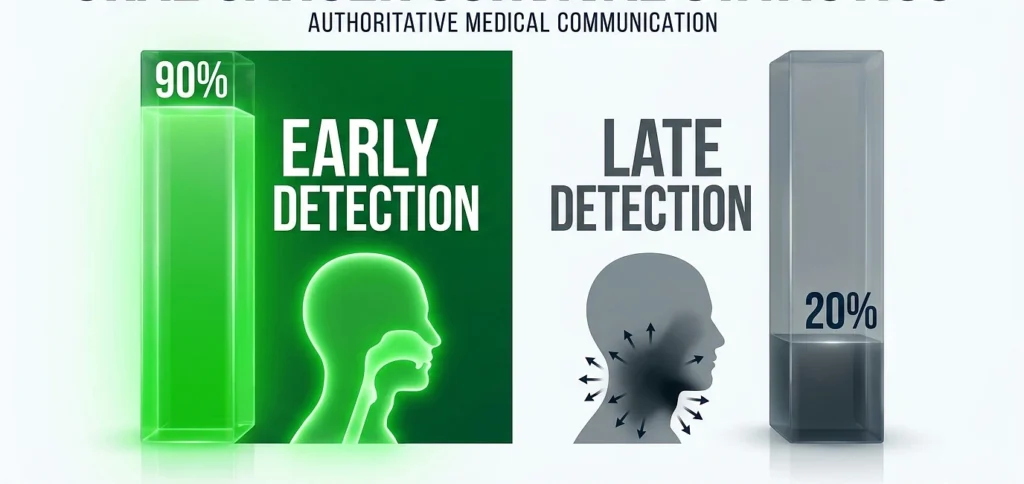
Here’s the part that makes the two-week rule more than fussiness, and it’s stark. Oral cancer survival depends enormously on how early it’s caught, more than for many other cancers.
When oral cancer is found localized, early, before it has spread, the five-year survival rate is roughly 80 to 90%. Once it has spread to distant sites, that figure drops to around 20%. Same disease, wildly different outcomes, and the main variable is how early it was caught. That’s not a small gap you can afford to gamble with by waiting to see if a sore sorts itself out.
There’s real scale behind this too: about 58,000 to 60,000 Americans are diagnosed with oral or oropharyngeal cancer each year. It is not a rare disease, and it affects people who’ve never used tobacco as well as those who have.
Who’s At Higher Risk
Anyone can develop oral cancer, but some factors raise the odds substantially, and knowing yours should lower your threshold for getting something checked.
- Tobacco in any form is the biggest, linked to up to 75% of oral cancers, and that includes cigarettes, cigars, pipes, and especially chewing tobacco and betel/areca nut, which are strongly tied to cancers where they sit against the cheek and gum.
- Heavy alcohol use, and tobacco plus alcohol together multiply each other’s risk rather than just adding.
- HPV infection, particularly HPV-16, which is driving a rise in oropharyngeal (throat) cancers, including in younger, non-smoking people. The HPV vaccine reduces this risk.
- Sun exposure for lip cancers specifically.
- Being male and over 40, historically, though the HPV-driven cases are shifting that picture.
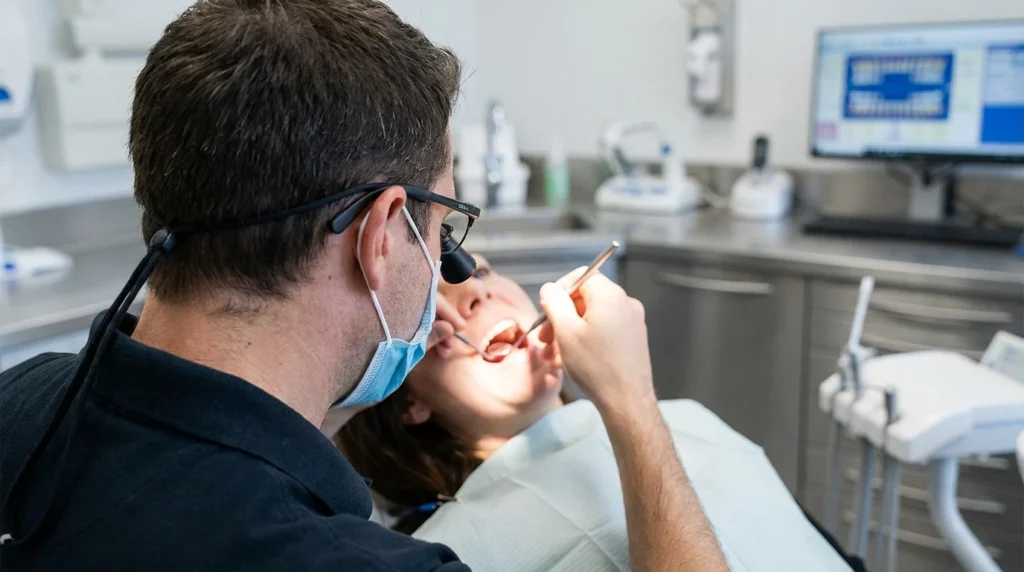
If you carry one or more of these, the two-week rule matters even more, and yearly dental exams (where dentists screen for oral cancer, often before you’d notice anything) become genuinely worth keeping.
What To Actually Do
Do a quick monthly self-check: with a mirror and good light, look and feel around your lips, gums, cheeks, tongue (top, bottom, and sides), the floor and roof of your mouth, and feel your neck and jaw for lumps. It takes about two minutes, and it’s how a lot of early lesions get spotted. Keep your regular dental visits, because dentists are trained to catch suspicious changes before you’d ever notice them. And apply the two-week rule without second-guessing it: if something in your mouth hasn’t healed in two to three weeks, get it looked at.
Most of the time, you’ll be reassured it’s nothing, and that reassurance is worth the visit by itself. But the reason not to talk yourself out of it is the whole point of this article, the version of this cancer that’s caught early is largely survivable, and the version that’s caught late often isn’t, and the difference between them can come down to whether you assumed a painless sore was just a toothache and waited. Don’t wait. A dentist or doctor can tell you in one appointment which it is, and that’s a genuinely good trade for a few minutes of your time.