


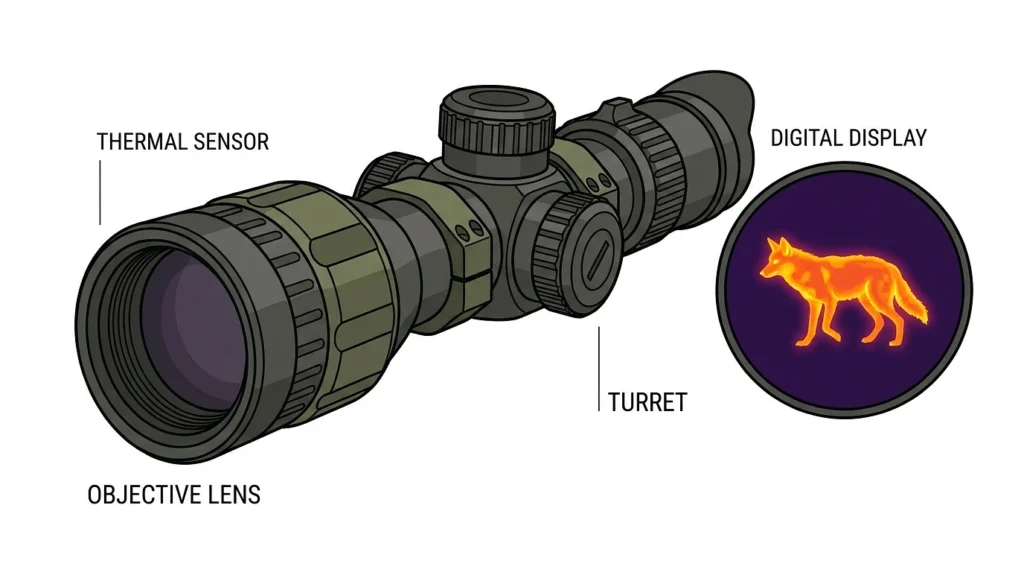
Thermal scopes are legal for hunting feral hogs, coyotes and other species that are not classified as game animals in most US states, and about nine states prohibit them for hunting entirely. Hunting deer, elk, turkey or any big game animal at night with thermal is illegal in every state, with no exception anywhere in the country. On money, a capable first thermal scope runs somewhere between $1,200 and $3,000, digital night vision undercuts that at roughly $1,000 to $2,500, and a Gen 3 night vision tube actually costs more than most thermal at $3,000 to $6,000 and up. On specs, the two numbers that decide your real experience are NETD sensitivity and sensor resolution paired with lens size, and published detection range is close to meaningless.
Now the detail behind all of that, because each one of those sentences has a story under it that will save you money or keep you out of trouble.
The Legal Picture Splits Into Three Buckets, And You Need To Know Which One Your State Is In

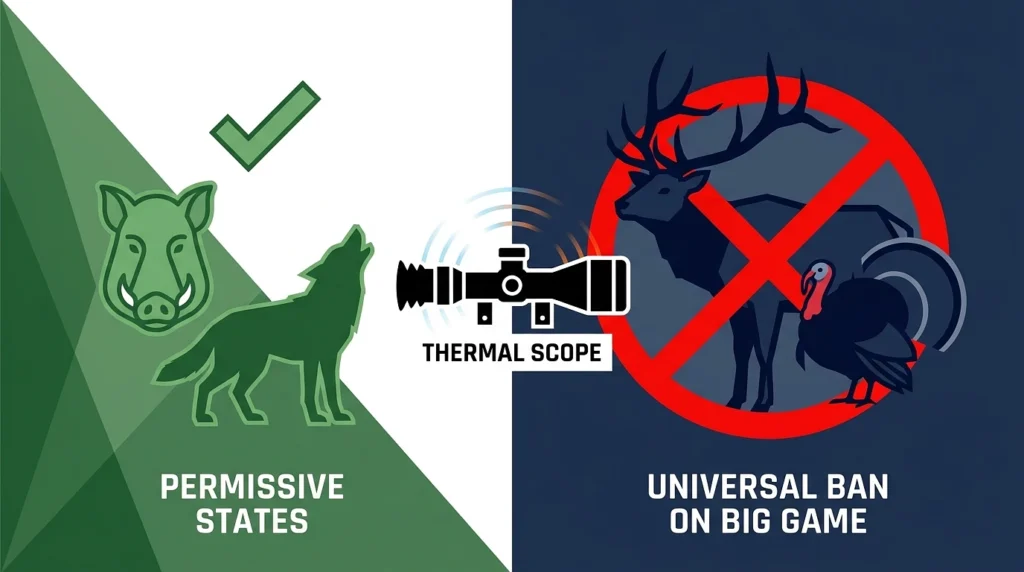
Wildlife rules in the United States are written state by state, which means the law changes the moment you cross a line on the map, and there is no federal rule covering thermal optics at all. Pulsar’s write up on night hunting law puts the split plainly, and it sorts into three groups.
The permissive group is mostly the South and parts of the Midwest, and these are states dealing with real agricultural damage from feral hogs and heavy coyote pressure on livestock. Texas is the obvious example, where night hunting of hogs and coyotes is allowed year round on private land with landowner permission, and the state puts no restrictions on the method or the equipment for those species. Florida runs similar, with hogs huntable year round day or night on private land using any lawful method. Georgia allows it too but requires a free permit for night hunting, and their coyote window runs March through October while hogs stay open year round on private land.
The restricted middle group is where most of the country sits. Thermal is allowed but it comes wrapped in conditions, and the conditions are the part people get wrong. You might be limited to a specific weapon type, or a narrow winter season, or private land only with written permission. Missouri, for one, allows coyote night hunting only from February 1 through March 31 on private land.
Then there is the prohibited group. According to Sightmark’s state by state roundup, Alaska, Arizona, California, Colorado, Hawaii, Nevada, New Mexico, Oregon and Tennessee prohibit thermal optics for hunting. And I want to add a real caution to that list rather than just printing it, because these rules move. Tennessee has had a new predator season working through the process, Idaho has had a bill splitting how thermal is treated, and any list published today can be wrong by next season.
So here is the only safe instruction I can give you about legality, and I mean this seriously. Pull up your own state wildlife agency page, find the current regulations, and read the actual language yourself before you hunt with one. Not a forum post, not a retailer blog, and not this article either. The agency page is the only source that matters if a warden is standing in the field with you.
The One Rule That Is The Same Everywhere Is That Big Game At Night Is Off Limits
Deer, elk, moose, turkey. It does not matter what optic you own or which state you are standing in, hunting big game animals at night is illegal across the country, and using thermal to do it stacks a second violation on top of the first one.
There is a quieter version of this rule that catches otherwise careful people too. Some states restrict having a thermal scope in the vehicle with a firearm at night at all, even when you are simply driving home from a completely legal daytime hunt. Worth knowing before you toss everything in the truck.
Thermal Costs More Than Digital Night Vision But Less Than A Real Gen 3 Tube
This is the comparison that surprises most first time buyers, because everybody assumes thermal is the expensive option and night vision is the budget option, and that is only half true.
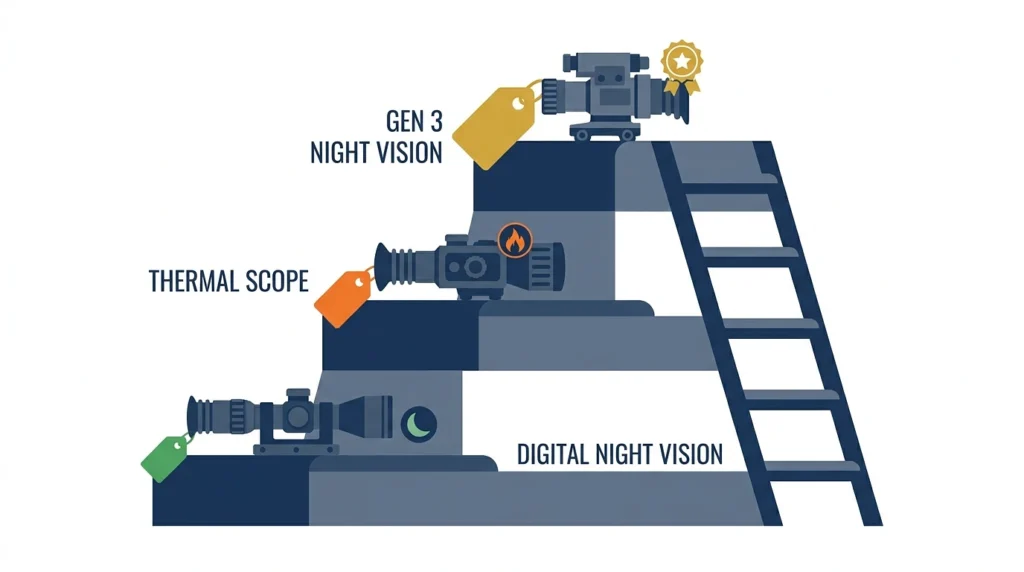
Digital night vision at the $1,000 to $2,500 range is genuinely the cheapest way to see in the dark. But the honest tradeoff is that digital night vision needs some ambient light to work with, and it needs an infrared illuminator in true darkness, which is a light source that some animals notice and some state rules restrict. Thermal needs nothing. It reads heat, so it works in complete blackness, and it also cuts through fog, light brush and smoke in a way no night vision can match.
To get night vision performance that actually competes with a decent mid tier thermal, ATN’s own price breakdown notes you generally need a Gen 3 image intensifier tube, and those run $3,000 to $6,000 or more. So the ladder is not what people expect. It goes digital night vision, then thermal, then Gen 3 night vision at the top.
There is one more practical difference that decides it for a lot of hog hunters. Thermal finds animals. Night vision shows you animals you already found. If you are scanning a big field trying to locate a sounder in the dark, thermal is doing something night vision simply cannot do, and that detection advantage is most of what you are paying for.
NETD Is The Spec That Matters Most And Almost Nobody Shopping Knows What It Is
Picture yourself with two scopes open in browser tabs, both listed at $1,900, both saying 384 resolution, and one of them is somehow better and you cannot tell which. I have been exactly there, staring at spec sheets full of numbers nobody explained, and the number that resolves it is the one buried halfway down the list.
NETD measures the smallest temperature difference the sensor can actually see, written in millikelvin, and lower is better. That is the whole definition.
Why it matters more than resolution: a scope with lots of pixels and poor sensitivity gives you a detailed picture of nothing, because it cannot pull a warm animal out of a background that is nearly the same temperature. On a humid night, on wet ground, with an animal bedded in brush, sensitivity is what separates a visible coyote from an empty field.
The numbers to shop against:
- Under 40mK is a good sensor and perfectly usable.
- Under 25mK is where quality begins in the current market.
- Sub 20mK, and especially sub 15mK, is premium territory and it shows on hard nights.
A scope rated sub 20mK at 384 resolution will beat a 640 scope rated at 60 or 80mK in real hunting conditions, every time, and that is the single most useful thing in this article for someone about to spend two thousand dollars.
Sensor Resolution Sets Detail, And 384 Is Enough For Most Hunters Inside 200 Yards
A 640 sensor holds roughly three times the pixels of a 384, and per AGM’s resolution comparison the practical gap looks like this: a 384 sensor identifies a hog at about 200 meters and detects at up to 700, while a 640 identifies a hog around 500 meters and detects out past 1,400.
Read those identification numbers rather than the detection ones. If your shots happen inside 200 yards, which describes most hog and coyote hunting in brush and mixed terrain, a good 384 does the job and you should put the saved money into better sensitivity or a better lens instead. If you are calling coyotes across open agricultural ground and taking shots past 300 yards, the 640 earns its price.
Lens Size Sets Reach And Field Of View, And Bigger Is Not Automatically Better
A 25mm or 35mm lens gives you a wide field of view, which is what you want in thick woods and tight brush lines where animals appear close and move fast. A 50mm lens narrows that view and pushes the detail farther out, which suits open fields.
Buy the lens for the terrain you actually hunt, not the terrain in the marketing video.
Refresh Rate Below 50Hz Smears Moving Animals
50Hz is smooth and it is the current standard worth holding out for. 30Hz is workable. Anything below 30Hz makes a running hog look choppy and makes tracking genuinely difficult, so older 25Hz cores are worth avoiding even at a discount.
Published Detection Range Is A Marketing Number, So Divide It By Three Or Four
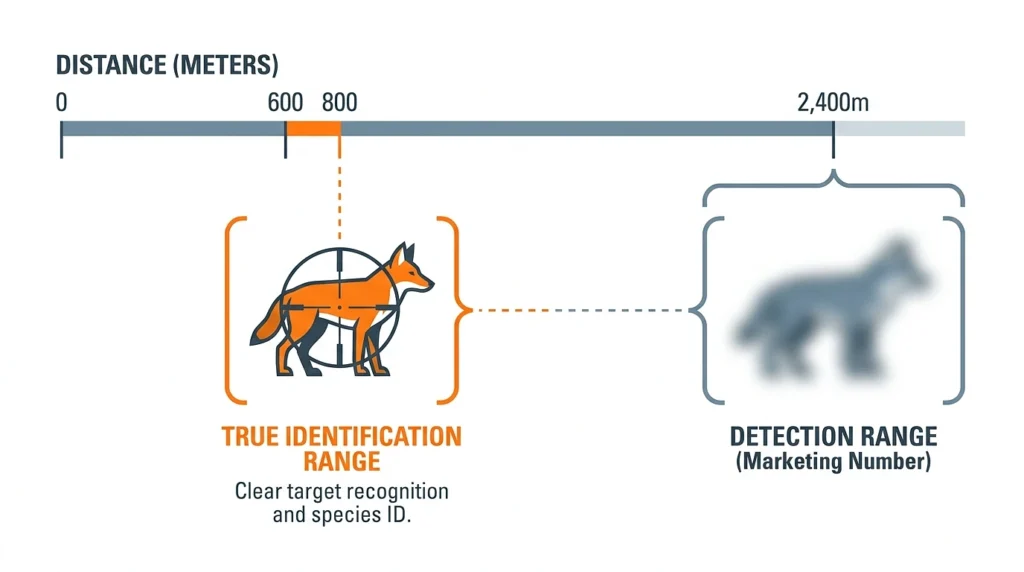
When a scope advertises 2,300 meters of detection range, that figure means the sensor can register that something warm exists out there. It does not mean you can tell whether it is a hog, a calf, a dog or a person.
Guidance from current scope roundups is to treat real world identification range as roughly a third to a quarter of the advertised detection number, so a 2,500 yard claim translates to confident target identification somewhere closer to 600 to 800 yards. And identification is the number with ethical and legal weight attached to it, because you cannot take a responsible shot at a heat blob you have not positively identified. Detection sells scopes. Identification is what you actually hunt with.
What To Buy At Each Budget
Entry level today runs $1,200 to $3,000 and gets you a 256 or 384 sensor with a 25mm or 35mm lens, roughly 50Hz, and usable image quality inside about 150 to 200 yards on hog sized targets. That is a real scope and plenty of people hunt successfully with nothing more.
The mid tier opens up 640 sensors, 50mm lenses, better NETD ratings and 60Hz frame rates, and it is where recognition distance stretches noticeably.
Two small things worth checking on any purchase regardless of tier. Look for a scope that runs standard swappable batteries such as 18650 cells, because a dead scope at two in the morning ends the hunt when you have no spare to drop in. And check the warranty length, since these are electronics living on a recoiling rifle in bad weather, and the good manufacturers back them for years rather than months.
Buy sensitivity first, then match sensor and lens to your actual distances, and let everything else be a refinement on top of those two decisions.