


Moving again within 3 years? Rent. Nothing below changes that answer.
Staying 7+ years with stable income and a real emergency fund? Buying probably wins, and the sooner you start the clock the better.
Somewhere in the messy middle, 3 to 7 years? That’s where this decision actually lives, and where the answer depends on your specific city, your down payment, and one variable almost nobody accounts for honestly.
Everything after this is about that middle group, because the other two already know what to do and mostly need permission to stop agonizing.
The Breakeven Number You’ll Find Online Is A Mess, And The Reason Matters

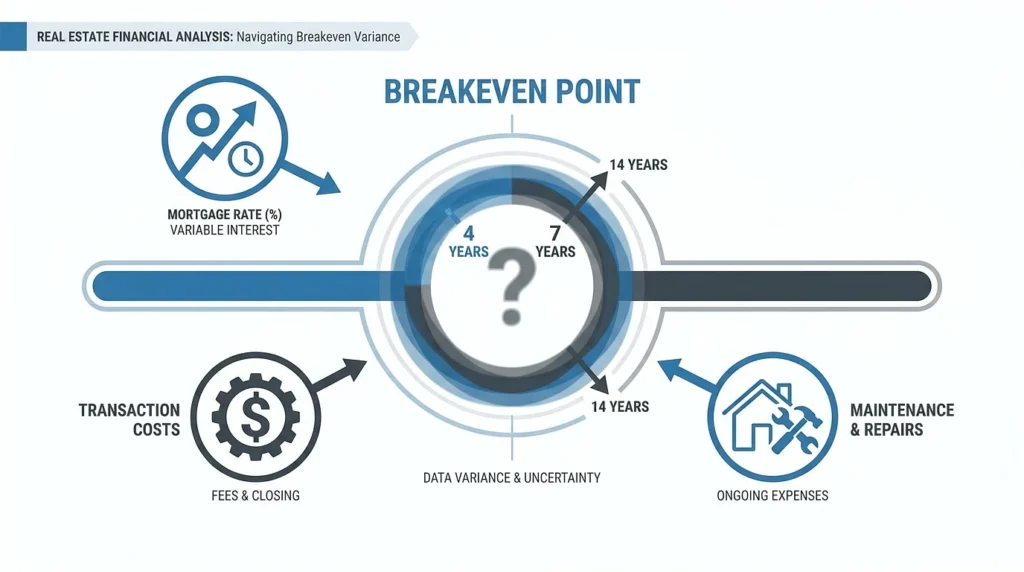
Go looking for “how long until buying beats renting” and you’ll get 4 to 6 years from one source, 5 to 7 from another, 7 to 14 from a third, and around 12 from a fourth. Same year, same country. That spread drove me a little crazy until the reason clicked, and it’s worth understanding because it changes how you should read any calculator.
The variance comes almost entirely from what return the calculator assumes you’d earn by investing your down payment instead. Assume a conservative 4% and the breakeven stretches toward year 12. Assume nothing, treat the down payment as dead money, and buying wins in year 4. Neither is dishonest. They’re answering slightly different questions, and only one of them matches how you’d actually behave with $80,000.
Here are the 2026 inputs that hold up regardless of which model you like:
- Mortgage rates. Freddie Mac’s survey had the 30-year fixed at 6.01% and the 15-year at 5.35% in late February 2026, the lowest since September 2022. Every breakeven estimate above is brutally rate-sensitive. At a hypothetical 4% rate, the same math collapses to 3 to 5 years.
- Transaction costs. Round trip runs 8% to 13% of home value once you count buyer closing costs of 2% to 5% and seller commissions averaging around 5.44% after the NAR settlement. That’s the wall a short holding period smashes into.
- The costs that aren’t the mortgage. Maintenance, insurance, and property taxes average roughly $16,000 a year by Zillow and Thumbtack’s accounting, commonly adding 30% to 40% on top of the payment itself.
- National median rent sat near $1,686 in May 2026, having posted its 34th consecutive month of year-over-year decline nationally. Though San Francisco, San Jose, and New York moved the other direction, which is the whole point about local variation.
The single most useful screen is the price-to-rent ratio: median home price divided by annual rent for a comparable place. Under 15 favors buying, over 20 favors renting, and 15 to 20 is genuinely a coin flip settled by your personal situation. It takes two minutes and it beats any national average, because national averages are describing a country you don’t live in. Breakevens by metro run from about 1.5 years in Pittsburgh and 2 in Memphis and Baltimore to well over a decade in coastal markets.
One number gets quoted constantly and deserves a caveat rather than a cheer. The Federal Reserve’s Survey of Consumer Finances shows median homeowner net worth around $430,000 against roughly $10,000 for renters. That 43-to-1 gap is real, and it is not all caused by owning. Homeowners skew older, higher-earning, and partnered, and a good chunk of the gap is those things showing up in the data. The honest version is that a mortgage is forced savings that most people wouldn’t otherwise do, which is a genuine benefit and a psychological one more than a mathematical one.
The Stairs Problem, Which Is More Real Than Parenting Forums Suggest
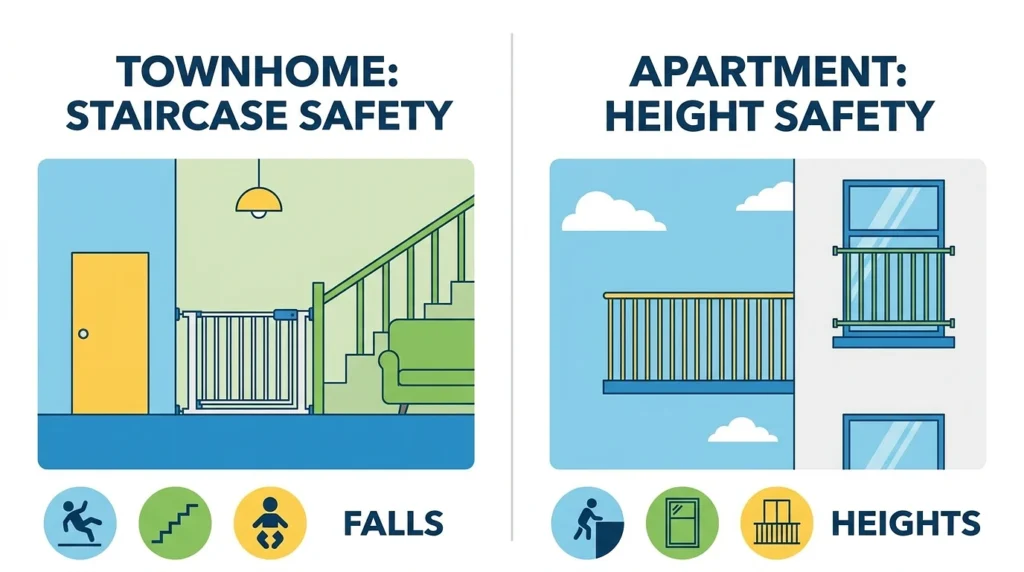
Now the part that separates a townhome from an apartment in a way no spreadsheet captures, and this one has actual research behind it.
Researchers at Nationwide Children’s Hospital analyzed a decade of national injury surveillance data and published the results in Pediatrics in 2012. Over the study period, an estimated 931,886 children under age 5 were treated in US emergency departments for stair-related injuries, averaging 93,189 a year, or about 46.5 per 10,000 kids. That works out to a child under five arriving at an ED for a stair injury roughly every six minutes.
Three findings from that study are the ones worth actually knowing:
- Head and neck injuries made up 76.3% of the total. Stairs and toddler skulls are a bad combination for the obvious geometric reasons.
- One-year-olds accounted for the largest share, about 32.4%. The peak risk window is the year they can move but can’t judge.
- Injuries to children being carried down stairs were rising, even as total injuries fell 11.6% across the decade. That one surprised me. The dangerous moment often isn’t the toddler on the stairs alone, it’s the adult carrying the toddler and a laundry basket.
And the obvious countermeasure has its own footnote. A companion study found roughly 1,794 baby gate injuries a year among children under 7, with more than 60% under age 2, most often when a gate collapsed or was simply left open. Gates work. Gates installed badly or propped open during a busy morning do not.
So does this mean don’t buy a townhome? No, and I want to be careful here, because “stairs are dangerous” turns into paralysis fast. Millions of children grow up in two-story home and living without incident. What the data supports is narrower and more useful:
- Hardware-mounted gates at both the top and the bottom, not pressure-mounted at the top.
- Handrails a child can actually grip, which most builder-grade rails are not.
- A real rule about carrying kids and objects at the same time, since that’s the rising injury pattern.
- If you’re choosing between two otherwise equal places during the crawling-to-toddling years, the single-level unit removes a genuine daily risk. That’s a legitimate thumb on the scale, not paranoia.
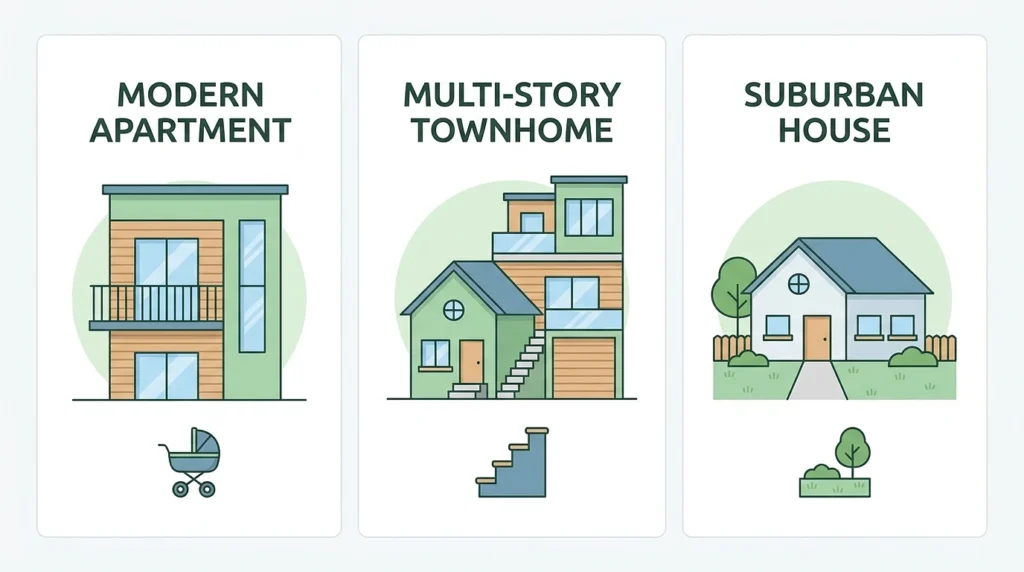
The flip side rarely gets mentioned: apartments have their own child-specific hazards, particularly windows above the first floor, balconies, and shared stairwells nobody gates. Neither format is the safe one. They’re differently unsafe, and the mitigations differ.
What Each Format Actually Buys You Day To Day
- Apartments win on cost, maintenance, and flexibility. Somebody else fixes the furnace at 2 a.m. Nothing is stopping you from moving when the job changes. The costs are noise transmission in both directions, which matters enormously with a baby and matters again when your three-year-old discovers running, plus storage that stroller-and-gear life outgrows fast.
- Rented townhomes are the underrated middle option and the one most families skip past. You get the square footage, the direct-entry door, often a small yard and attached garage, and you keep the ability to leave. You’re paying a premium over an apartment for space rather than for equity, and if your horizon is genuinely in that murky 3-to-7-year band, renting the format you’d eventually buy is a low-risk way to find out whether you actually like it.
- Buying buys stability and school-district continuity and the freedom to paint a wall, and it charges you liquidity for all of it. That last part is the real cost for young families, whose next five years contain more unpredictability than any other life stage: second kids, job changes, one parent stepping back from work, a parent’s health, a childcare arrangement collapsing.
When Buying Is The Wrong Move, Plainly
Some of these are unpopular to say out loud in a culture that treats homeownership as a maturity milestone.
- Your timeline is honestly under five years. Transaction costs eat the gains, and “we’ll just rent it out” is a business you haven’t decided to run.
- Buying would drain your emergency fund. A house generates surprise expenses on its own schedule. Closing with nothing behind you is how a water heater becomes a credit card balance.
- Your income is new, commission-based, or shaky. Underwriting will approve you well before your budget is actually ready.
- You’re stretching to a payment that only works if nothing changes. Daycare costs, a second child, one income pausing. Run the payment against your worst plausible year, not your current one.
- You’re buying to fix a feeling. Instability, family pressure, the sense that everyone else has figured it out. A mortgage doesn’t resolve any of those and it removes your ability to change your mind cheaply.