


Most flight-outfit guides are padded to the point of uselessness, treating your choice of scarf with the same gravity as the one thing on the list that’s actually backed by hard medical evidence. So I’m going to do this the other way around. There’s exactly one item you could put on for a long flight that has a real, high-quality study behind it, and it isn’t the thing anyone photography. Everything else is comfort and taste, and I’ll be honest about which parts of the usual advice are worth following and which are just filler dressed up as wisdom.
Compression Socks, And It’s Not Close

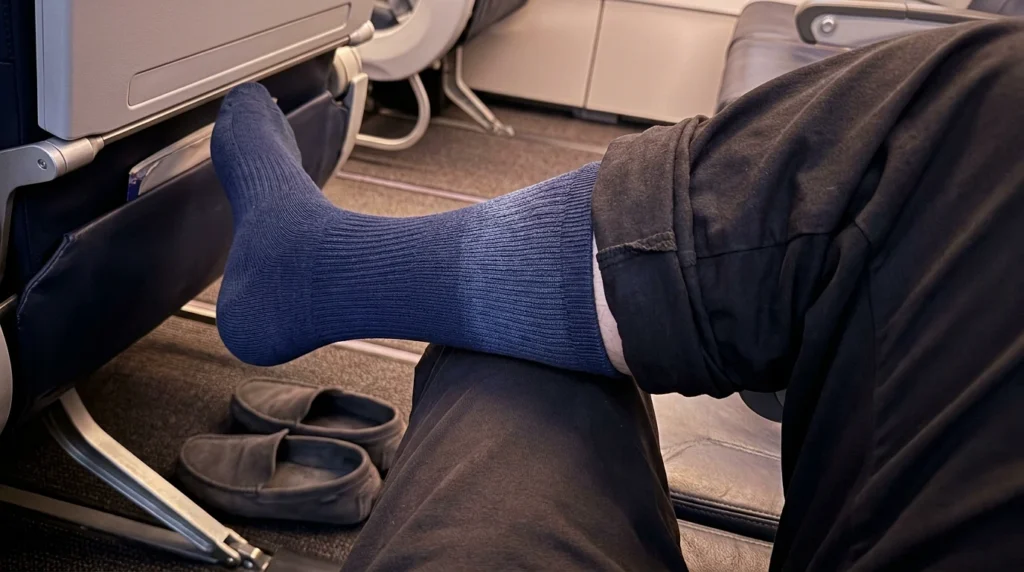
Here is the single most evidence-backed piece of flight clothing, and it’s a boring pair of socks. On flights over about four hours, sitting still lets blood pool in your legs, which raises the risk of a deep vein thrombosis, a clot in a leg vein. Graduated compression socks squeeze a little harder at the ankle to keep that blood moving.
The evidence here isn’t a wellness blog’s opinion, it’s a Cochrane review, which is about as rigorous as medical evidence gets. Pooling randomized trials of nearly 3,000 passengers, it found high-certainty evidence that wearing compression stockings on long-haul flights cut the odds of a symptomless DVT by around 90 percent. In concrete terms, that’s dropping the risk from roughly 10 to 30 cases per 1,000 long-haul passengers down to about 1 to 3 per 1,000. They also reduced leg swelling, the puffy-ankles feeling everyone knows after a long flight, and across the trials the socks were well tolerated with no real downside.
A few honest qualifiers, because I won’t oversell even this. The trials measured symptomless clots picked up on scans, not deaths or dangerous ones, because those are rare enough that no such events happened in the studies. And the baseline risk for a healthy person on one flight is genuinely low to begin with. But the intervention is cheap, comfortable once you’re used to it, and carries essentially no downside, which is a rare combination. If you have specific risk factors, recent surgery, pregnancy, a history of clots, hormone therapy, active cancer, this stops being optional and becomes a conversation with your doctor before you fly, because you’re in the group where it matters most.
That’s the one genuinely important thing. Everything below is comfort and style, which matter too, just don’t confuse them with this.
Layers You Can Actually Take Off One-Handed
The cabin-temperature complaint is the real one. Planes swing from stuffy to freezing and back, and you have no control over it, so the whole game is being able to adjust without a production.
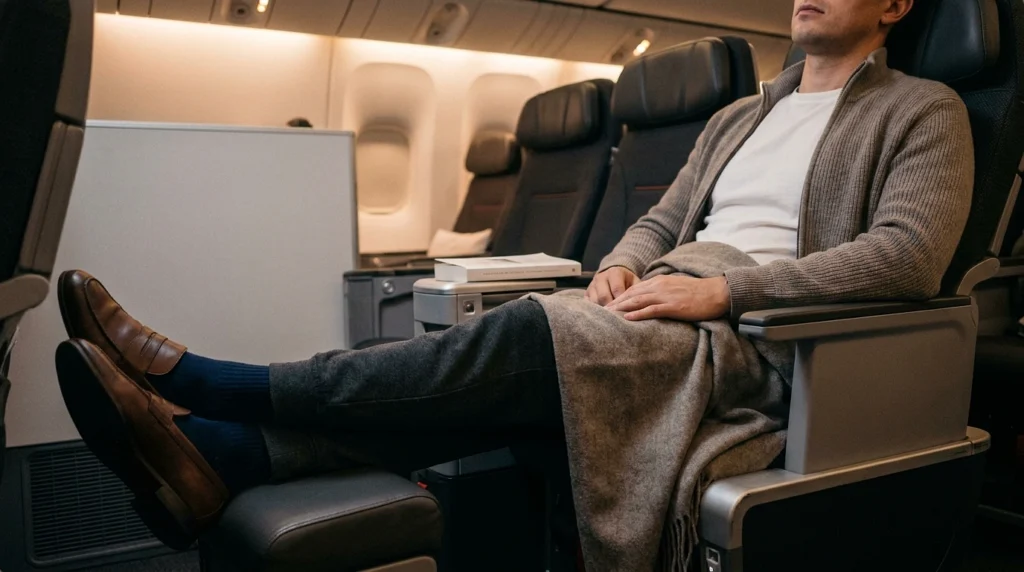
The useful principle is boring and correct: a light base layer, something warmer over it, and an outer layer that comes off in one motion. The part the guides skip is that the outer layer has to be genuinely easy to remove while belted into a seat, which rules out anything you’d have to stand up and wrestle with. A zip or open-front cardigan beats a pullover for exactly this reason. A big soft scarf earns its place here not as a fashion statement but because it doubles as a blanket when the airline’s is thin or absent, and airplane blankets are almost always thin or absent.
Natural or performance fabrics that breathe, cotton, merino, bamboo, or a good technical blend, are worth choosing over pure synthetics that trap heat and hold smell, especially on a flight long enough that you’ll arrive in whatever you left in. That’s not a rule so much as the difference between landing feeling stale and landing feeling human.
Shoes You Can Slip Off, Sized For Feet That Will Swell
Your feet swell on a long flight. That’s not a maybe, it’s fluid pooling from sitting still, the same mechanism the socks address, and it means the shoes that fit at the gate can feel tight by hour eight.
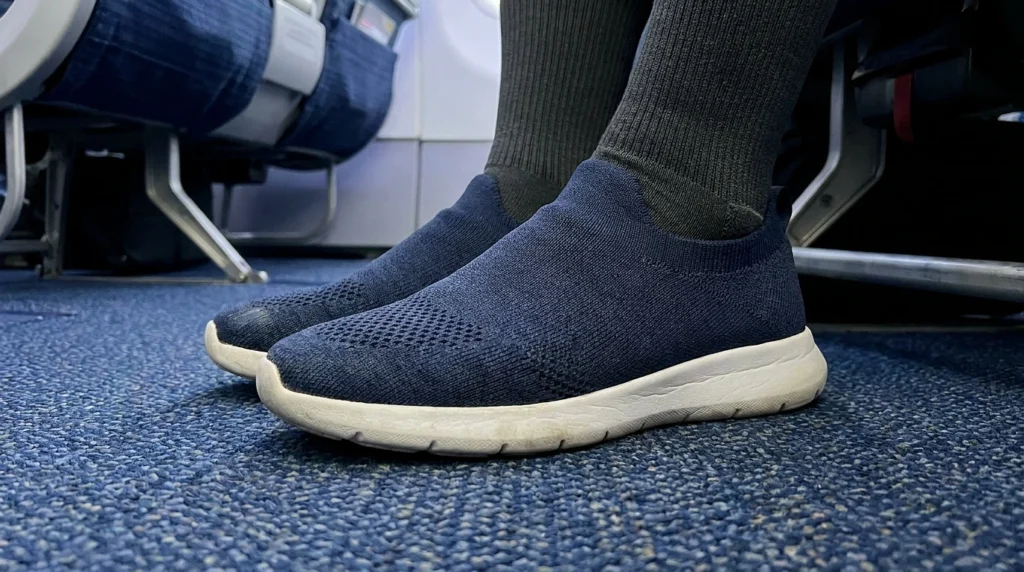
So the move is slip-on shoes with a bit of give, worn with those compression socks. Slip-on because you’ll want them off during the flight and off again at security, and fighting laces in a cramped seat is misery. A cushioned sneaker or a soft loafer both work. What doesn’t work is anything narrow, stiff, or new. A long flight is the worst possible place to break in shoes, and I’ve watched people learn that the hard way, limping through an arrivals hall carrying the shoes that fit that morning.
Most Of What The Guides Tell You To Accessorize With
Here’s where I part ways with the standard advice, which loves to fill space with accessories that photograph well and do nothing.
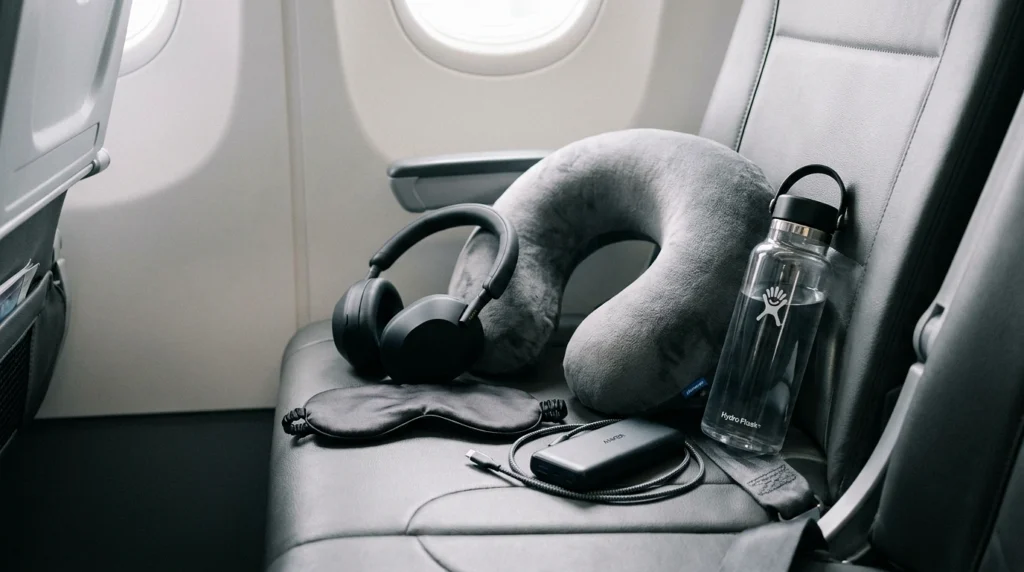
You don’t need a wide-brimmed hat for a flight. You’re indoors. The “air of mystery” sunglasses, the statement jewelry, the carefully coordinated pashmina as a style piece, these are the filler that makes a 600-word topic into a 2,500-word article, and following them just gives you more stuff to keep track of, drop, and lose in a seat-back pocket. The genuinely useful accessories are few: a neck pillow if you actually sleep on planes, an eye mask and earplugs or noise-canceling headphones if noise wrecks your rest, a portable charger, and an empty water bottle to fill past security. That’s the list. Everything beyond it is weight.
And skip the fantasy of the perfectly polished arrival outfit if it costs you comfort for ten hours. If you truly have a meeting off the plane, the smart move isn’t suffering in stiff clothes the whole way, it’s packing the sharp layer, a blazer, a fresh top, and changing near the end or in the arrivals bathroom. Dress for the flight, carry the destination.
Dehydrating Yourself And Then Blaming The Flight
This isn’t clothing, but it undoes a good outfit faster than anything, so it belongs here. Cabin air is extremely dry, and the two things people reliably do wrong are not drinking enough water and drinking too much alcohol and coffee, which pull fluid the wrong way. The comfort you built with the right fabrics and the compression socks gets partly erased if you land dehydrated, stiff, and puffy. Fill the bottle, go easy on the free wine, and get up to walk the aisle a few times, which also happens to be the same circulation advice the socks are working on. The clothes and the habits are solving the same problem from two directions.
None of this needs to be complicated, which is my actual objection to the way it’s usually written. Put on the compression socks because they’re the one thing here with a real study behind it. Wear breathable layers you can peel off without standing up. Choose forgiving slip-on shoes. Drink the water. Everything else, the hats and the mystery sunglasses and the eight interchangeable outfit formulas, is somebody padding an article, and you can skip all of it and fly more comfortably than the person who read the long version.