

Let me start by disagreeing with my own headline, because the industry data does not quite support it and you deserve the real numbers rather than a tidy slogan.
Dresses take longer than flowers. Bridal gowns typically require 6 to 9 months to arrive with alterations on top, which is why shops tell you to start shopping 10 to 12 months out. Florists book 6 to 12 months ahead, with 8 to 10 months described as the sweet spot. So on a strict reading, the dress goes first.
Here is what is true, and it is the thing the headline is reaching for. Couples treat the dress as a deadline and the flowers as a decoration, and that difference in mental category is what wrecks floral plans. The dress gets a calendar entry in month one. Flowers drift toward month seven, by which point the good designers are gone and the specific stems in the inspiration photo are no longer sourceable. The two should be running in parallel, and almost nobody plans them that way.
Why flowers behave like a supply chain rather than a purchase
You are booking a person before you are buying a product
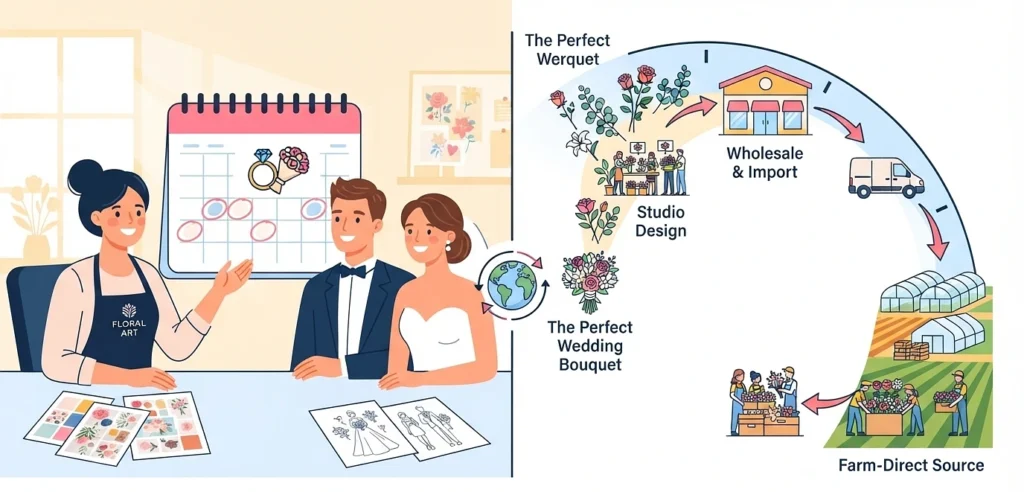
The first thing to understand is that the early deadline is not about the flowers at all. It is about the florist.
Florists take a limited number of weddings per weekend, which means their calendar fills the same way a venue’s does. Popular designers routinely book 12 months out, particularly for spring and autumn dates, and May, June, September and October fill fastest. Miss that window and you are not choosing from a shortlist, you are taking whoever remains available, which is a completely different exercise.
The sourcing clock is separate and shorter
Then there is the flower supply itself, which runs on its own schedule and is where the headline’s instinct is genuinely right.
Sourcing quality drops in identifiable stages as the date approaches. Inside 60 days, sourcing shifts from farm direct to whatever inventory happens to be available, which narrows your palette. Inside 30 days, designer availability becomes the bottleneck rather than the flowers. Inside two weeks, it is very hard for any professional florist to do a full wedding, though scaled down arrangements remain possible.
Those thresholds are why a late booking costs you specificity. The bouquet in your saved photo contains particular stems in particular colours, and farm direct ordering is what secures them.
The actual sequence, with the dress in its proper place
| Months out | What should be happening |
|---|---|
| 12 plus | Date and venue locked. Nothing else can be booked properly without them |
| 10 to 12 | Dress shopping begins. Florist enquiries and consultations start in parallel |
| 8 to 10 | Florist booked, the sweet spot for maximum flexibility |
| 6 to 9 | Dress arrives, alterations begin. Floral design refinement continues |
| 4 to 8 weeks | Final guest counts and table counts to the florist so quantities can be ordered |
| Under 60 days | Sourcing shifts to available inventory. Large design changes become difficult |
Note the venue row. Your date is not real until a deposit sits on the ceremony and reception sites, and hiring other vendors before that is building on sand. The venue also dictates the floral scale, so a florist genuinely cannot design properly without knowing the room.
What early booking actually buys you
Three things, and only one of them is availability.
- Choice of designer, which is the whole game. Florists differ enormously in style, and at three months out you are not selecting a style, you are accepting one.
- Farm direct sourcing, meaning the specific stems rather than substitutes chosen under pressure.
- Price stability, since some florists honour their current rates for early bookings even when they raise prices later.
And a fourth that gets undersold. Time to iterate. Good floral design happens through rounds of refinement, mock ups and adjustments as the rest of the wedding takes shape, with the flowers connecting to linen, candlelight and the scale of the room. Compressed into six weeks, that process becomes a single order rather than a design.
What you can still change late, and what you cannot
Couples panic about this more than they need to, so the honest breakdown.
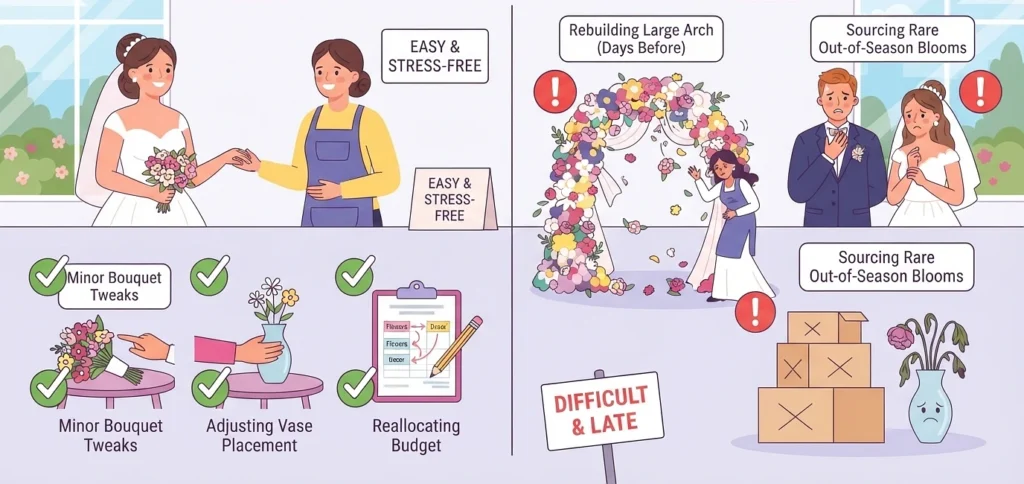
Usually still possible. Small shifts in placement, moving budget between elements, minor adjustments to arrangements.
Difficult once production is underway. Large cuts to the order, major design changes, swapping in specific stems that were never sourced.
Worth deciding at the start rather than later. Repurposing ceremony flowers for the reception is entirely realistic, and only if the arrangements were designed for it from the beginning. Retrofitting that plan late tends not to work.
If you are already inside the window
Nothing here helps if your wedding is in ten weeks, so briefly, practically.
Be flexible on flower types and say so explicitly in the first conversation, because trusting a designer to suggest available alternatives opens doors that a rigid stem list closes. Consider online floral services, which have a structural advantage on short timelines since virtual consultations skip the in person scheduling bottleneck and a national designer network improves the odds of local availability. And scale down honestly. A smaller number of well executed arrangements reads far better than an ambitious plan built from whatever was left at the wholesaler.
The dress and the flowers are not really competing for your calendar. They are competing for your attention, and the dress wins that competition every time because it is the emotional purchase and the flowers are the logistics one. Book the florist while you are still excited about the dress, and the flowers stop being the thing you rush.

