


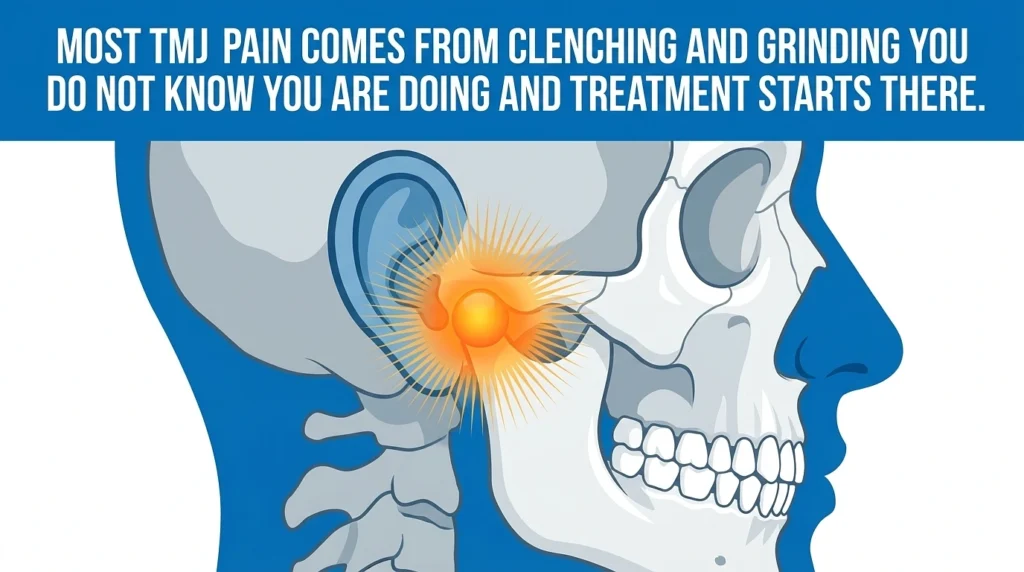
There is a finding buried in the clinical literature that explains why so many people with jaw pain get nowhere for years. When patients were left to report their own symptoms, only about one in five mentioned clenching or grinding. When the same sort of patients were asked about it directly, roughly two thirds said yes. The behaviour did not change between those two numbers. Only the question did.
That gap is the practical heart of this topic, because a habit you perform without noticing is a habit nobody treats. Before getting into what to do about it though, the claim in the title of this article needs tightening, since the honest version of it is more useful than the confident version.
What The Research Actually Supports
Clenching and grinding, which clinicians group under bruxism, is strongly associated with temporomandibular disorders. A meta analysis pooling twenty studies found that people with bruxism had roughly 2.25 times the odds of having TMD compared with people without it. Splitting by type, awake bruxism came out slightly higher than sleep bruxism.
What that does not establish is cause. A review of 46 papers on the question failed to demonstrate a causal link, and researchers writing on this describe the relationship as contentious, with studies producing contradictory results depending on how both conditions were defined and measured. Some work finds bruxers and non bruxers differ clearly on muscle pain diagnoses while showing no meaningful difference on disc displacement or arthritis. Whether jaw symptoms cause the clenching, the clenching causes the symptoms, or both grow from a shared root is genuinely unsettled.
So the accurate framing is that clenching and grinding is the most common modifiable factor in jaw pain rather than the proven cause of most of it. That distinction matters because TMD also arises from disc displacement, arthritis, injury, and joint changes that no amount of habit awareness will fix, and someone whose pain comes from a displaced disc deserves to find that out rather than spending eight months trying not to clench.
Where the title holds up completely is on the treatment sequence. Behavioural awareness is cheap, carries essentially no risk, and addresses the one factor you can influence yourself, which is why it belongs first regardless of what else turns out to be going on.
Awake Clenching and Sleep Grinding Are Not The Same Problem


Sleep bruxism is classified as a sleep related movement disorder and appears to arise in response to arousals during sleep. It runs on its own machinery, mostly outside your influence in the moment, and it tends to produce the classic pattern of waking with a tight jaw or a dull temple headache.
Awake bruxism behaves differently. It is tied to emotional state and concentration, and the research on this is quite consistent. In a study of 222 TMD patients, awake bruxism showed significant associations with depression, anxiety and stress, while sleep bruxism showed no such associations at all. Higher stress raised the odds of awake bruxism specifically.
Two consequences follow from that split.
- Awake clenching is the one you can actually interrupt, because it happens while you are conscious and it responds to noticing.
- Sleep grinding needs a different approach, generally involving a dentist, a guard to protect the teeth, and attention to sleep quality rather than willpower.
Anyone told to simply stop clenching at night has been given advice that does not match the condition.
The Combination is Where The Risk Climbs Steeply
One finding is worth knowing on its own. Awake bruxism alone and sleep bruxism alone each carried a modest increase in TMD pain risk in a large study, with odds ratios sitting under two. When both were present in the same person, the odds ratio for TMD pain jumped to 7.7.
That is a much sharper rise than adding the two separately would predict, and it suggests the jaw muscles getting no genuine rest across a full 24 hour cycle is a different situation from either half alone.
Working Out Whether You Are One of Them

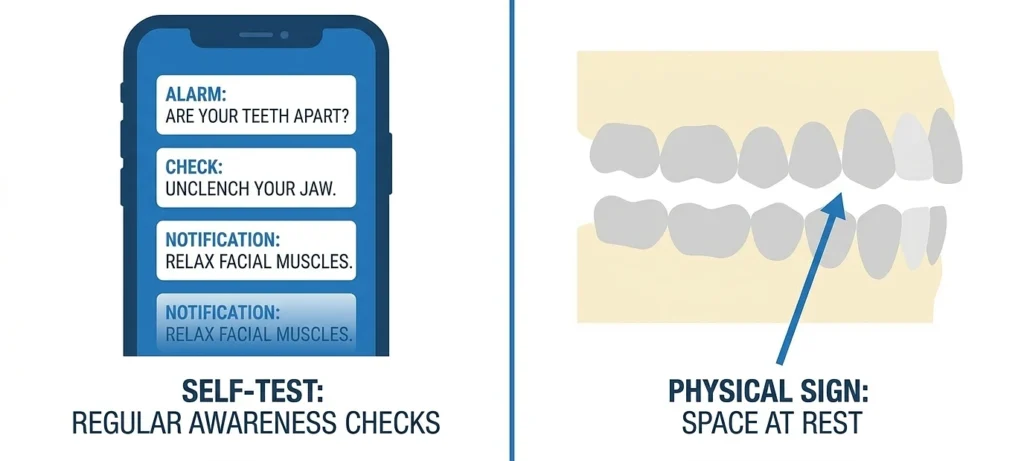
Since self reporting is unreliable, the useful approach is looking for evidence rather than trying to remember.
Physical signs a dentist or physiotherapist would check for:
- Flattened or worn tooth surfaces, particularly on the biting edges.
- A ridge of thickened tissue along the inside of the cheek at the level where teeth meet.
- Scalloped indentations along the edges of the tongue.
- Enlarged masseter muscles, giving the lower face a squarer look.
- Tenderness in the jaw muscles when pressed, or in the temples.
Timing patterns worth paying attention to as well. Toothache pain that is worst on waking points toward the sleeping half. Pain that builds through the day and peaks in the late afternoon points toward daytime clenching, and it often tracks your workload rather than your diet or your talking.
The awareness test that works better than memory is setting a repeating alarm on your phone for random points through the day. When it goes off, notice where your teeth are before you change anything. Most people who clench are genuinely surprised the first day, because the resting position they assume they have is not the one they find. Teeth should be apart at rest with lips closed, and the tongue sitting against the roof of the mouth, which is a position a lot of daytime clenchers almost never occupy.
What Treatment Actually Starts With

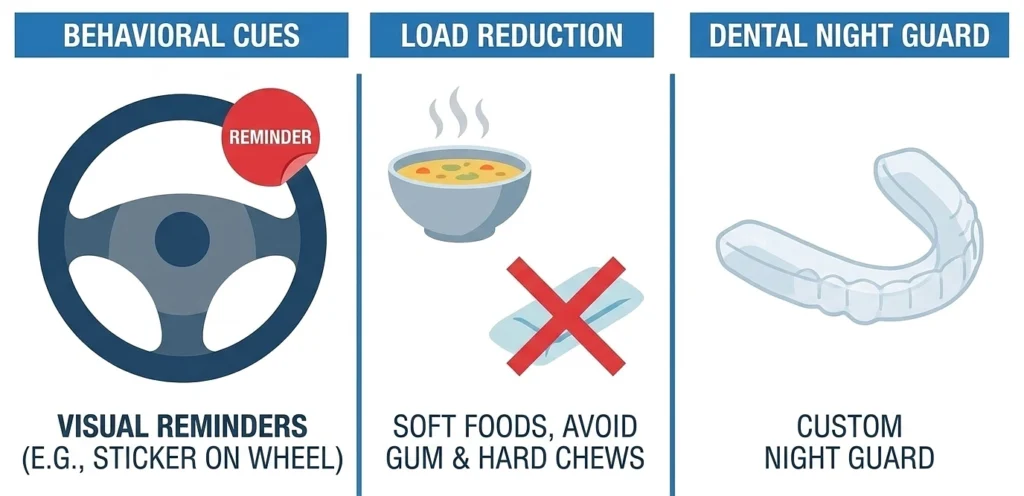
Behavioural work first, and it is less about discipline than about building a signal.
The alarm method above doubles as the treatment, since the correcting is easy once you catch yourself and the difficulty is entirely in the catching. People often add physical cues, a sticker on the monitor or the steering wheel, positioned where they already look during the activities that trigger it.
Load reduction matters too while things settle. Softer food for a period, cutting gum, avoiding wide yawning and biting into large items, and keeping the jaw quiet enough for irritated muscle to calm down. Heat over the muscle helps some people, cold suits others, and this is one of those areas where the evidence is thin enough that trying both and keeping whichever helps is reasonable.
For the sleep side, a dental guard fitted by a dentist protects the teeth from wear, though it is worth understanding what a guard does and does not do. It provides a surface for the forces to land on. It does not stop the underlying muscle activity, which is why guards reduce damage more reliably than they reduce pain.
Since awake bruxism tracks stress and mood so closely in the research, addressing that side is not a soft add on. It is treating the driver. That might mean sleep, workload, or genuine support with anxiety, and clinicians writing on this specifically call for psychological screening as part of TMD management rather than as an afterthought.
Where This Stops Being Something to Manage Yourself
A few situations warrant a professional rather than another month of self monitoring.
Jaw locking, either open or closed, needs assessment. So does a sudden change in how your teeth meet, pain severe enough to interrupt sleep or eating, swelling around the joint, or symptoms that keep worsening across several weeks despite reducing load. Clicking on its own is common and frequently harmless, though clicking that arrives alongside pain or restricted opening is worth having looked at.
The other reason to go early is the diagnostic one. Chronic TMD symptoms, meaning beyond three months, are strongly associated with depression, anxiety and stress in the clinical data, and pain that has been running that long tends to need a broader approach than a habit change. Dentists, orofacial pain specialists and physiotherapists with jaw training all work in this area, and which one suits you depends on what the examination finds.
None of this is a diagnosis of your particular jaw, and anyone whose pain has persisted deserves an actual examination rather than a checklist. If you are going to start somewhere tonight though, set the alarm and find out where your teeth sit when nobody is asking. The people who discover they have been clenching all along are usually the ones who had no idea there was anything to discover.