


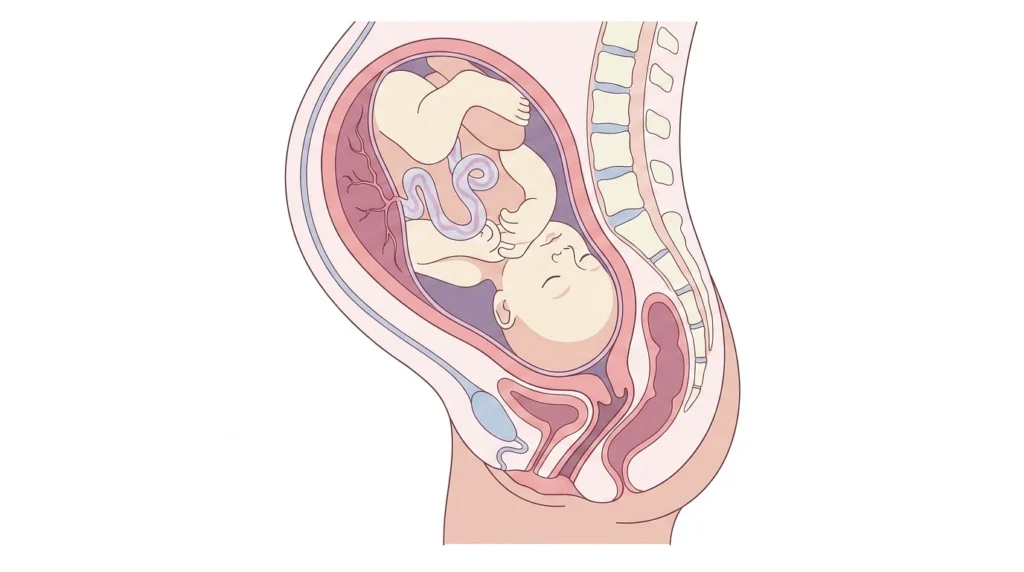
One time, while doing a scan, a reader asked if her baby could feel the cold gel on her belly. I probably gave her a longer answer than she wanted. That question, what gets through to a fetus and when, is one of the genuinely strange corners of medicine, because the answers are more specific and more uncertain than people expect.
But this development isn’t conceived of as a long blank period, nothing, nothing, baby care. It isn’t like that at all. Touch before taste, taste before sound, a nervous system laying its own cable in a sequence that barely changes from one pregnancy to the next. Ten things about that, below, roughly in the order they actually happen, though it’ll come out differently for different babies.

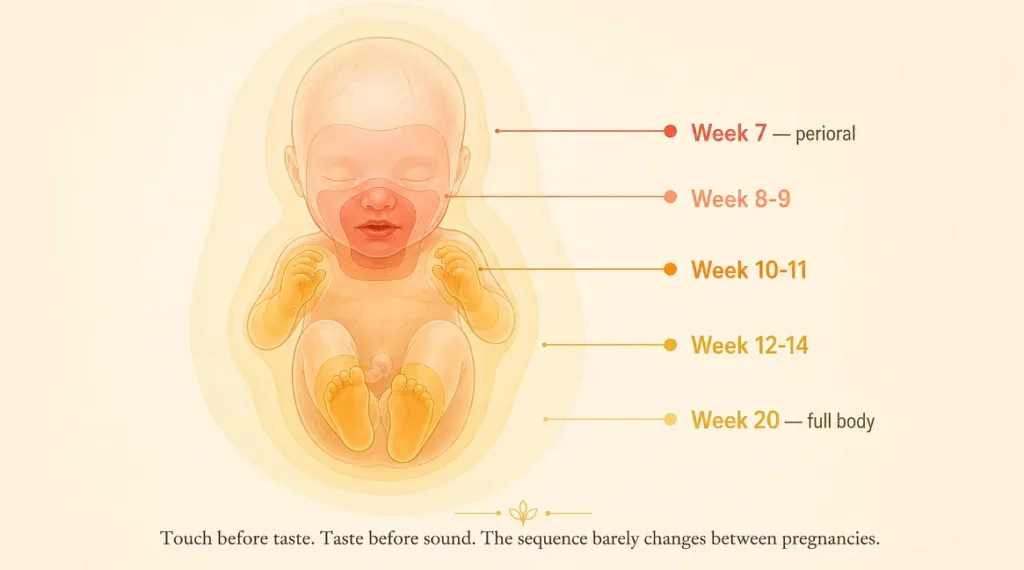
1. Touch Comes First, And It Starts At The Mouth
Skin before eyes. Skin before ears. Touch is the first sense to develop, with tactile systems operational by about week seven, before a recognizable face has formed.
It begins periorally, or around the mouth, and spreads outward in a nonrandom way. That’s the reason a newborn stroked across the cheek turns toward the touch and roots for the breast. That wiring was set down in the first trimester, so when that mother asked about the gel, touch was the one piece I could answer for without hedging. Pressure on the belly, past a certain point, yes. The cold of the gel, probably not, the abdominal wall sees to that. But a hand pressing down, that registers.
2. Adult-Style Taste Buds, Sitting There Unused For Weeks
Some sources say taste buds form at seven or eight weeks, while others say 13 to 15 weeks. Both sources are reputable and scientific. Pick a source, pick a week. But there’s another gap, between the structure forming and it switching on. The taste bud system doesn’t actually become functional until probably week twenty. So it exists for some months before it works. That’s a build it now, switch it on later theme, and in fact if you zoom out, that’s the theme of fetal development as a whole.
3. Garlic, ANISE, CARROT, ALL OF IT REACHES THE BABY

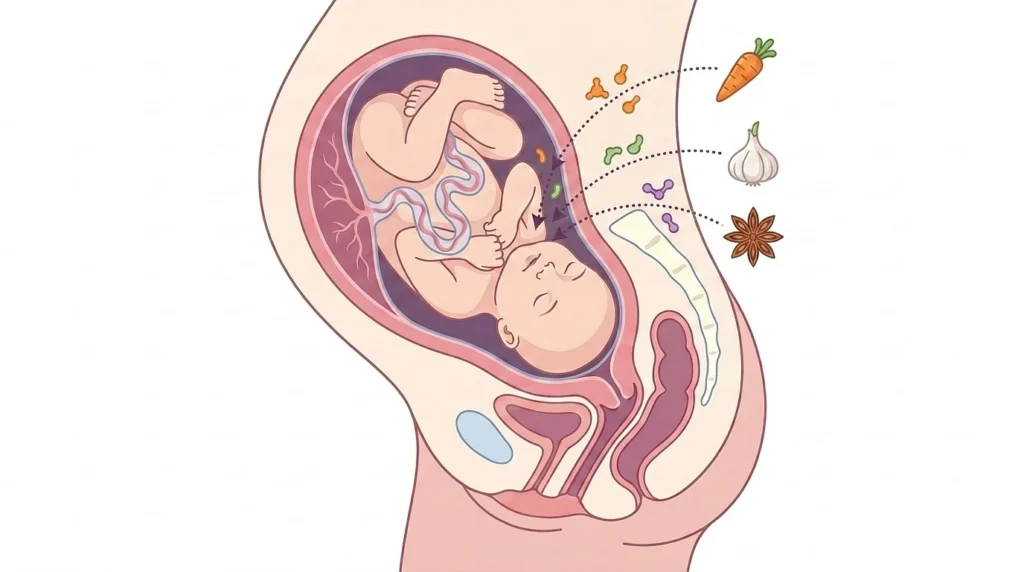
Eat a strongly flavored food, and the fetus may be able to taste a very weak version of it. This is not an old wives’ tale; it can be seen on ultrasound.
Flavor compounds in the mother’s diet reach the amniotic fluid and are swallowed by the developing fetus. In studies, mothers were given capsules containing flavoring compounds (carrot in one study, bitter and sweet compounds in others) and their expressions were recorded. Bitter made a face, sort of like the cry-face. Sweet got a calmer face and did some swallowing. And here’s the part that elevates it above a curiosity: it sticks. Postnatally, babies are more likely to take to foods their mothers consumed in large amounts during pregnancy. As the French researchers found with anise: the taste of the womb becomes the taste of home, before there is any home to taste.
4. The First Sound It Hears Is You, From The Inside
The fetus responds to sound from twenty weeks onwards, but the first thing it responds to is not music from outside.
It’s the mother’s body. Her heartbeat, the wash of blood through the great vessels, her own voice conducted down through bone and tissue rather than through the air, which is a different, lower, muddier sound than the one other people hear when she talks. Everything that comes in is low and muffled, like a song through a wall two rooms over. By the thirty-fifth week the cochlea is essentially complete, and the fetus can differentiate frequencies and intensities. There’s a working ear in there for the better part of a trimester before anyone meets it.
5. It Files Those Sounds Away And Keeps Them After Birth
Now the part that made me sit up. The hearing isn’t just happening, it’s recording.
One group of fetuses was played a spoken nursery rhyme once a day beginning at thirty-four weeks gestation. After birth, the babies heard the same rhyme again and responded with less waking activity, deeper sleep, and a slower heartbeat. Control babies who had never heard it in utero did nothing special: same rhyme, no effect. So something is being written down during those last weeks, and carried across birth intact. That’s the boring physiological reason a newborn already prefers its mother’s voice in the first days of life: it’s been studying her for months. People reach for something mystical there, but it’s just memory, laid down early.
6. Hour For Hour, It Sleeps More In REM Than It Ever Will Again
Look long enough at ultrasound pictures of late-pregnancy fetuses and you’ll see their eyes flicking back and forth.
That’s REM, or rapid eye movement sleep, which makes up a large portion of the third trimester. One study with eye trackers, tracking fetuses between 24 and 39 weeks, showed a steep increase in REM at 28 to 29 weeks. The percentage of REM sleep at this age is higher than at any time in human life, infancy included. No one knows why a brain with nothing yet to process needs so much of it. The most popular theory is that the construction work is happening during REM itself, the process of wiring the cortex, rather than replaying any experience.
7. Does It Dream? I Don’t Know, And I Don’t Trust Anyone Who Says They Do
Since REM in adults means dreaming, it’s easy to extrapolate to a dreaming fetus. But I won’t be the one to.
A brain that has never seen a face, never heard an unmuffled sound, never had a single waking moment to draw from, what would it even dream of? Dreams are built from experience and this one hasn’t had any yet. The eye movements are real and observable. The dream behind them is just a projection. I’d rather give you that flat “we don’t know” than some warmer answer I’d have to invent.
8. Months Before Its First Breath, It’s Already Practising

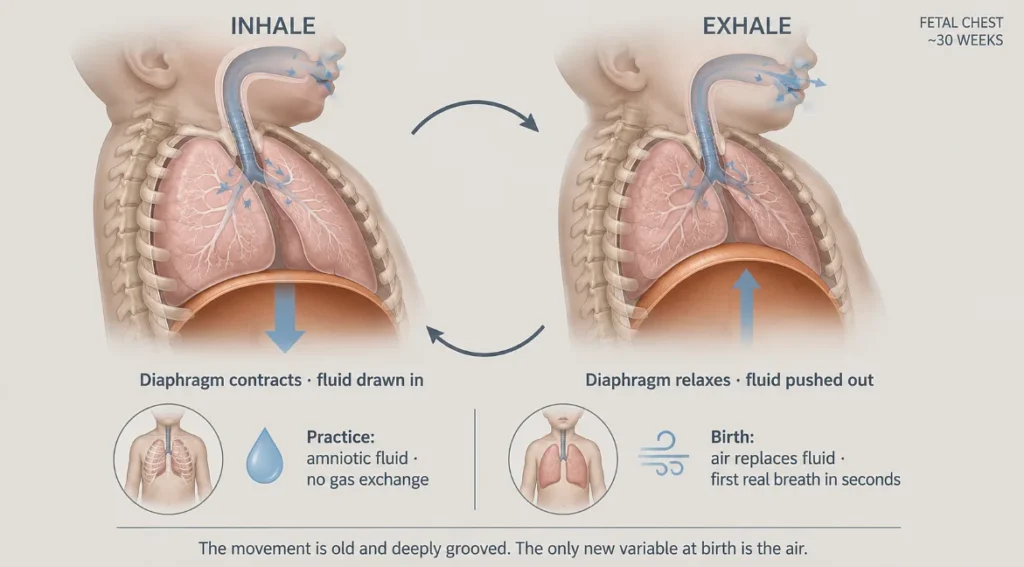
There’s no air in the womb, and the fetus is “breathing” anyway.
Rhythmic movements of the diaphragm and chest wall, drawing amniotic fluid a little way in and pushing it back out, begin well before birth. The brainstem sets the rhythm, the breathing muscles build tone, and the whole thing runs dry-fire practice for a job it can’t do yet. That’s why a healthy term baby breathes within seconds of delivery without being taught, the movement’s old and deeply grooved. The only truly new variable at birth is the air.
That’s clinically useful too, because those breathing movements are one of the things we score on a biophysical profile, the ultrasound test we do in the last weeks of pregnancy to check whether the baby is well. A baby making regular breathing movements is one whose nervous system, on that measure, is behaving the way it should.
9. Light Gets In, Sort Of, Near The End
The eyes are shut for several months, but it isn’t completely dark inside.
Around twenty-eight weeks the fetus can open and close its eyes, and if a bright light is held to the mother’s abdomen, it’ll react, move, or shift. Call it a sense of light and dark rather than sight. A reddish glow filtering through the abdominal wall, not shapes, not faces. The hard part of vision, a cortex that learns to read what the eye reports, mostly waits until there’s an actual world to look at. The eye is nearly complete at birth. The seeing is the part that takes years.
10. Fetal Pain Is The Hardest Question On This List, And It Is Not Settled

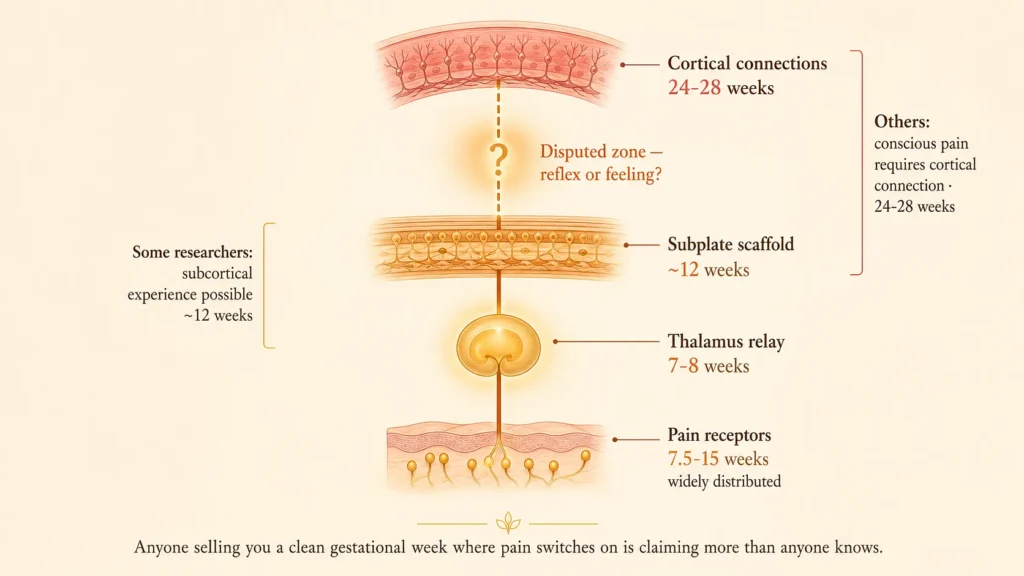
I saved this one because it’s reported with a certainty in both directions that the science has never justified, and the certainty is the lie.
The plumbing first, because the plumbing isn’t really in dispute. Pain receptors are widely distributed through the fetal body between 7.5 and 15 weeks. By 7 to 8 weeks the signals reach the thalamus, and by about 12 weeks the cortical subplate, a temporary scaffold layer below the developing cortex. Connections into the cortical plate proper form after 24 weeks, a process that’s been well mapped.
The fight is over which rung on that ladder is the one where a reflex becomes a feeling.
One school, cortical necessity, argues there’s no conscious pain until the thalamus-to-cortex connections are working, from 24 to 28 weeks, and treats everything before that as reflex. A 2005 meta-analysis in the Journal of the American Medical Association sits in that camp, putting functional pain perception unlikely before the late second or third trimester. The other school thinks the subplate and subcortical structures might carry something earlier, maybe around 12 weeks, pointing out that the cortex may not be strictly required for an experience the way that model assumes. Meanwhile clinical practice has already moved on. In 2021, the American Society of Anesthesiologists and the North American Fetal Therapy Network recommended that analgesia be used for invasive in-utero procedures. They didn’t wait for philosophers to agree.