


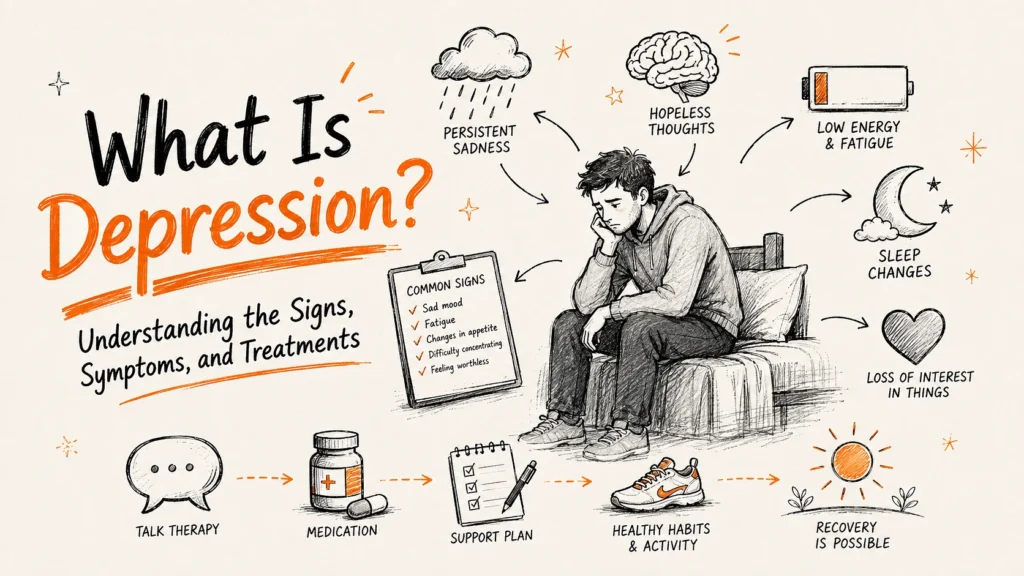
Most people who look this up have already decided what depression is. They think it is a chemical imbalance, specifically low serotonin, and that antidepressants top it back up the way insulin tops up what a diabetic is missing.
Surveys suggest around 80% of the public believes this. It is the explanation given in doctors’ offices, on health sites, and in most articles with this exact title.
It is also not what the science currently says, and the gap matters more than it might seem, because what you believe is causing your depression shapes what you think will fix it.
Starting With What Depression Actually is
Depression is a mood disorder that changes how you think, feel, sleep, eat, and function. The clinical threshold for major depressive disorder is symptoms lasting at least two weeks and interfering with daily life.
That two-week marker exists to separate it from ordinary sadness, which is real, painful, and passes. Depression does not pass on its schedule, and it frequently arrives without a triggering event, which is one reason people dismiss it in themselves. Nothing bad happened, so nothing should be wrong.
The symptoms most commonly recognized clinically:
- Low mood or emptiness most of the day, most days.
- Loss of interest in things you used to enjoy, which clinicians call anhedonia.
- Fatigue that sleep does not resolve.
- Difficulty concentrating or making decisions.
- Sleeping far too much or far too little.
- Appetite and weight changes in either direction.
- Feelings of worthlessness or disproportionate guilt.
- Physical aches with no clear cause.
- Thoughts of death or suicide.
If you are having thoughts of suicide, call or text 988 in the US. It reaches the Suicide and Crisis Lifeline, it is free, and it is available every hour of every day. You do not need to be in immediate danger to use it.
The Chemical Imbalance Story, And Why It is Worth Correcting

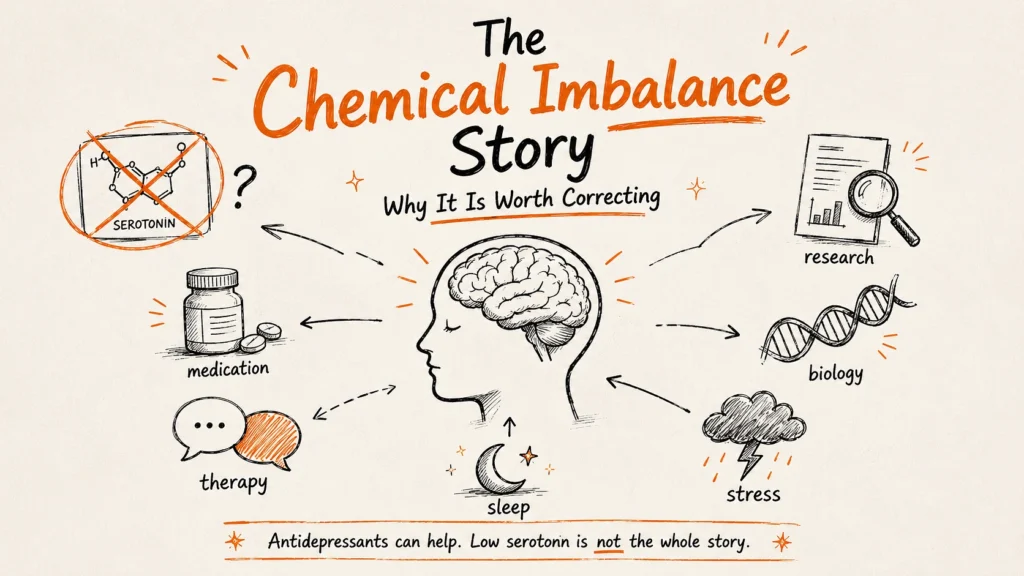
In 2022, a research team at University College London published an umbrella review in Molecular Psychiatry examining decades of studies on serotonin and depression. Their conclusion was that there is no consistent evidence that depression is caused by lowered serotonin levels or activity.
That review was contested. A group of 36 researchers published a formal response arguing the methodology was flawed and that it summarized existing results without new analysis.
Here is the part that gets lost in the argument, though. Both sides agree the simple version was never accurate. The critics’ own position is that the original serotonin hypothesis has been considered outdated for decades and that depression is heterogeneous, genetically, clinically, and biologically. Nobody serious is defending “low serotonin causes depression” as a complete explanation.
So Do Antidepressants Work?
Yes, for many people, and that question is separate from the serotonin question.
Medication working does not prove a chemical cause, in the same way that aspirin relieving a headache does not mean headaches are caused by low aspirin. The honest position is that we do not fully understand the mechanism, and that antidepressants nonetheless produce real improvement for a substantial number of people, particularly in moderate to severe depression.
What the correction changes is not whether to consider medication. It is the framing. If you were told your brain is broken in a specific measurable way and pills fix that specific thing, you may conclude that therapy is pointless, that you will need medication permanently, or that stopping is dangerous by definition. None of those follow.
Where Depression Actually Comes From
The current understanding is unsatisfying because it is not a single cause. It is a combination that varies by person.
Genetics contribute meaningfully, which is why depression runs in families. Chronic stress and trauma contribute, particularly early in life. Medical conditions can produce depressive symptoms directly, including thyroid disorders and chronic illness. Substances contribute both ways, since depression drives drinking and drinking deepens depression. And circumstances matter, including isolation, poverty, and grief.
This is why one person’s depression responds to therapy while another’s needs medication and a third turns out to have an untreated thyroid problem. The label describes a set of symptoms, not a single underlying disease.
The Types Worth Knowing Apart
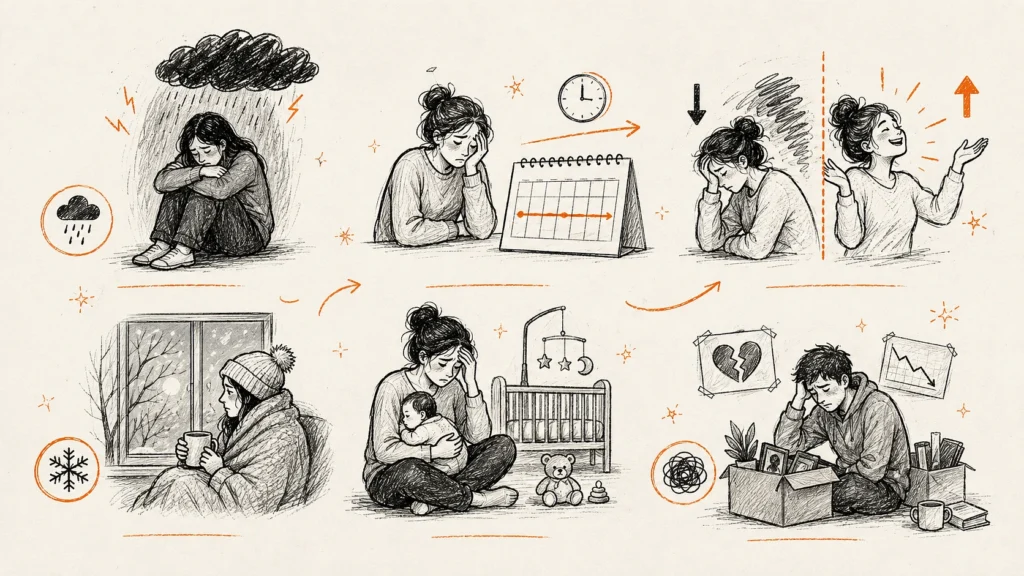
Major depressive disorder is the most common, with severe symptoms lasting at least two weeks.
Persistent depressive disorder, sometimes called dysthymia, is milder but lasts two years or more. People with this frequently never seek help because they assume it is their personality.
Bipolar depression occurs in the depressive phase of bipolar disorder. This distinction is critical rather than academic, because antidepressants alone can trigger mania in bipolar disorder, which is why any assessment should ask about periods of unusually elevated mood or reduced need for sleep.
Seasonal affective disorder follows the light cycle, usually worsening in winter.
Postpartum depression occurs after childbirth and is distinct from the short-lived baby blues.
Situational depression follows an identifiable event. It is not a separate DSM-5 diagnosis and is usually coded as an adjustment disorder with depressed mood.
What Treatment Actually Involves
Therapy
Cognitive behavioral therapy has the largest evidence base. It works on the relationship between thoughts, feelings, and behavior. Interpersonal therapy focuses on relationships and role transitions and has comparable outcomes. Behavioral activation, which is simpler than it sounds and involves rebuilding activity before motivation returns, performs well in trials.
Therapy is not the lesser option. For mild to moderate depression, it performs comparably to medication, and its benefits tend to persist better after treatment ends.
Medication
Antidepressants are a legitimate and often necessary treatment, particularly for moderate to severe depression.
What I want to say about them here is procedural rather than promotional. Which medication is right for you is a clinical decision that depends on your symptoms, your history, other conditions, and other drugs you take. Some carry sedating effects that help if you cannot sleep and hinder if you already sleep too much. Some interact badly with common medications. Some are inappropriate if there is any bipolar history.
That assessment requires a prescriber who takes a full history. It is worth being cautious about any service that moves quickly from a brief questionnaire to a prescription, and worth being especially cautious about content that recommends specific drugs by name to strangers, which several depression articles now do because those recommendations are paid placements.
Expect the process to be iterative. Antidepressants typically take four to six weeks to show full effect, and the first one prescribed does not work for everyone. That is normal rather than a failure.
Lifestyle Changes, Honestly Framed
Exercise, sleep regularity, and nutrition genuinely help. They are also, cruelly, the things depression makes hardest to do.
Suggesting a walk to someone who cannot get out of bed is not useless advice, but it is useless first advice. These work best as support alongside treatment rather than instead of it, and anyone presenting them as an alternative to clinical care is underestimating what depression does to a person’s capacity.
What To Do If This Describes You
Start with a primary care doctor if that is easier than a psychiatrist. They can screen for depression, rule out physical causes like thyroid dysfunction or anemia, and refer onward. Ruling out the physical stuff first is genuinely worth doing, because a small number of people arrive with what looks exactly like depression and turns out to be something treatable in a different way.
Say the symptoms plainly, including how long they have lasted and whether you have had thoughts of harming yourself. Doctors need the specifics, and understating it is the most common reason people leave without adequate help.
And if it is bad tonight rather than generally, 988 by call or text, any hour. If you are outside the US, your local emergency number or crisis line does the same job.
Depression is treatable. The mechanism is less understood than you have probably been told, and that uncertainty is uncomfortable, but it does not change the part that matters. People get better, in large numbers, with treatment that exists now.
Sources
- Moncrieff J et al., “The serotonin theory of depression: a systematic umbrella review of the evidence,” Molecular Psychiatry, 2022
- Jauhar S et al., response to the umbrella review, Molecular Psychiatry, via King’s College London
- Möller HJ, Falkai P, “Is the serotonin hypothesis of depression still relevant?