


There’s a moment every deal-hunter has with discounted gift cards, and it’s usually the moment that decides whether they save money or lose it. You find the resale marketplaces, you see “up to 35% off,” you get the little dopamine hit, and then you search for the card you actually want, Amazon, say, and the discount is half a percent. Half. And two tabs over, someone on a classifieds site is offering the same Amazon card at 40% off. One of those two prices is real. Understanding why it’s the boring one is the entire skill of this market, because the same logic that sets your realistic savings is the logic that identifies every scam on sight.
The One Rule That Explains Every Price: Discounts Run Inverse To Demand

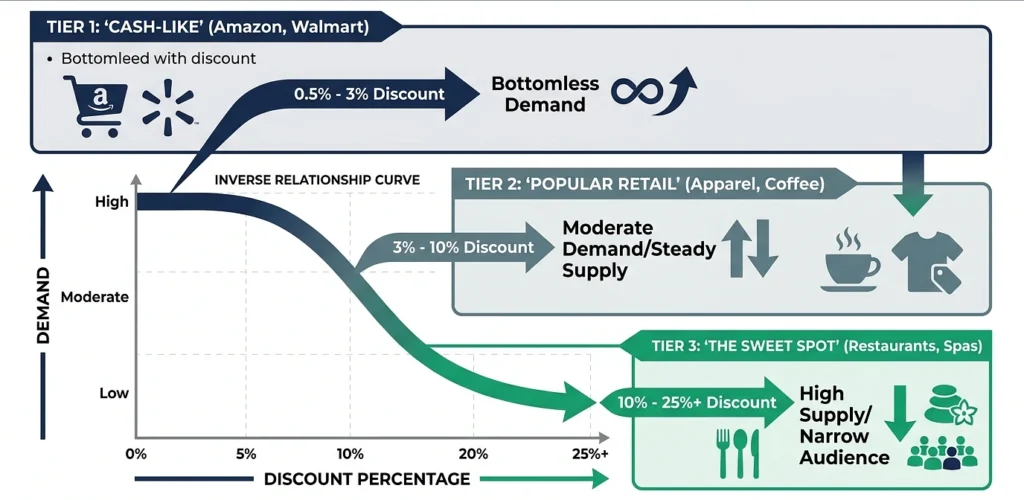
The discounted gift card market is a resale market, mostly people and businesses offloading cards they don’t want, through marketplaces that broker or buy them. And like any liquid market, it prices things efficiently. A card everyone wants sells for nearly full value. A card fewer people want has to offer a real discount to move. That single mechanic produces the whole category landscape:
- Near-zero discounts (0.5% to 3%): the cards that are basically cash. Amazon, Walmart, Target, Visa/Mastercard, grocery. These spend anywhere on anything, so demand is bottomless and the resale price hugs face value. Amazon cards on Raise sit around 0.5% off. That’s not the marketplace being stingy, that’s the market telling you what an Amazon card is worth, which is almost exactly its face.
- Modest discounts (3% to 10%): broad, popular retail. Big apparel, home improvement, department stores, major coffee chains. Useful to lots of people, so the discount is real but shallow.
- The sweet spot (10% to 25%+): restaurants and specialty retail. Casual dining chains, niche apparel, spas, specific-use brands. These are the cards people receive as gifts and don’t want, supply is high, the audience is narrow, and the discounts get genuinely deep. If you already eat at these places, this is where discounted gift cards stop being a gimmick and become a standing 15-20% off your normal life.
- The membership route: warehouse clubs. Costco and Sam’s Club sell third-party gift cards (mostly restaurants and experiences) at roughly 10-30% and 5-25% off respectively, first-party and fraud-risk-free, if you hold a membership.
The honest summary of “realistic savings” on the cards you most wish were discounted, you’ll save a rounding error. On the categories you’re flexible about, especially dining, you’ll save real money, reliably. The overall marketplace ranges, 1-30% on Raise, 3-35% on CardCash across 1,100+ retailers, are true, but the deep end of that range is populated by Olive Garden, not Amazon, and anyone promising otherwise is about to lead you somewhere bad.
Why That Pricing Rule Is Also Your Scam Detector
Here’s the payoff of understanding the market. Since real resale prices are set by real demand, a deep discount on a high-demand card is not a deal, it’s a confession. Nobody sells a legitimate $100 Amazon or Visa card for $60, because the open market will pay them $97 for it in minutes. The only cards that sell far below their market price are ones the seller needs to convert fast because they’re stolen, bought with stolen credit cards, already drained, or never existed. The too-good discount isn’t a risk factor for fraud. At sufficient depth, it basically is the fraud.
The classic mechanics, so you recognize them:
- The check-then-drain. The seller gives you a card number and PIN that shows a valid balance when you check it, and drains it before you spend it, they kept the numbers. By the time your purchase declines, the seller’s profile is gone. This is the signature scam of classifieds, auction sites, and social-media marketplaces, where cards get advertised at that tempting 10-30% off and the platform’s buyer protection frequently doesn’t cover gift cards at all.
- The fake-reputation seller. Convincing profiles, manufactured positive reviews, urgency (“three left”). Reputation on a general platform is trivially fakeable; it means nothing for gift cards.
- The in-store cousin. Even physical racks aren’t immune, tampered cards whose numbers were recorded before being reshelved, drained the moment someone loads them. Take cards from the middle of the rack, check packaging for tampering, and keep receipts.
And one adjacent rule that protects the people you love more than it protects you no legitimate business, government agency, or “support technician” ever demands payment by gift card. Anyone who does is a scammer, full stop, that’s the standing consumer-protection line, and it’s worth repeating at family dinners.
The Buying Rules That Actually Keep You Safe
Given all that, the safe playbook is short and strict:
- Buy only where there’s a real, stated buyer guarantee. The established marketplaces back their cards CardCash offers a 45-day money-back guarantee; Raise backs cards with a one-year guarantee. That guarantee is the entire difference between a marketplace and a gamble, it means someone with a business to protect verified the card and will make you whole. Comparison engines like GiftCard Granny aggregate listings from these vetted sellers, which is a sane way to price-shop without wandering somewhere unprotected.
- Never buy from classifieds, social media, or auction listings. No guarantee, no recourse, and, per the pricing rule, the discounts that lured you there were the tell.
- Spend the card promptly, inside the guarantee window. This is the honest caveat about even the legitimate marketplaces protection expires. Users have reported balances going bad after CardCash’s 45-day window with no recourse, and the platform carries a middling B- rating with the Better Business Bureau partly for that reason. The discipline is simple buy a discounted card when you’re ready to use it, not to stockpile. A gift card is a liability that only becomes savings at the register.
- Buy digital when you can, and use it same-week. Instant delivery, no tampered packaging, minimal window for anything to go wrong between purchase and spend.
- If you do get burned, report it, to the retailer and card issuer first (with your purchase records), then at ReportFraud.ftc.gov, and at ic3.gov if it happened online. Individual recoveries are hit-or-miss, but the reports are how patterns get shut down, and the paper trail supports any claim you make.