


Hand a six-year-old a pencil in September, ask for one sentence about a pet, and you may well get this back ilikmidog. The idea is all there. What’s missing is everything that lets another person read it, from the shape of the letters to the gaps between the words to the capital at the front and the period at the back.
By spring, a lot of those children are writing “I like my dog.” with nobody standing over them. A good worksheet is one of the plainest tools for getting them there, provided it’s the right kind and it’s used in small doses. This guide is for parents and teachers who want to know what the right kind looks like, how long a child should spend on it, and when it’s time to put the page away and let them write something of their own.
What a Letter-Formation Worksheet Should Practice
First graders are expected to print all 26 letters in both upper and lower case by the end of the year. That’s 52 shapes, and each one has a starting point and a direction that the hand has to learn until it stops needing thought. Reading Rockets, in its article on the importance of teaching handwriting, warns that habits picked up early, such as an awkward pencil hold or letters built from the bottom up, are hard to shift later.
Worksheets vary a lot in how well they teach those movements. Before you print a stack of them, look for a few things on the page:
- numbered arrows on the model letter, showing which stroke comes first and which way it travels.
- letters grouped by how they’re made (c, a, d, g and o all begin with one curve), since alphabetical order mixes easy and hard shapes.
- the model sitting on the line the child writes on, so there’s no copying from a board across the room.
- new letters put to work in short words alongside letters the child already knows.
That list follows what the researchers Richard Gentry and Steve Graham describe as the marks of a good handwriting program. One more habit is worth adding at the table. Have the child say the letter’s sound while writing it, because the hand and the ear then learn the letter together and the practice feeds reading as well.
Ten to twenty minutes a day is plenty. Graham’s guidance for kindergarten through third grade is short sessions adding up to 50 to 100 minutes a week, and a tired hand at minute twenty-five mostly practices mistakes.
Why The Words Run Together, And What Fixes The Spacing
Spoken English has no gaps in it. Say “I like my dog” out loud and it comes out as one stream of sound, so a child who writes ilikmidog is recording what they hear quite faithfully. The space between words is a convention of print, and it has to be taught as deliberately as any letter.
A spacing worksheet does this by making the gap visible. Some give each word its own box. Others print a dot or a small picture where the space belongs, then take those props away over a few weeks. Either design works, as long as the child is asked to copy or write a short sentence and can see where one word stops.
The “finger space” described in Edutopia’s guide on how to teach handwriting still earns its place beside the page. After finishing a word, the child lays a finger of the other hand on the line and starts the next word on the far side of it. In its guide to teaching handwriting, Keys to Literacy suggests a popsicle stick as an alternative, and for left-handed children the stick is the better choice from the start, since their spare hand lands right where the next word needs to go.
Adults can help by overdoing it. When you write a sentence for a child to copy, leave gaps wide enough to drive a toy car through, and say “space” out loud each time you make one. It feels silly, and children pick it up quickly.
How Worksheets Take a Child From Single Words To a Whole Sentence
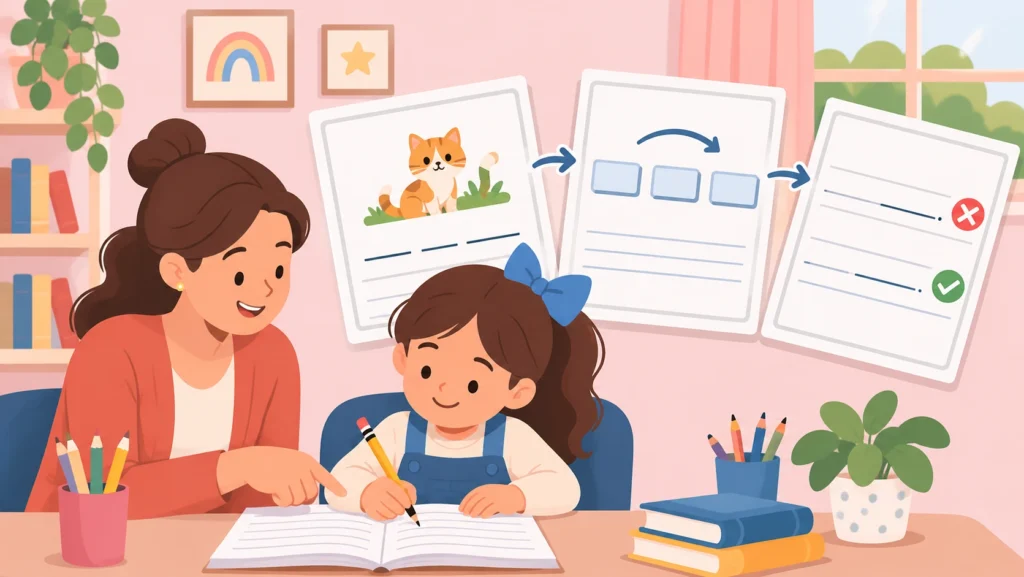
Knowing letters and leaving spaces still doesn’t produce a sentence. A sentence needs somebody doing something, a capital to open it and a mark to close it, and first-grade standards ask children to produce complete sentences and to use end punctuation. The federal What Works Clearinghouse guide, summarized by Reading Rockets as Teaching Elementary School Students to Be Effective Writers, names sentence construction alongside handwriting and spelling as a basic skill to be taught directly. Three kinds of worksheet do most of that teaching.
Sentence Frames
A frame supplies the skeleton and leaves a blank: “I can see a ____.” “My ____ is ____.” The child only has to find one or two words, yet what ends up on the paper is a full, correct sentence in their own handwriting. Frames are the gentlest starting point, and many children outgrow them quickly.
Scrambled Sentences
Here the words are given in the wrong order (dog. my like I) and the child rearranges them and writes the result. There’s a clue built in, and it’s worth pointing out the first few times. One word has a capital letter, so it goes first. One has a period stuck to it, so it goes last.
The Capital And Period Check
The third kind prints a few sentences with mistakes in them and asks the child to play teacher. she likes chips needs two fixes. Most children would much rather catch an error than avoid one, and the habit carries over. Before long you can ask “what does every sentence start with?” about their own work and get an eye-roll and a correction.
Spelling doesn’t need to be perfect during any of this. That federal guide encourages the youngest writers to use invented spelling, so “mi dog” is fine for now if the spaces and the period are there.
How Much Worksheet Time is Enough
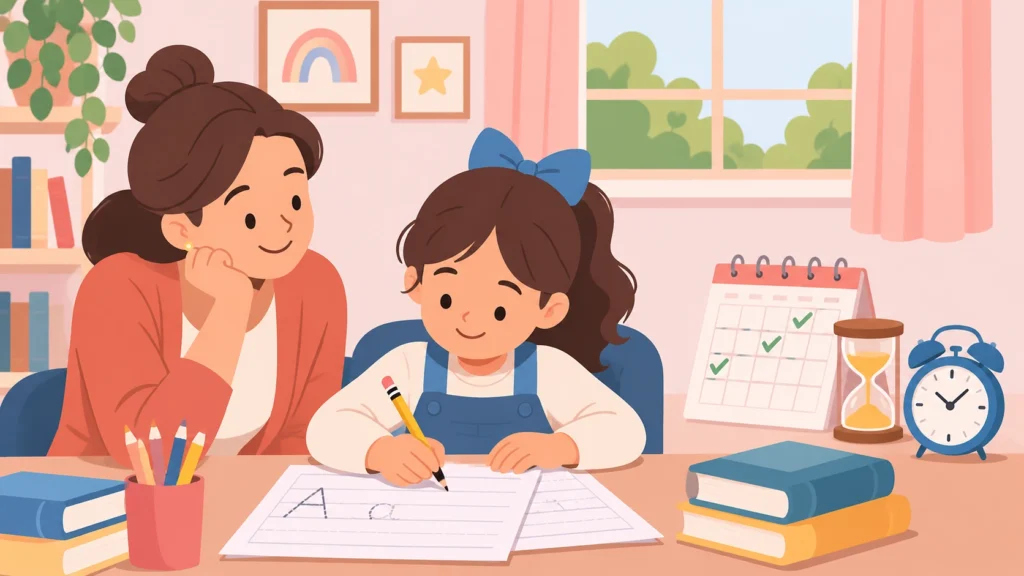
Less than most parents assume, and more often.
In school, the What Works Clearinghouse panel recommends an hour of writing a day from first grade on, with about half of it spent being taught skills and half spent using them. Worksheets belong in the first half. At home, where a child has already done a full day, one page is a sensible limit, and ten minutes at the kitchen table on four evenings will do more than forty minutes on Sunday.
It also helps to chase one thing at a time. Education World’s advice on handwriting instruction is to work on letter formation first, then size, then spacing, and that order also suits a parent with a red pen. If tonight’s page is about spaces, praise the spaces and let a backwards s go. A child who gets five corrections on one line tends to stop trying on the next.
A few signs tell you a worksheet has done its job and can be retired:
- the child forms the letter without glancing at the model.
- spaces turn up in writing that had nothing to do with the worksheet, like a birthday card.
- they start a sentence with a capital without being reminded.
When you see those, move on. Filling in another twenty pages of something already mastered is how children come to dislike writing.
When to Put The Worksheet Away And Let Them Write
A worksheet teaches the mechanics. It can’t give a child a reason to write, and by the middle of first grade the reason starts to matter more. The federal guide makes a point that’s easy to miss: unless children write for different audiences, they may come to see school writing as something done only for the teacher.
This is the stage for a different sort of page. Planning sheets, story checklists and simple editing lists ask the child to come up with the idea and carry it through, and the mechanics get practiced along the way. Studentreasures, a company that turns class stories into bound books, offers free first grade lesson plans of this kind, with sheets for brainstorming, for narrative, opinion and informative writing, and for editing. Notice that none of them drill letter shapes. They assume the earlier worksheets have done that and move the child on to writing something a classmate or a grandparent will read.
Real audiences are easy to find at home. A shopping list. A note for the tooth fairy. A label for the Lego bin, a card for a cousin, two sentences under a drawing that goes on the fridge. Each of those uses letters, spaces and a full sentence, and the child can see the point of every one.
Some of the groundwork happens away from the pencil. Giving a child time to finish a thought out loud is good practice for finishing one on paper, and this article on listening skills in your children explains the three-second pause that makes room for it. And the wider aim, a child who can do a thing without an adult stepping in, comes up again in this guide to teaching children with food allergies to advocate for themselves.
Whichever sheets you choose, keep the sessions short and stop while the child still wants to do one more.

