



Former users. That is the part worth sitting with.
In a study comparing 101 long-term anabolic steroid users against 71 weightlifting controls, eleven percent of the users had an ejection fraction under 40%. That number is the clinical line for heart failure. Ten percent of them were still using. Eleven percent had already stopped, on average six years earlier.
Stopping had not undone it.
Quick clarification before going further, because the word does double duty. Corticosteroids, the prednisone-and-inhalers family, are a different class of drug with a different risk profile and are not what this is about. This is about anabolic-androgenic steroids at the doses people actually take in gym members are still.
The Belief That Quitting Resets Everything

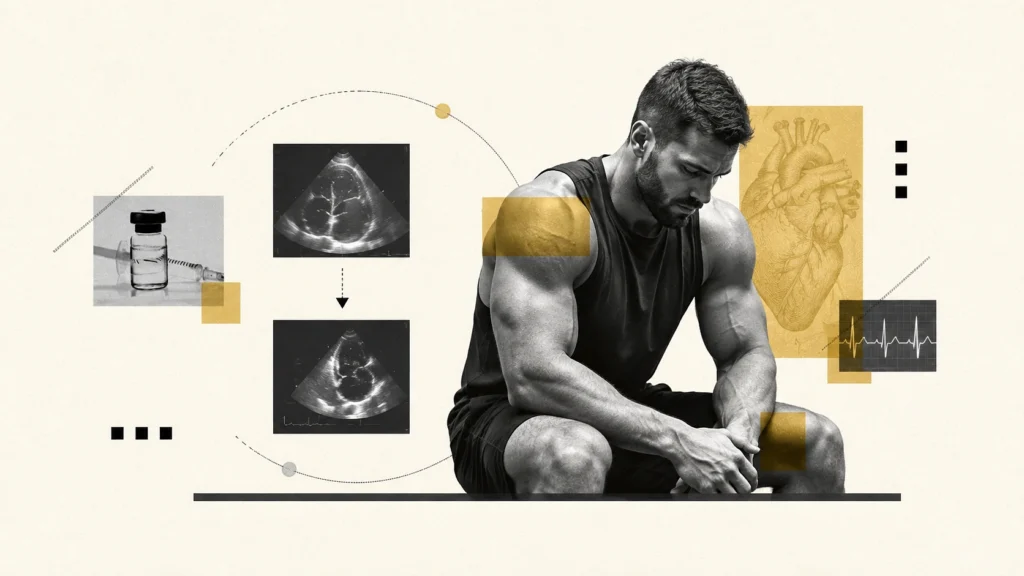
Every gym has a version of this. Run a cycle, come off, your body sorts itself out. It is the assumption underneath almost every decision anyone makes about these drugs, and it is not baseless.
The HAARLEM study is where it comes from, more or less. Thirty-one men, tracked with 3D echocardiography before a cycle, at the end of it, and a year later. Median cycle length sixteen weeks. Ejection fraction fell 4.9%, left ventricular mass climbed 28.3 grams, and the size of the increase tracked with how much they were taking each week.
Eight months after stopping, every measurement was back where it started.
So for one cycle in a healthy young man, the reset is real. Anybody who tells you otherwise is arguing with an echocardiogram.
What that study cannot tell you is anything about a decade.
The men in the cardiomyopathy study had eleven years of accumulated use behind them, give or take seven. Both current and former users showed disease in both ventricles, left and right. And when the researchers went looking for what best explained the reduced pumping function, it was not the heavy training, and it was not blood pressure. It was history of use. Not current use. History.
There is a sixteen-year follow-up that softens this somewhat, and it should be mentioned rather than buried. Thirty-two users tracked over a decade and a half, showing larger heart muscle mass and lower ejection fraction than strength-trained non-users, 266 grams against 215, 49% against 53%. But among those who quit during the follow-up period, remodeling and systolic function did seem to improve, even after ten-plus years of use.
Two findings, not perfectly reconcilable, both published. What they agree on is that duration is doing something distinct from dose, and that the eight-month reset in HAARLEM was measuring a very different exposure than eleven years.
Cardiomyopathy
Disease of the heart muscle. It enlarges, thickens or stiffens, and pumps less well. A systematic review pulled together 32 published cases attributed to steroid use, almost all men, average age 38. Left ventricular dilation and reduced ejection fraction in most of them. Most improved on heart failure treatment after stopping. Some needed managing for life. One reported case came in under 15% ejection fraction.
Thirty-eight is not old.
The Fertility Problem Shows Up At a Different Clinic

Steroids pharma grade shop shut down the hypothalamic-pituitary-gonadal axis. The body reads the incoming androgen as sufficient and stops making its own, and testicular function goes quiet along with it.
What that produces: hypogonadism, low libido, erectile dysfunction, gynecomastia, and sperm counts ranging from very low to zero.
Most men recover in six to twenty-four months. That is the honest headline and it is genuinely reassuring for most people reading this.
The caveat in the review literature is narrower and worse. Recovery is uneven, hormone levels come back before sperm production does, and heavier or longer exposure is linked to delayed or incomplete recovery in a subset of users. Nobody has a way of identifying that subset in advance.
If you are twenty-four and children are theoretical, this reads as a footnote. It stops reading as a footnote in a fertility clinic at thirty-three.
Everything Else, Briefly
The liver takes it hardest from oral compounds, with cholestasis, cell damage, and in bad cases toxic hepatitis or tumors. Lipids get dysregulated and the blood turns more prone to clotting. Mood effects run through aggression, cognitive changes, and a depression on cessation that gets consistently underestimated by everyone except the people going through it.
Tendons deserve one more line than that. Muscle strength climbs faster than connective tissue adapts, and steroid use is associated with tendon fragility on top of that mismatch. The rupture stories that circulate in every gym are not a run of bad luck.
Tell a Doctor, Not a Coach
Nobody has ever been argued out of using by a warning, so the practical part matters more than the lecture.
A physician who does not know what you are taking cannot read your bloods or your ECG properly. The American College of Cardiology publishes clinical guidance on managing cardiovascular risk in athletes using these compounds, and it exists because refusing to engage with users left them unmonitored and undiagnosed.
Get an echo before you have symptoms. Every change described above shows up on imaging long before it shows up in how you feel, which is the entire reason the former-users number at the top of this article is what it is. Those men felt fine for years.
Sources:
- Smit et al., HAARLEM study, reversible LV hypertrophy and cardiac dysfunction
- Severe biventricular cardiomyopathy in current and former long-term users, European Journal of Preventive Cardiology
- Cardiac structure and function in AAS users, sixteen-year follow-up
- Steroid-induced cardiomyopathy, systematic review and case report
- Health consequences of anabolic steroids, sexual medicine perspective, International Journal of Impotence Research
- American College of Cardiology, managing cardiovascular risk among athletes using AAS