


Tasmanian Oak has nothing to do with oak trees. It’s eucalypt, and most people in the trade just call it Tassie Oak. Blackwood is brown. Victorian Ash is a gum tree too. The names seem to go back to resemblance, because the boards looked a bit like oak or ash to whoever first milled them, and they tell a furniture buyer very little.
What a buyer does need to know is if the timber will survive outdoors or should stay in the house. In Australia that question comes with a number attached, and once you know the number for a species, most of the choosing is done.
The Durability Class Separates Indoor Timber From Outdoor Timber
Australian Standard AS 5604 gives each commercial species a durability class from 1 to 4. The class is an estimate of how long the heartwood lasts before rot gets into it. For timber standing outside and off the ground, the published life expectancies are:
- Class 1, more than 40 years.
- Class 2, 15 to 40 years.
- Class 3, 7 to 15 years.
- Class 4, 7 years or less.
Outdoor furniture should be Class 1 or Class 2. Inside the house the class stops mattering, since any of the four will do for furniture that stays dry.
Those year counts look precise, and they aren’t really. They come from small untreated test pieces, 35 mm square, left out in the weather. A table with thick legs and a coat of oil ought to do better than a bare stick in a paddock.
The rating also covers heartwood only. Sapwood, the paler band that grew nearest the bark, rots quickly in any species and has to be treated before it goes outside. Termites are a separate matter again, and a Class 1 stamp is no promise against them.
Tasmanian Oak, Victorian Ash and Blackwood Are Timbers For Inside The House

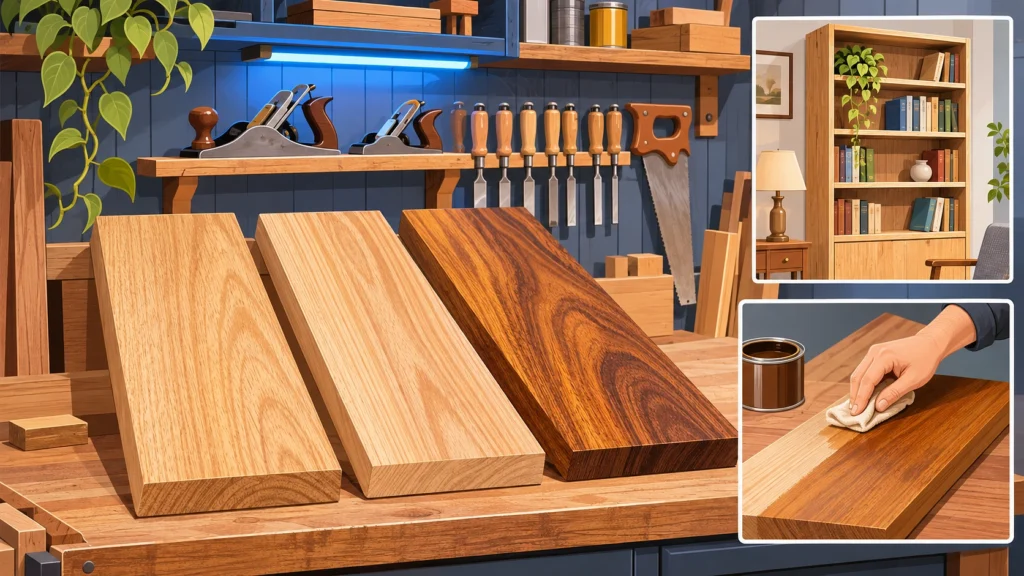
Tasmanian Oak
Three eucalypt species are milled in Tasmania and sold under this one name. Outdoors it is only a Class 3 timber, so the industry’s own species guide describes it as best suited to indoor applications and furniture. Indoors it does very well. The boards run from straw to a light reddish brown, and you should expect the odd gum vein, a thin dark line of resin that is a normal feature of the timber and no defect.
Tassie Oak is known for staining well. Bear that in mind in a showroom, because the colour in front of you may be the finish and the timber underneath may be much paler.
Shelving suits it. A Tasmanian Oak bookcase spends its life in a dry room under a steady weight, and this is a strong timber that makers find easy to work.
Victorian Ash
Victorian Ash is the mainland cousin, cut in Victoria from two of those three species. It is Class 3 as well. For buying purposes, treat it as you would Tasmanian Oak.
Blackwood
Blackwood is a wattle. The timber ranges from golden to a deep brown, sometimes in one board, and it has long been used for furniture, veneers and panelling. Guitar makers use it too. It is an interior timber with poor durability in the ground, so keep it off the patio.
If you ever sand a Blackwood piece back yourself, wear a dust mask. The dust is a known irritant.
Spotted Gum, Jarrah, Ironbark and Blackbutt Can Live Outdoors
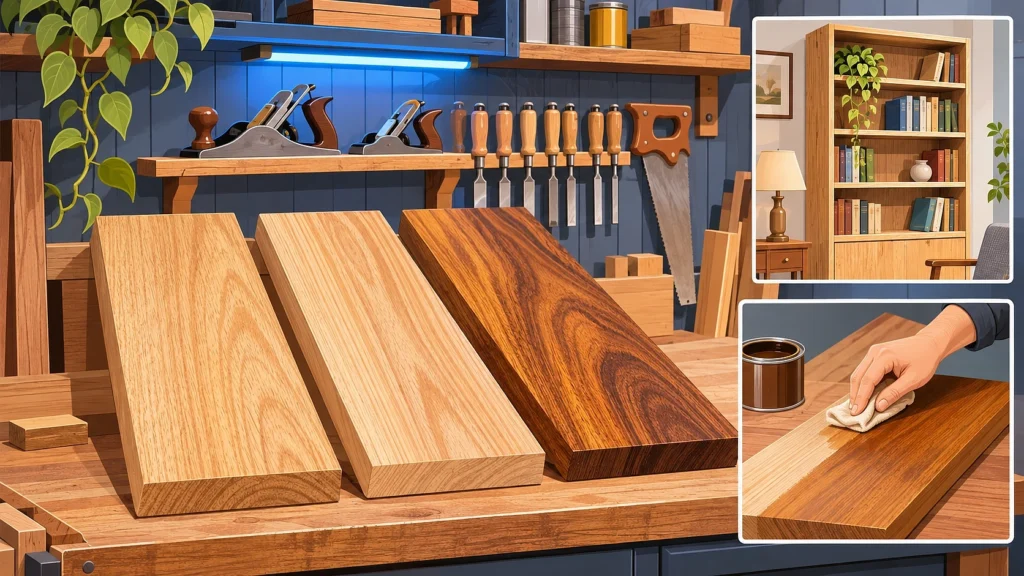
Spotted Gum
Most outdoor furniture makers would put Spotted Gum at the top, and the numbers back them. It is Class 1 above ground. The heartwood can be anything from light brown to a dark red-brown, so don’t expect two settings to match unless they were cut from one batch. Outdoor furniture made from Spotted Gum has won industry awards here and gets exported.
It’s a dense timber, and that shows up in practical ways. A Spotted Gum table takes two people to move. If you’re building your own, pre-drill the screw holes. It is also low in tannin, which helps on a paved courtyard, because some hardwoods leach brown stains onto pavers the first few times rain hits them.
Jarrah
Jarrah grows in the south-west of Western Australia and is the deep red one. It is rated Class 2, and it’s among the few timbers recommended for high-quality indoor furniture and for outdoor furniture, so you can have a dining table inside and a setting on the deck in one timber. There are jarrah jetties from around 1900 that are standing today, which says enough about how it handles weather.
Ironbark
Ironbark is Class 1 and very heavy. Makers grumble about what it does to saw blades. You’ll mostly find it in benches and big fixed tables, where nobody plans to lift the thing again.
Blackbutt
Blackbutt is the pale option outdoors, a straw to light brown. Its class gets quoted as 1 or 2 depending on who is selling. The national durability guide puts it in Class 2 beside Jarrah, and that’s the figure to go by.
Hardness Matters Most on Tabletops And Desks
Durability is about rot. Hardness is a different property, and it tells you how easily a surface dents. In Australia it’s given as a Janka rating in kilonewtons (kN), and a higher number means a harder timber:
- Tasmanian Oak, around 5.5 kN.
- Blackwood, 6.0 kN.
- Jarrah, 8.5 kN.
- Spotted Gum, 10.1 kN.
The Tasmanian Oak figure undersells it a little. The rating is based on the softest of its three species, and that species makes up only a small share of what is sold.
For a dining table or a desk that gets plates, keys and laptops dropped on it, the harder timbers are worth paying for. A bookcase, a bed frame or a bedside table takes far fewer knocks, and anything from 5 kN up will serve.
Oiling, Greying And Proof Of Where The Timber Came From
Left bare outside, even a Class 1 hardwood goes silver-grey within a season or two. The timber is fine underneath, and plenty of owners prefer it that way. To hold the original colour you’ll need to oil it, and to keep oiling it whenever water stops beading on the surface.
Suppose an indoor timber ends up on a covered verandah. The growers’ data sheet for Tasmanian Oak says it should be painted or coated for exterior use, so give it that protection and keep it out of direct rain.
Timber choice also changes how you set up a yard. Anyone planning an outdoor living area can put a Class 1 table out in the open, whereas a lower class wants a roof over it. A quick look over the joints and fixings once or twice a year fits easily into the preventative home maintenance you already do.
On the question of origin, ask the seller for the species by name and ask if the timber is certified. Certified timber can be traced back through a chain of custody to a certified forest. A certified piece of furniture carries a Responsible Wood, PEFC or FSC logo with an identification number, and a seller who has it will be able to show you.