


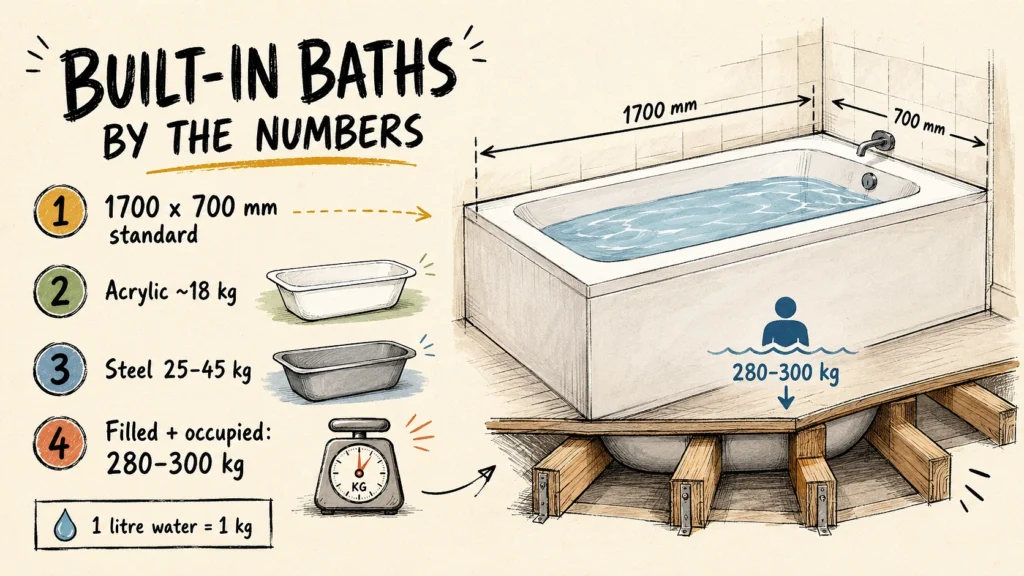
Before anything else, the four numbers that settle most bath-buying arguments:
- 1700 x 700mm is the standard built-in bath. If you’re replacing an existing straight bath, this is almost certainly what’s in the wall right now.
- A standard acrylic bath weighs about 18kg empty. The same size in steel runs 25 to 45kg.
- Filled and occupied, either one puts roughly 280 to 300kg on your floor.
- One liter of water weighs one kilogram. That last fact is the entire upstairs question, and we’ll do the math below.
The Sizes That Actually Fit

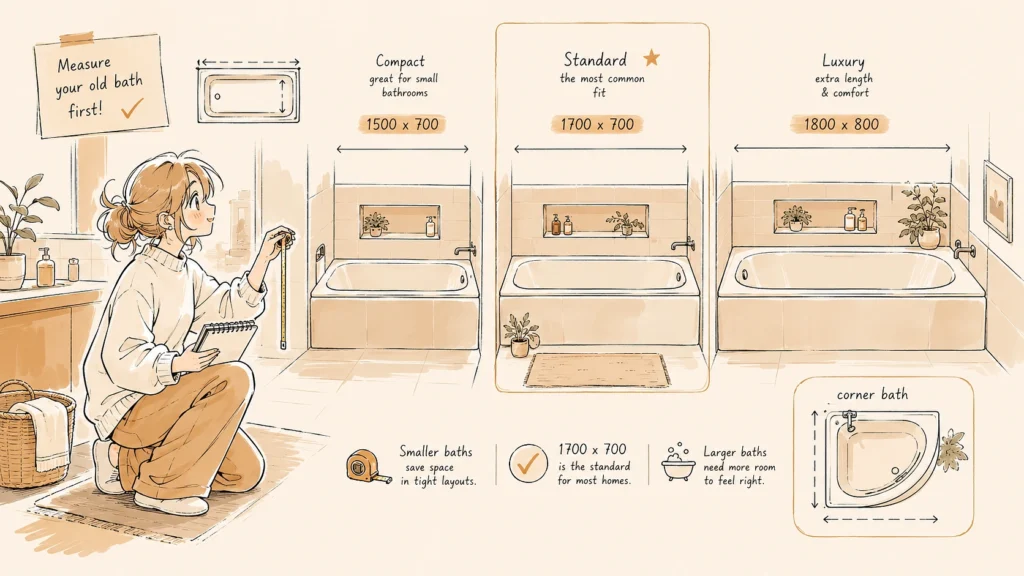
The reason 1700 x 700 became the standard is boring and useful it’s the size that fits the alcove in most bathrooms built in the last several decades, so manufacturers make everything in it and plumbers stock panels for it. Go through any retailer’s bath buying guide and you’ll see the whole range organized around that center lengths run from 1500mm to 1800mm, widths from 700mm to 800mm, and corner baths live in their own world at roughly 1200 to 1600mm long by 900 to 1400mm wide.
What that means in practice:
- Replacing like for like? Measure the old bath before you fall in love with anything. If it’s 1700 x 700, your choice is enormous. If it’s 1500, your choice is fine. If it’s something odd, budget for tiling repairs.
- Small bathroom? 1500 x 700 baths exist for exactly this, and many run a little deeper to make up for the lost length. A short deep soak beats a long shallow one.
- Want luxury? Double-ended baths stretch to 1800mm with the waste in the middle. Lovely. Also heavier, wider, and the first candidates for the structural conversation at the bottom of this page.
One measuring note that trips people constantly the quoted size is the outer rim, not the space you bathe in. Two baths with identical 1700 x 700 footprints can have noticeably different internal room depending on how the shell is molded. Sit in one at a showroom if you can. It’s a purchase you’ll be lying in for a decade.
Acrylic Vs Steel: What The Price Gap Actually Buys

Which One Is Cheaper?
Acrylic, usually, but barely, and that’s the surprise. A standard budget acrylic bath starts around the £100 to £150 mark, and entry-level steel is right on top of it, the Kaldewei-made Eurowa contract range has been the fitters’ open secret for years at close to the same money. The real price split isn’t between the materials. It’s between the budget and premium ends of each one.
Here’s where the money goes, and the numbers to check on any listing:
- Acrylic thickness. Quality acrylic starts at 8mm. Below that you get flex, and flex is what causes the thing bathroom fitters complain about most, the creaky, drummy give underfoot when you stand in a cheap acrylic bath to shower. Reinforced acrylic (Carronite is the name you’ll see) fixes it and pushes the price toward the £300 to £500 zone.
- Steel gauge. Budget steel baths use sheet as thin as 1.6mm. Premium makers like Kaldewei run a combined steel-and-enamel build at 3.5mm, which flexes less, sounds solid instead of tinny, and carries guarantees as long as 30 years.
- The feel. Acrylic is warm to the touch immediately and forgiving if you drop something in it. Steel feels cold for the first minute, holds heat longer once the water’s in, shrugs off scratches, and its enamel keeps a shine acrylic slowly loses.
My honest read, and this is the editorial part for a family bath that gets showered in daily, cheap acrylic is the one purchase in the bathroom you’ll regret fastest. Either spend up to reinforced acrylic or sideways to entry steel. The creak is not a small thing at 7am.
The Weight Check For Upstairs
Here’s the definition that makes the whole thing calculable, no engineering degree required.
A liter of water weighs one kilogram. That’s it. That’s the tool.
So take the standard acrylic bath from the top of this page: 18kg of bath, 180 liters of capacity. Fill it to the overflow and you’re at 198kg before anyone gets in. Add an adult and you’re brushing 280kg, concentrated on a footprint of about 1.2 square meters. Steel adds another 20kg or so to the same sum.
Now the number to compare it against. Domestic floors in the UK are designed to a live load of 1.5 kN per square meter under BS EN 1991-1-1, which works out to roughly 150kg per square meter. US residential code (the IRC) uses 40 pounds per square foot, around 195kg per square meter. Read those against the bath math and a filled, occupied tub exceeds the per-square-meter design figure. Which sounds alarming, so let’s be honest about why your ceiling isn’t on the floor.
Design live loads are set for loads spread across the whole floor, and a bath doesn’t work like that. It sits against a wall, usually across several joists, often near their bearing ends where they’re strongest, and building codes carry safety margins on top. A standard 1700mm acrylic or steel bath on a sound modern floor is a routine installation that fitters do every day without a second thought.
The Cases Where You Stop And Actually Check
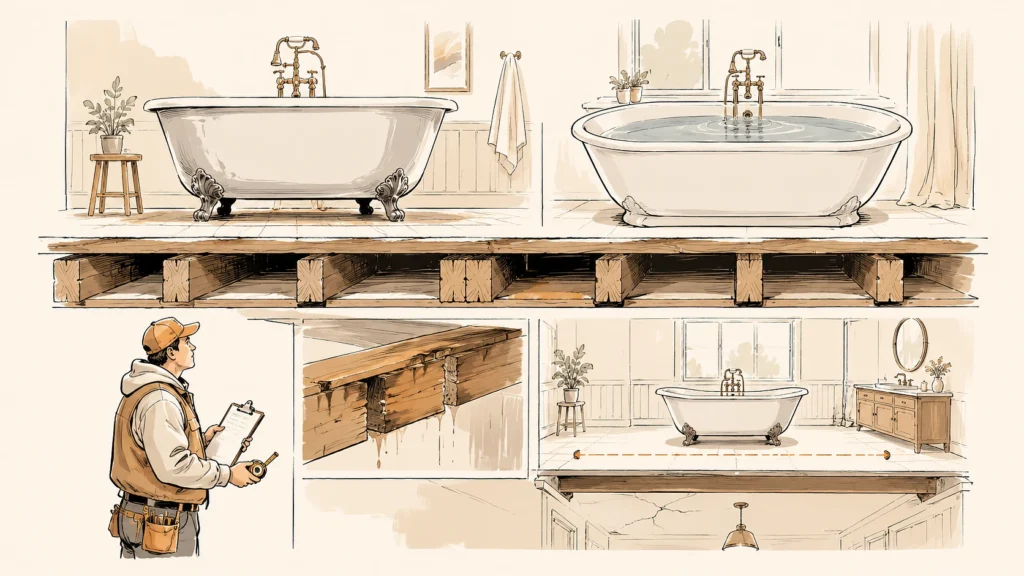
- Cast iron. A cast iron bath can weigh 100kg-plus before water touches it. Upstairs, that’s a structural conversation, not a style one.
- Oversized and two-person baths. An 1800mm double-ender holds a lot more than 180 liters. The math scales fast.
- Old or altered floors. Victorian joists, notched joists, water-damaged timber, anything that’s had walls moved around it. If the floor bounces when you walk it, it gets a professional look before a bath lands on it.
- Long spans. A bath sitting mid-span on long joists, away from any wall, carries less margin than one tucked into an alcove.
The check costs a builder’s hour. The alternative costs a ceiling. It’s the cheapest insurance in the whole project.
Buy the standard size unless your room argues otherwise, spend the extra on thickness rather than on shape, and do the one-liter-one-kilogram math before anything heavy goes up the stairs. That’s the entire article in one sentence, and it’s more than most showrooms will tell you.