


The reason a cheap pub table feels cheap is almost never the price tag. It is a two inch height mismatch between the table and the stools, which ruins the ergonomics no matter what you spent. The rule that governs the whole purchase is that seat height should sit 10 to 12 inches below the tabletop, so a 36 inch counter height table wants a 24 to 26 inch stool and a 42 inch bar height table wants a 28 to 30 inch stool. Get that right and a modest set is comfortable for hours. Get it wrong and an expensive one leaves knees jammed underneath. Beyond height, the money is worth spending on the base, the footrest and the seat, and it is safe to save on the tabletop surface, the finish and the styling. This piece covers all three, plus the apron trap that catches people who measured carefully and still ended up wrong.
I helped a friend return a pub set last spring that was, on paper, a bargain. Real wood top, decent reviews, big discount. The stools were 30 inches and the table was 36, which meant six inches of legroom instead of eleven, and everyone who sat there ended up perched sideways with their knees turned out. The furniture was fine. The math was wrong, and no amount of money would have fixed it.
The Measurement That Decides Everything Else
Before style, before material, before budget, there is one number.
Aim for 10 to 12 inches between the top of the stool seat and the underside of the table. Dimensions.com puts 10 inches as the bare minimum clearance, and 12 is where taller people stop feeling cramped.
The formula that falls out of it is simple enough to do in a store. Measure floor to tabletop, subtract 10 to 12, and that is your stool seat height.
The Two Heights You Are Choosing Between
Pub tables come in two families and the labels get used loosely, which is where a lot of mismatched purchases start.
| Table type | Table height | Matching stool seat |
|---|---|---|
| Counter height | 35 to 40 inches | 23 to 28 inches |
| Bar height | 41 to 43 inches | 29 to 32 inches |
| Tall bar | 44 to 47 inches | 33 to 36 inches |
The 36 inch counter is the residential gold standard according to NKBA data, because it matches standard kitchen counters, and that is why counter height pub tables tend to work better in homes. Bar height creates the more dramatic look and it is genuinely harder for kids, shorter adults and anyone with mobility limitations to use.
For most apartments and family kitchens, counter height is the safer call, even though bar height photographs better.
The Apron Trap
Here is the part that catches careful people, and I only learned it after that return.
You measure floor to tabletop and do your subtraction, and the number is right. Then you sit down and your thighs press against something. That something is the apron, the frame running under the tabletop connecting the legs. A table with a 3 inch apron gives you 3 inches less actual knee clearance than the tabletop height suggests.
So measure to the underside of the apron rather than to the top of the table, or check the product listing for knee clearance specifically. Budget tables often have deeper aprons because it is a cheaper way to add rigidity.
Where The Money Is Genuinely Worth Spending
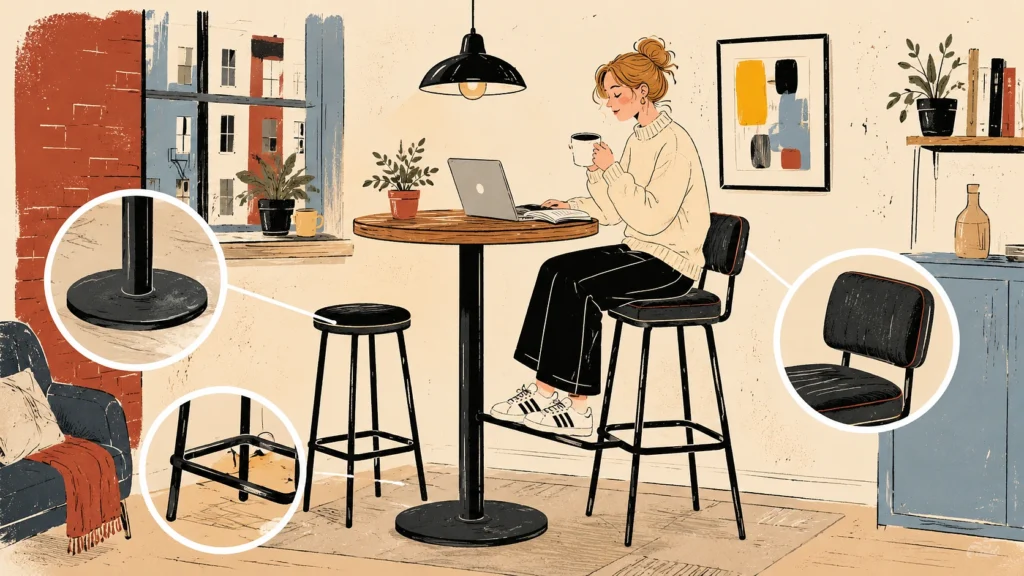
Three things justify paying more, and none of them are what the marketing photographs.
The Base And How It Is Weighted
A pub table is tall and narrow, which makes it inherently tippy, and this is where cheap construction shows up as a real problem rather than a cosmetic one. Look for a weighted base or a broad footprint, and check the material of the column rather than the tabletop.
Powder coated steel bases are the budget sweet spot here. They cost little more than particleboard columns and they hold up for years.
The Footrest
On any stool above about 26 inches, a footrest is not a style detail, it is load bearing ergonomics. Without somewhere to put your feet, your legs hang and fatigue sets in fast, which is the actual reason people stop using a pub table they bought and liked.
Check that the footrest is welded or bolted through rather than tacked on, since it takes constant weight.
The Seat, If Anyone Will Sit More Than Twenty Minutes
Backless stools are cheaper, they tuck away neatly, and they are rarely comfortable past about twenty minutes.
That is fine for a table you use for morning coffee and occasional drinks. It is a bad choice for a table that doubles as your dinner spot or your work desk. Coordinated sets from specialists like Logo Seating make matching easier and usually cost less than sourcing stools separately, which is worth knowing if the table you like comes bare.
Where You Can Safely Go Cheap
Now the good news, and this is most of the purchase.
- The tabletop surface. Engineered wood with a decent veneer looks close to identical to solid hardwood on a piece this small, and a pub top rarely spans enough width for wood movement to matter the way it does on a dining table.
- The finish and style. Industrial metal and distressed wood, rustic farmhouse, minimalist neutrals, glass on chrome. All of these are widely available at low prices and none of them cost more to manufacture in any meaningful way.
- Glass tops, which read expensive and are cheap to produce. Just check for tempered glass rather than annealed.
- The accessories doing the real styling work. A pendant light over the table, a rug defining the zone, decent placemats. These lift a modest table more than an extra two hundred dollars of table would.
Style is genuinely cheap right now, and structure is not. That is the whole budget strategy in one line, and it is why a well chosen inexpensive set can look considerably better than a mid priced one that spent its money in the wrong places.
Fitting It Into A Small Space
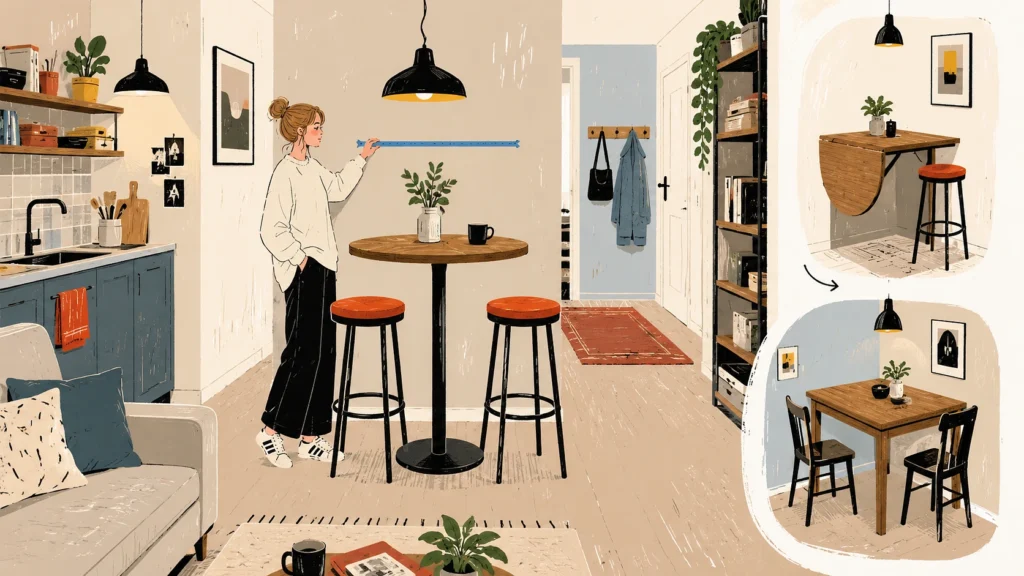
Compact is the usual reason people choose a pub table in the first place, so the spacing rules matter.
Allow 21 to 24 inches of horizontal width per stool along the table edge, and at least 6 inches between stool edges, with 8 to 10 being noticeably more comfortable. A round 30 inch top realistically seats two people well and three at a squeeze, whatever the listing claims.
Shapes behave differently in tight rooms:
- Round keeps everyone in conversation and has no corners to catch a hip in a narrow walkway.
- Square and rectangular push flat against a wall, which recovers floor space in a studio.
- Drop leaf expands for company and folds back down, at the cost of a slightly less stable surface at the joint.
One practical thing worth doing before you order anything. Mark the table height on a wall with painter’s tape, pull up whatever chair you own, and sit there for a few minutes. Whether the height suits your body is not something a product listing can tell you.
Taking It Outdoors, With One Caveat
Lightweight metal and treated wood pub tables genuinely do move to a patio for the summer, which stretches the value of the purchase.
The caveat is that indoor engineered wood tops do not survive the great outdoors humidity, and a particleboard core will swell permanently the first time it gets properly damp. If moving it outside is part of the plan, buy metal or a top rated for outdoor use, and check that the stools have non marring glides, since taller stools concentrate more pressure on small contact points and will mark a deck or a floor faster than dining chairs do.
That returned set my friend sent back got replaced with a cheaper table and correctly sized stools, and nobody has mentioned the price of either since.

