


Key Points
- Buying from the factory removes the dealer’s markup and design service, and the measuring that came with them becomes your job.
- Installed cabinets average $100 to $300 per linear foot for stock and $500 to $1,200 for custom.
- Measure after drywall and flooring are finished, at counter height, to the nearest eighth of an inch.
- Plan around the shortest ceiling reading and leave room for a filler strip wherever a cabinet meets a wall.
- Look for the KCMA quality seal, and check the order confirmation against your sketch before approving it.
Cabinet factories build to an order sheet. They don’t visit the house, and they have no way of knowing that the wall behind your range leans or that a soffit runs above the sink. In a showroom sale, a dealer’s designer finds those things with a tape measure and carries the cost if a cabinet arrives the wrong size. In a direct sale, the numbers on the sheet are yours.
That trade is worth making for plenty of buyers. It works when you treat the measuring as a real job with a method, done once and done slowly.

The Dealer’s Markup Is The Part Of The Bill You Stop Paying
Prices in this trade are quoted per linear foot of cabinet run. The averages below come from HomeLight’s guide to the cost of kitchen cabinets installed for 2026.
| Cabinet type | Average cost per linear foot, installed |
|---|---|
| Stock | $100 to $300 |
| Semi-custom | $200 to $650 |
| Custom | $500 to $1,200 |
| Installation labor only | $100 to $300 |
Look at the last row beside the first. On a stock kitchen, labor makes up a large share of the installed price. Buying direct doesn’t touch that labor. What it removes is the dealer’s markup and the design service folded into a showroom price.
How much that comes to varies by factory, door style and order size, and no trustworthy published figure exists, so none is given here. Get a showroom quote and a factory quote for one identical list of cabinets and compare them yourself.
Builders have an easier time of it. A contractor fitting out several homes orders from manufacturers of wholesale kitchen cabinets in volume and already employs someone who measures for a living. A homeowner buying one kitchen gets no volume price and has to supply the measuring skill personally.
Measure After The Drywall And Flooring Are In, Never Before

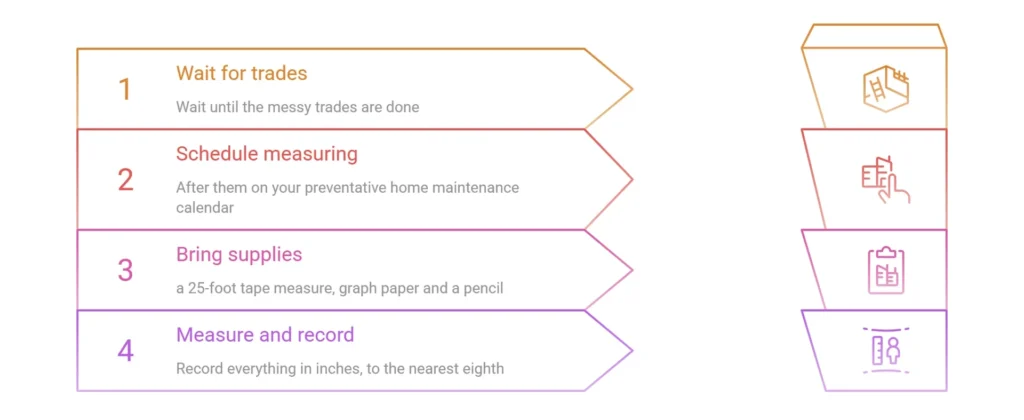
Timing matters more than most first-time buyers expect. New drywall adds thickness to a wall and new flooring raises the floor, so a room measured before those go in will be smaller than your notes say. Wait until the messy trades are done. If the kitchen is one of several jobs on the house this year, slot the measuring into your preventative home maintenance calendar after them.
Bring these with you:
- a 25-foot tape measure.
- graph paper and a pencil.
- a 4-foot level.
- a step stool.
- a helper for the long walls, if you can get one.
Record everything in inches, to the nearest eighth. Feet-and-inches notes are easy to misread a week later.
There Are Five Things To Measure, And Each One Has A Common Slip
Draw The Room Before You Pick Up The Tape
Draw the kitchen from above. Scale isn’t important at this stage. Show each wall, doorway and window, and number the walls. Add radiators, floor vents and anything else a cabinet can’t cover.
Where it goes wrong: skipping the sketch and keeping a loose list of numbers. A list can’t show you which measurement belongs to which side of the window.
Wall Lengths Are Taken At Counter Height
Measure each wall from corner to corner, roughly 36 inches above the floor. Walls can be wider or narrower at that height than they are at the baseboard, and the countertop line is where the fit counts.
Where it goes wrong: measuring the old cabinets. They may have been fitted with gaps or fillers. Measure the wall as though the room were empty.
Windows And Doors Get Measured With Their Trim
Go from the corner to the outer edge of the trim, across the opening with its trim, and on to the next corner. Then add the sections up. They should equal the full wall length you took a minute ago.
For a window, measure from the floor to the underside of the sill as well.
Where it goes wrong: measuring the glass or the door slab and leaving out the trim, which sticks out past the opening on each side.
Your Ceiling Is Probably Not Level, So Check It In Several Spots

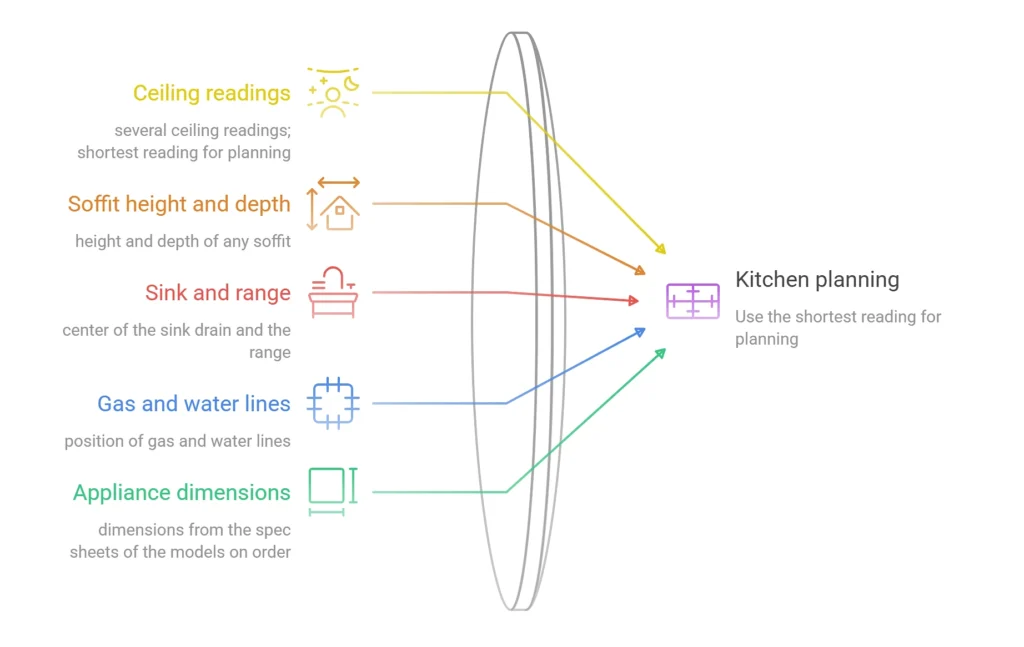
Use the shortest reading for planning. Write down the height and depth of any soffit. Wayfair’s instructions on how to measure a kitchen for cabinetry also call for several ceiling readings, since height can vary across one room.
Where it goes wrong: one reading in the middle of the room, then wall cabinets that won’t clear a low corner.
Mark Where The Sink, The Range And The Gas Line Sit
Mark the center of the sink drain and the range, and the position of gas and water lines. Take appliance dimensions from the spec sheets of the models on order.
Where it goes wrong: assuming the new refrigerator or range matches the size of the old one.
Cabinets Come In Set Widths, So Leave Room For Fillers
Factory cabinets are made in set widths, commonly rising 3 inches at a time. A run of them will almost never add up to the exact length of your wall, and it isn’t supposed to. The leftover space is closed with a filler strip that the installer trims on site.
Fillers also solve the crooked-wall problem. Hold your level against each wall and into each corner, and note any lean. A wall that is half an inch out of plumb will stop the last cabinet from sliding into the corner unless a filler has been allowed for there.
Check clearances on paper before you order. A dishwasher door has to drop open without hitting the handle of the cabinet beside it, and a corner drawer has to pull past its neighbor.
Some factories will draw the layout if you send your dimensions. Take the offer, and keep in mind that the drawing is only as good as the figures you sent. When the order confirmation comes back, lay it next to your sketch and read it wall by wall. Made-to-order cabinets are rarely returnable, so this is the last cheap moment to catch a mistake.
Ask The Factory For Its KCMA Seal And Be Home On Delivery Day
You can’t pull a drawer open before buying from a factory two states away. What you can do is ask for proof of testing. The Kitchen Cabinet Manufacturers Association runs a quality certification for cabinets with 14 tests on the structure, drawers, doors and finish, and it uses independent laboratories. Home Innovation Research Labs is one, and it has written about putting cabinets through their paces with structural loads, hardware cycling and finish tests.
Ask which product lines carry the seal, because a company may certify some lines and leave others untested. Order a sample door in your chosen finish. Get the lead time and the damage policy in writing.
On delivery day, be at home. Open or inspect the boxes before you sign the freight receipt, and write any damage on it. A signature without notes makes a later claim much harder.
The habit carries over to other projects. If cabinets for a grill station are part of an outdoor living area you have in mind, measure and check that order with equal care.