


Before a family doctor orders a cane or a walker for a patient, the selection chart that Drs. Mandi Sehgal, Jeremy Jacobs and Wendy Biggs published in American Family Physician in 2021 asks two plain questions. Does the patient need one arm or both arms for support? And how often does the leg have to be relieved of weight: hardly ever, now and then, or all the time? Color, price and brand do not appear anywhere on that chart.
People who shop for themselves tend to go about it in the opposite order. They pick what looks manageable, or what a neighbor has in the garage, and only later discover that it does not hold them up the way they hoped. If you are choosing for yourself or for a parent, it helps to begin where the doctors begin, with the share of your body weight that the aid will be asked to take.
How Much Weight Can A Cane, A Walker And Crutches Each Take?

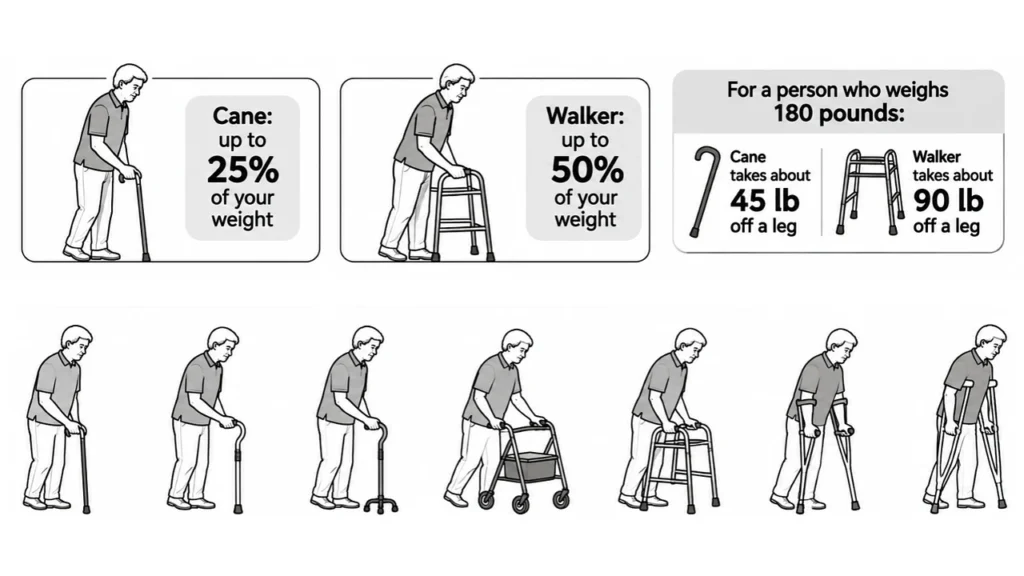
The American Geriatrics Society gives two round figures in its tip sheet on choosing the right cane or walker. A cane can support up to 25% of your weight, and some walkers can support up to 50%.
Put into pounds, that is easier to picture. For a person who weighs 180 pounds, a cane can take about 45 pounds off a sore leg at most, and a walker about 90. Neither will carry someone who has been told to keep a foot off the ground entirely.
A cane suits a leg that still does most of its own work, and a walker or crutches are for a leg that cannot.
The finer differences come from the 2021 review of mobility devices in American Family Physician, and they run roughly from least support to most:
- A standard cane with a curved handle helps balance and should take only minimal weight.
- An offset cane, whose handle sits over the shaft, is suitable for weight-bearing now and then.
- A quad cane stands on four small feet and gives more stability than a single tip.
- A rollator (the four-wheel walker with a seat) should not be leaned on for weight at all, and it is the least stable kind of walker.
- A standard or two-wheel walker is the choice when both arms are needed often.
- Forearm crutches allow occasional weight-bearing and leave the hands freer.
- Underarm crutches can take 80% to 100% of the weight off one leg.
Notice where the rollator falls on that list. With its four wheels, brakes and seat it can look like the sturdiest option in the store, though it is meant for people who tire quickly and need to sit, and it can roll forward under anyone who puts real weight on the handles.
A Cane Is Enough When One Hand Can Do The Job
Most people who walk a little unsteadily, or who have arthritis in one knee or one hip, fall into this group. Their legs carry them. What they want is a third point of contact with the ground and a few pounds lifted off the joint that hurts. Readers who are managing that kind of joint pain may also want to see which joint supplement ingredients have real evidence behind them before spending money on a bottle.
A cane does ask something of its user. The review’s authors describe it as the least stable of the devices, and they point out that a person needs sufficient balance, upper body strength and dexterity to handle one safely. Somebody whose grip is weak in both hands, or who sways even when standing still, is likely to need more than a cane.
What To Look At When You Buy One
When you shop for a walking cane, the finish is the last thing to judge. Look first at the handle. On an offset handle the palm rests above the shaft, and the review rates that grip as more comfortable and easier on the hand and wrist than a round crook. The review mentions that offset canes are often held backward, with the curve of the neck pointing the wrong way, and whoever sells you the cane should be able to show you the right grip.
Length comes next. Aluminum canes adjust with a push-button, whereas a wooden cane has to be cut to size, and it is worth knowing which sort you are buying before it arrives. Finally, turn the cane over and check that the rubber tip is thick, has a clear tread and fits tightly, because a worn tip slides on a wet floor.
As for cost, a plain standard cane was priced at roughly $10 to $20 in the review’s table. Better handles and materials cost more, though a higher price does not raise the amount of weight a cane can safely take.
A Walker Or Crutches Are Needed When Both Arms Have To Help
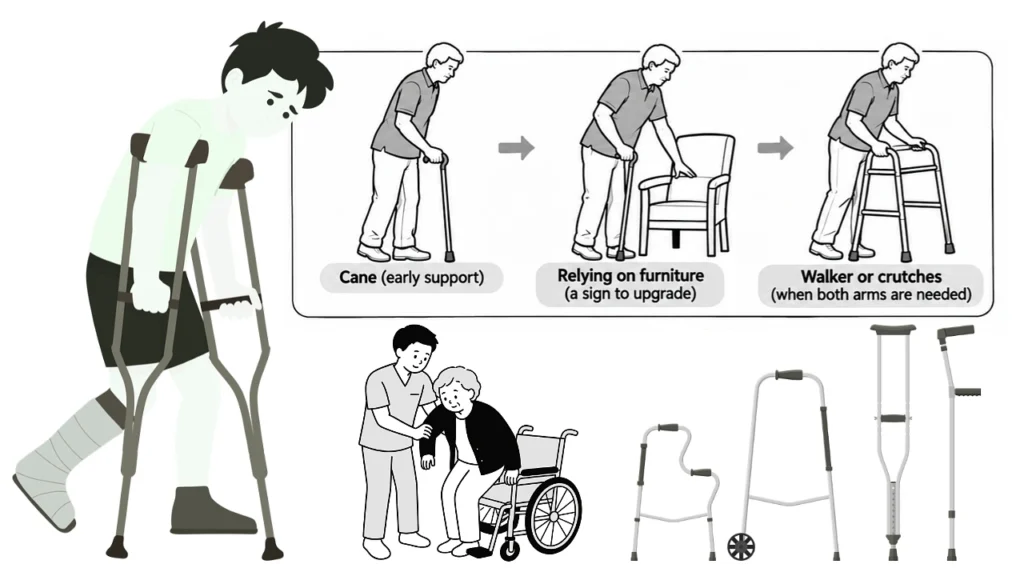
Once a person is leaning hard on a cane, switching it from hand to hand, or reaching for the furniture as well, the cane has been outgrown. Weakness in both legs calls for a frame that both hands can hold.
Standard And Two-Wheel Walkers
A standard walker has four rubber-tipped legs and no wheels. It is very steady, but it must be lifted and set down with each step, and that takes arm strength and patience. The two-wheel version rolls at the front and drags at the back. According to the 2021 review, it is more functional and easier to maneuver than the standard frame, and it is often the better starting point.
Walkers have drawbacks that are seldom mentioned in the store. They demand more attention than a cane does, they are awkward in narrow bathrooms, and stairs are difficult with one. A home with steps at the front door may need a rail or a second walker kept upstairs.
Rollators For People Who Tire But Can Carry Their Own Weight
A rollator suits someone with a heart or lung condition who can walk steadily for a few minutes and then has to rest. The seat is its real advantage. Anyone who needs to push down on the handles to stay upright should choose a different walker.
Crutches After An Injury Or Surgery
Of the walking aids covered here, crutches are the ones that can take a leg out of use completely, and for that reason surgeons send patients home on them after a fracture or an operation. They are hard work. The 2021 review notes that older adults rarely use crutches because of the upper body strength required. How much weight the injured leg may take is decided by the surgeon, and that instruction should be followed exactly.
An injury brings more than a sore leg, of course, and the weeks on crutches can be a low time. This guide to what counts as a normal stress response after an accident covers that side of recovery.
The Right Aid At The Wrong Height Will Still Let You Down

An older review in American Family Physician, from 2011, reported that up to 70% of canes were faulty, damaged or the wrong height, and that most users had never been shown how to use theirs. Height is the easiest of those faults to correct at home, and Mayo Clinic’s guide to choosing and using canes gives the two checks:
- Stand in your usual shoes with your arms hanging loose. The top of the cane should line up with the crease of your wrist.
- Take hold of the handle. Your elbow should bend comfortably, at about 15 to 20 degrees.
Mayo adds that a cane set too long makes you work harder to lift and move it, while one set too short makes you lean to the side and can upset your balance. Walker handles are set to the wrist crease as well.
Hold the cane in the hand opposite the weak or injured leg.
This surprises nearly everyone, since instinct says to put the cane beside the bad leg. MedlinePlus calls it the most common question about canes in its page on using a cane. The cane and the weak leg then move forward together, much as an arm swings with the opposite leg in ordinary walking, and the load is shared between them.
On stairs, take the rail with your free hand whenever there is one. Going up, the stronger leg steps first, and the weaker leg and the cane follow. Before relying on any aid outdoors, practice indoors for a day or two, on carpet and on a hard floor.
Who Should Help You Choose, And What Will Medicare Pay?
A physical therapist is the best person to ask. Therapists watch how you actually walk, try you on more than one device, and set the height while you are standing in front of them. Cathy Ciolek, a physical therapist who has spoken for the American Physical Therapy Association, has cautioned that many patients borrow walking aids from friends and relatives, and a borrowed aid was fitted to somebody else’s height and somebody else’s problem.
If you would prefer to buy first and ask later, take the aid along to your next appointment and have the fit checked there. It takes a couple of minutes.
On cost, Medicare Part B treats canes, crutches and walkers as durable medical equipment. Under the rules on Medicare’s page for canes, the device has to be medically necessary and prescribed by your provider for use in the home, and after the Part B deductible you pay 20% of the Medicare-approved amount. White canes for the blind are not covered. The supplier matters as well, so ask whether the store is enrolled in Medicare before you order.
Many people simply pay out of pocket for a cane, given how little a basic one costs. A walker or a rollator is a bigger purchase, and for those it is worth getting the prescription and letting insurance carry its share.
Needs change, too. Someone recovering from a hip replacement may go from a walker to a cane within weeks, whereas a person with a progressive condition may move in the other direction over several years. When the aid you have stops feeling steady, have it reassessed before you buy a replacement.